world · 2026-07-10
3 Ex-TMC Rajya Sabha MPs Join BJP
dd9f5454-2f1b-4204-8696-fac75c719a4b
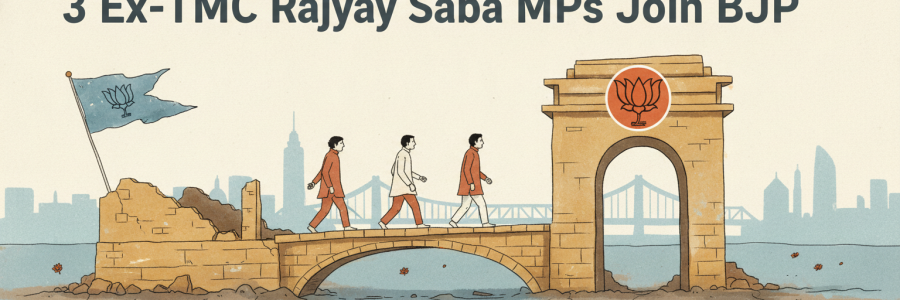
Sukhendu Sekhar Ray, Sushmita Dev, and Prakash Chik Baraik formally joined BJP in Kolkata after resigning from TMC and Rajya Sabha last month.TMC has lost 60 of its 80 MLAs to a rebel faction, making these defections part of the most severe party collapse in Bengal in decades.BJP gains Rajya Sabha experience and Bengal organizational depth, while TMC faces an existential split with bypoll dates set for Jul 24.
Why did all three resign before the bypoll?
By resigning before the Jul 24 Rajya Sabha bypoll, the three MPs created vacancies BJP can now contest. Had they simply switched parties without resigning, anti-defection law would have disqualified them. Resigning first and rejoining lets BJP field fresh candidates for those seats, potentially flipping them from TMC to BJP in the Upper House.
How does anti-defection law work here?
India's anti-defection law (10th Schedule) penalizes legislators who switch parties. But it only applies to sitting members. By resigning their Rajya Sabha seats entirely, these MPs avoided disqualification. They became private citizens free to join any party. The law's loophole is that it cannot prevent a resign-then-rejoin sequence.
Could BJP win all three Rajya Sabha seats?
Rajya Sabha seats are filled by state legislators voting. BJP won 208 of 294 Assembly seats in Bengal. With that majority, BJP commands enough votes to win all three seats on Jul 24. TMC's rump of ~20 loyal MLAs lacks numbers to win even one seat, a complete reversal from TMC's previous dominance in Bengal's RS delegation.
Have RS resignations been used this way before?
Yes. In 2020, Jyotiraditya Scindia resigned from Rajya Sabha and Congress before joining BJP, which then fielded him for a Madhya Pradesh RS seat. The resign-rejoin path has become a standard playbook. It respects the letter of anti-defection law while achieving the same outcome, a party switch, through a two-step process.
Could TMC survive losing 75% of its MLAs?
Losing 60 of 80 MLAs is historically devastating. The rebel faction, led by Ritabrata Banerjee, has already removed Mamata Banerjee as chairperson. The Election Commission met the rebels, signaling potential recognition of their faction as the real TMC. Without legislative numbers, Mamata's faction cannot claim party symbol or funds, echoing the 1999 NCP-Congress split in Maharashtra.
What triggered TMC's collapse after Apr polls?
BJP's 208-seat landslide exposed deep anti-incumbency against TMC's governance. Once the mandate was clear, MLAs calculated that staying with a diminished TMC offered no patronage or power. The cascade effect, where each defection makes staying riskier, accelerated the exodus. By Jun, 60 of 80 MLAs had joined the rebel faction led by Ritabrata Banerjee.
Can a split faction claim the party symbol?
The Election Commission decides which faction is the real party based on majority of organizational members and legislators. The rebel faction controlling 60 of 80 MLAs has a strong numerical claim. In 1999, the EC awarded NCP the clock symbol after Sharad Pawar's faction split from Congress. Mamata's side argues the EC violated procedure by even meeting the rebels.
Has any Indian party recovered from this scale?
India's Congress lost massively in 1977 post-Emergency but rebuilt to win in 1980. However, TMC's situation is structurally harder. TMC was a single-leader party built around Mamata Banerjee, with no independent organizational depth. Parties structured around one leader, like AIADMK after Jayalalithaa's death, tend to fragment permanently once the leader loses control.
Who gains most from these specific recruits?
Sushmita Dev brings Northeast connections as a former Silchar MP from Assam. Sukhendu Sekhar Ray is a veteran constitutional affairs voice in Parliament. Prakash Chik Baraik represents tribal communities in Bengal. BJP state chief Samik Bhattacharya said their parliamentary expertise will help BJP expand reach across Bengal's diverse voter segments.
What do these recruits gain personally in BJP?
All three lost their Rajya Sabha seats by resigning. If BJP fields them as candidates on Jul 24, they regain parliamentary positions plus access to the ruling party's patronage network. Dev, for instance, was a Congress leader before joining TMC in 2021, so this is her third party, each move tied to where power resides.
Does BJP need Bengal seats to control Rajya Sabha?
BJP holds roughly 100 of 245 Rajya Sabha seats and relies on allies like JDU and TDP to pass legislation. Three additional seats from Bengal help but don't change the math dramatically. The real value is symbolic: flipping TMC's Bengal RS seats signals BJP's total dominance in a state where it had zero Lok Sabha seats as recently as 2014.
How does this reshape Bengal's opposition space?
With TMC splitting and BJP holding 208 Assembly seats, Bengal effectively has no viable opposition. The Left Front, which ruled for 34 years until 2011, was reduced to near-zero seats. Congress is marginal. If the rebel TMC faction merges with BJP, Bengal could resemble Gujarat's pattern of single-party dominance for an extended period.
Source: thehindubusinessline.com