politics · 2026-11-07
A ₹250 coin that costs ₹6,985: why?
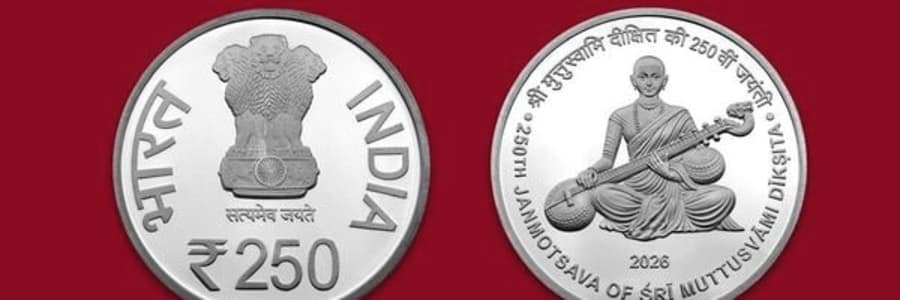
Photo: via mint
The government released a special coin for a music legend. It's priced at ₹6,985, not ₹250, because it's a collectible, not for spending.
Can I spend the Dikshitar ₹250 coin at a shop?
In principle, yes. Coins issued by the Government of India under the Coinage Act (the law governing coinage) are legal tender for any sum up to ₹1,000 in a single transaction. But this is a commemorative coin minted in limited quantities using precious metals, collected as memorabilia rather than used for regular transactions. So a shop could accept it, but it's not meant for spending.
Who is the real buyer of these expensive coins?
Collectors are the buyer, not the public. The mint lists dozens of commemorative coins from ₹1,829 to ₹31,170, all booklet- or folder-packed in proof or uncirculated finish. Most celebrate figures like Netaji or Rani Durgavati. Production is deliberately limited, which keeps them scarce and valuable to enthusiasts. This one, at ₹6,985, sits mid-range, its price set by finish and packaging, not the ₹250 face value.
Who pays for the coin when a company's CSR contribution is involved?
The government mint sets the ₹6,985 price, but in this case BSE's managing director made a 'special contribution' under the exchange's CSR programme to fund the commemorative coin. Under the 2026 Companies Act amendment, CSR money can flow through zero-coupon instruments on the Social Stock Exchange, capped at 10% of a firm's total CSR spend. So the buyer is ultimately BSE's shareholders, not the public. Our read: the coin's real cost is borne by corporate social responsibility budgets, making it a sanctioned cultural patronage channel.
What does BSE's shareholders get out of funding the coin?
The Companies Act requires qualifying firms to spend on CSR, and Schedule VII now explicitly allows subscribing to zero-coupon, zero-principal instruments on the Social Stock Exchange, capped at 10% of total CSR expenditure. BSE's contribution counts as a scheduled CSR activity, so it satisfies a legal obligation while supporting a heritage project. Shareholders do not receive a return; the benefit is compliance plus public goodwill. Our read: the coin is how a company converts a mandatory spend into cultural patronage with public visibility.
How does the coin pass the CSR test when it doesn't look like charity?
The Central Government widened Schedule VII of the Companies Act to explicitly include subscribing to zero-coupon zero-principal instruments on the Social Stock Exchange as a valid CSR activity. A non-profit can issue such an instrument to raise funds for a public welfare project, and the company's contribution counts as CSR spend, capped at 10% of its total obligation. This gives legal cover to projects like the commemorative coin, which are deemed cultural patronage. Our read: the rule was written to make this kind of funding permissible, not to stretch an old definition.
What stops a company from routing all its CSR money this way?
A hard cap. The Ministry of Corporate Affairs amendment says expenditure on zero-coupon zero-principal instruments on the Social Stock Exchange cannot exceed 10% of a company's total CSR spend for that financial year. The rest must still go to the older Schedule VII activities. So the instrument is a side channel, not a replacement, and the ceiling is written into the rule itself.
Can a company hit the 10% cap every year?
Nothing in the MCA amendment prevents a company from using the instrument each year, as long as the cap holds. The rule puts the ceiling at 10% of total CSR spend per financial year, so repeated use is permitted within that bound. A company that wanted to could route the maximum every year. Our read: the cap exists to keep the channel a minority of CSR, not to limit how often it can be used.
Is this channel just a way to dodge real CSR work?
No. The MCA amendment caps spending on zero-coupon zero-principal instruments at 10% of a company's total CSR expenditure per financial year, so at least 90% must still go to traditional Schedule VII activities. The instrument is deliberately a side channel, not an escape hatch, and the issuing non-profit remains responsible for project execution and evaluation under Rule 4A. Our read: the rule is designed to fund niche cultural projects without letting companies convert their entire social obligation into sponsorship.
Why is a stock exchange backing a music coin?
BSE's managing director made a 'special contribution' under the exchange's CSR programme (corporate social responsibility, where firms spend on public welfare). The Companies Act lets firms spend on listed activities; from 2026, a new channel lets them fund non-profits through zero-coupon instruments on the Social Stock Exchange, capped at 10% of total CSR. Funding a heritage coin counts as public welfare, so it becomes a sanctioned way for BSE to spend its CSR money.
Who is actually accountable if the funded project goes wrong?
The non-profit that raises the money. The MCA release is explicit that responsibility for project execution and project evaluation sits with the Not for Profit Organisation issuing the instrument, which is defined in Rule 2 and governed under Rule 4A of the CSR Policy Rules. The company's obligation ends at subscribing; the delivery risk and the reporting burden move to the issuer.
Why does the mint charge ₹6,985 for it?
You are not buying ₹250 of metal. The mint sells a proof-quality coin (a specially struck, high-finish coin) finished and packaged for collectors, not for spending. Its website lists the '250th Janmotsava of Sri Muttusvami Diksita' booklet at ₹6,985. Comparable collectibles cost more: a Netaji Subhas Chandra Bose proof booklet is ₹8,322, a Rani Durgavati folder ₹23,650. The price reflects the packaging and finish, not the face value.
What checks keep a company's CSR money from just buying publicity?
The rule itself caps how much CSR can flow through the new Social Stock Exchange channel: no more than 10 percent of a company's total CSR spending for the year, per the Ministry of Corporate Affairs amendment. The rest must still go through the traditional Schedule VII route. The instrument is also zero coupon, zero principal, meaning the company gets nothing back; the not-for-profit must execute and evaluate the project. Our read: the cap is what stops CSR from becoming an ad budget, so expect companies to keep most of their spending in conventional projects.
What happens if a company spends more than the 10% cap?
The 10% cap is a legal ceiling set by the Ministry of Corporate Affairs: CSR spending through zero-coupon instruments on the Social Stock Exchange cannot exceed 10% of a company's total CSR expenditure for the financial year. Anything beyond that would fall outside the permitted channel, so a company cannot count it as CSR. It would have to fund such projects through the traditional Schedule VII route or face the expense as non-CSR, which carries compliance consequences. The cap is hard, not a guideline. Our read: companies test it only if the reputational gain outweighs the regulatory risk.
What stops a company from dodging the cap through multiple channels?
The Ministry of Corporate Affairs sets the 10% ceiling on all CSR spending through zero-coupon instruments on the Social Stock Exchange for a financial year. This cap applies to the total, not per project or per channel, so routing funds through different non-profits or multiple instruments would still count toward the same limit. Any spending above that cannot be classified as CSR and would miss the compliance benefits, leaving the company to fund it as a normal cost or face regulatory consequences. Our read: the cap is designed to keep the new channel a side route, not a workaround.
How does the SSE route change who controls a CSR project?
Under the new rules, the company funding a project through a zero-coupon, zero-principal instrument on the Social Stock Exchange does not execute or evaluate the project. The not-for-profit organization that raises the funds is responsible for both execution and evaluation, according to the Ministry of Corporate Affairs. This shifts operational control to the NPO, with the company's role limited to funding. Our read: this is a deliberate design to make CSR spending more outcome-focused and less company-driven, aligning with the transparency goals of the SSE framework.
Who checks that the NPO actually spends the CSR money on the advertised cause?
The framework puts responsibility for project execution and evaluation on the not-for-profit organisation, per the Ministry of Corporate Affairs. The zero-coupon, zero-principal instrument means the company gets nothing back and has no operational role, so the NPO alone is accountable for delivering the project. The exchange lists the instrument, but the compliance burden rests with the NPO and, ultimately, the regulator's disclosure rules. Our read: enforcement depends on transparent reporting by the NPO, not on company oversight.
If the NPO fails to deliver, who answers to the law?
The Ministry of Corporate Affairs rules place project execution and evaluation on the not-for-profit organisation raising funds through zero-coupon instruments on the Social Stock Exchange. The company funding it has no operational role and gets nothing back. The NPO alone bears the compliance burden, and the regulator's disclosure rules are the enforcement backstop. Our read: if the NPO fails, the company can point to its lack of control, which is exactly how the rule was designed to work.
Did the RBI issue this coin?
The source is muddled on this. It says the coin was "issued by the Bank of India (RBI)", a name that doesn't exist. The Reserve Bank of India (RBI, the central bank) is separate from Bank of India, a commercial bank. Coins are issued by the Government of India under the Coinage Act, so the article's phrasing can't be trusted.
Can you actually spend this coin as money?
No, not in practice. Under the Coinage Act, 2011, coins issued by the Government of India are legal tender for any sum up to ₹1,000 per transaction. That means the ₹250 coin could technically be used to pay a bill of ₹250 or less. But the mint sells it at ₹6,985 for collectors, and the article says such coins are 'primarily collected as memorabilia rather than used for regular transactions.' So while it is legal tender, nobody would hand it over at face value when it is worth far more as a collectible.
Who ends up paying for this coin if nobody spends it?
The government absorbs the difference. The mint sells the coin at ₹6,985, and it is legal tender for only up to ₹1,000 in a single transaction. So the buyer pays a collector premium of roughly ₹6,735 above its usable value. The government does not lose money because the coin is minted from precious metals whose cost is covered by the selling price, and it sells out at the price shown on the mint's website. Our read: collectors, not taxpayers, fund these commemorative issues.
Who actually bears the cost of this coin?
The collector does. The mint sells the coin at ₹6,985, a price that covers the precious metal, the booklet packaging, and the limited production run. The government does not subsidize it. Our read: the buyer pays for the entire enterprise, from minting to marketing, and the ₹250 face value is purely symbolic, a legal formality that never comes into play. The collector, not the taxpayer or the government, funds the commemorative issue entirely.
Why would anyone buy a coin they can't spend?
Collectors buy it because the coin's scarcity and finish give it a value far above its face value. The mint lists dozens of such coins, from ₹1,829 to ₹31,170, all in booklet or folder packing, and produces them in limited quantities. The ₹250 coin, at ₹6,985, sits midrange in that catalogue. For a collector, the coin is an artefact of limited supply, not a medium of exchange. Our read: the buyer is not paying for money but for a piece of cultural heritage that holds its worth through scarcity, not legal tender status.
Will this coin ever be worth more than the ₹6,985 you pay for it?
The mint produces these coins in deliberately limited quantities, and the catalogue shows a wide range of prices, from ₹1,829 to ₹31,170, with several coins priced above this one. Scarcity is what gives a collectible its value. Whether a specific coin appreciates depends on future collector demand, which no evidence here can predict. What is certain from the mint's listing is that the sell price covers all costs, so the buyer's downside is capped at the premium already paid. Our read: the ₹250 face value is irrelevant to the coin's investment case; the only value that matters is what a future collector will pay, and that is unknowable today.
Why is a stock exchange spending CSR money on a music coin?
BSE's managing director made a 'special contribution' under the exchange's CSR programme. Since 2026, the Companies Act allows firms to fund non-profits through zero-coupon instruments on the Social Stock Exchange, capped at 10% of total CSR spending. Funding a heritage coin counts as public welfare under Schedule VII. Our read: the coin gives BSE a visible, sanctioned way to satisfy its CSR obligation while promoting cultural heritage, and the 10% cap keeps such spending from becoming the company's main CSR channel.
Why is the price so high if the coin is only worth ₹250?
The price reflects the coin's finish and packaging, not its face value. The mint sells it in a booklet, likely in proof or uncirculated condition, which are made for collectors. Other commemorative coins range from ₹1,829 to ₹31,170, all in similar packaging. Production is limited to keep them scarce. So the ₹6,985 price covers the cost of minting in precious metal, the booklet, and the collector premium, making it a collectible item rather than currency for spending.
Source: livemint.com