business · 2026-07-05
Adani QIP raises ₹15K Cr, gets 4x bids
89f18179-f76f-4779-957d-00f6d79ef4e3
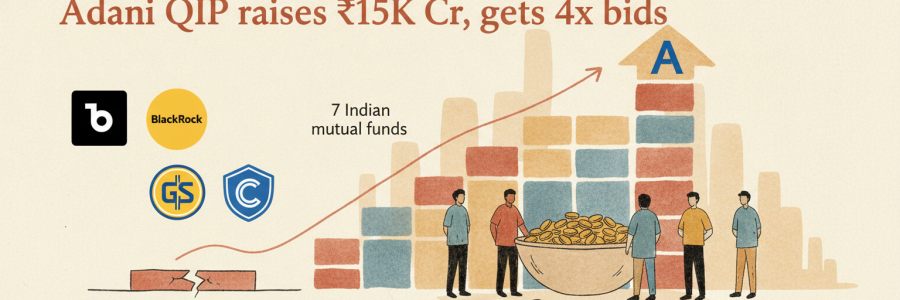
Adani Enterprises raised ₹15K Cr via a one-day QIP, upsized from ₹10K Cr after receiving ~₹38K Cr in bids, nearly 4x the base issue size.This is the third capital raise in under a year, signaling sustained institutional appetite despite the Hindenburg-era reputational hit Adani faced in 2023.BlackRock, Goldman Sachs, Capital Group, and 7 major Indian mutual funds including HDFC MF and SBI MF participated, diluting existing shareholders by ~2.6%.
Who bid for Adani's QIP and at what price?
Shares were priced at ₹2,883, a ~9.3% discount to the Jul 2 close of ₹3,177.50. Global investors included Capital Group, Goldman Sachs, BlackRock, Blackstone, and Nomura. Domestically, 7 large mutual funds bid, including HDFC MF, ICICI Prudential MF, and SBI MF. Total bids hit ~₹38K Cr.
Why did global funds bid despite past concerns?
Capital Group and BlackRock manage trillions in assets and conduct independent due diligence. The Hindenburg crisis was in Jan 2023. Since then, Adani stocks recovered, the group repaid bridge loans, and India's Supreme Court found no regulatory failure. For large global allocators, the risk-reward reset.
What does the 5% discount to SEBI floor mean?
SEBI sets a QIP floor price using a formula based on the stock's recent volume-weighted average. Adani priced at ₹2,883, 5% below the ₹3,034.68 floor. SEBI permits up to a 5% discount for QIPs. This maximum discount is common in large placements to guarantee full subscription in a single day.
Which banks managed this placement?
Jefferies, SBI Capital Markets, ICICI Securities, and IIFL Securities were the four book-running lead managers. They built the order book, coordinated pricing, and allocated shares. For a ₹15K Cr deal, fees typically run 0.5 to 1% of issue size, potentially earning the syndicate ₹75 to 150 Cr collectively.
Why raise capital three times in one year?
Adani Enterprises did a ₹25K Cr rights issue in FY26 across three tranches, then a QIP in Oct 2024, and now this ₹15K Cr QIP. Proceeds fund capex for incubation businesses, debt repayment, and potential acquisitions. Raising frequently while markets are receptive locks in capital before sentiment shifts.
Could Adani have used debt instead of equity?
Adani Enterprises could borrow, but its debt-to-equity ratio has been a market concern since 2023. Equity raises reduce leverage without adding interest burden. For context, Adani Green's bonds traded at distressed levels in early 2023. Using equity now, while stock is up 42% YTD, is cheaper than high-yield debt.
What incubation businesses need this capex?
Adani Enterprises acts as the group's incubator, housing newer ventures before they mature and get spun off. Current incubation businesses include Adani New Industries (green hydrogen), Adani Airports, and Adani Roads. Green hydrogen alone requires massive upfront capex, with one Mundra plant targeting 1 GW capacity.
How does frequent fundraising signal strategy?
Raising ₹40K+ Cr across three rounds in under a year mirrors Reliance Industries' 2020 playbook, when it raised ₹1.5L Cr across multiple rounds for Jio Platforms. The pattern suggests Adani is building a war chest for a capex-heavy growth cycle while institutional appetite is strong, locking in equity before any market correction.
How does 2.6% dilution affect Adani holders?
Adani Enterprises will issue ~34.7Mn new shares, diluting post-issue equity by ~2.6%. For existing shareholders, each rupee of earnings per share drops slightly. However, the stock is up ~42% YTD versus a 7% Nifty 50 decline, so the dilution occurs at a relatively rich valuation, limiting the sting.
Does 2.6% dilution matter at this market cap?
At a market cap of ~₹3.71L Cr, 2.6% dilution equals roughly ₹9,600 Cr of new equity value. For a retail investor holding 100 shares, their ownership fraction shrinks marginally. But if the raised capital generates returns above cost of equity, say 15%+, the dilution is value-accretive over 3 to 5 years.
Which mutual fund schemes now hold Adani?
HDFC MF and SBI MF are among India's largest, managing ₹7L+ Cr and ₹4L+ Cr respectively. QIP shares typically land in large-cap or flexi-cap schemes. Retail investors in these funds now have indirect Adani exposure. SEBI requires mutual funds to disclose holdings monthly, so exact allocations will appear in Aug factsheets.
Who benefits most from the QIP proceeds?
Adani Airports operates 8 airports including Mumbai and Jaipur. Green hydrogen and road projects are capital-hungry with long payback periods. Bondholders benefit because equity infusion improves debt coverage ratios. Contractors and EPC firms like L&T and Tata Projects, which build Adani's infrastructure, gain a more creditworthy counterparty.
Source: economictimes.indiatimes.com