business · 2026-07-02
Adani, UAE Partner on ₹1.08L Cr Aluminium
665dd9af-5e85-4899-8869-3f556015cd1e
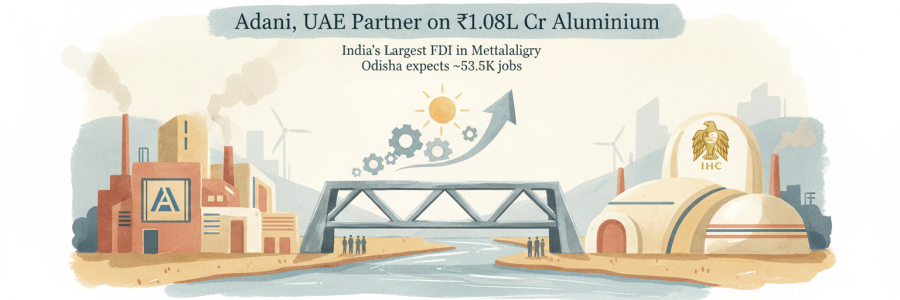
Adani Enterprises and Abu Dhabi's IHC signed a 50:50 JV MoU with Odisha to build a $11.5Bn greenfield aluminium project, Adani's first entry into the sector.This is India's largest FDI in metallurgy. It includes a 2 MMTPA smelter, 4 MMTPA refinery, and 4,000 MW captive power plant across two districts.Odisha expects ~53.5K jobs. Downstream parks aim to attract component makers in transport, construction, packaging, and renewable energy, boosting MSMEs.
Why is Adani entering aluminium now?
Adani has no aluminium operations today. The JV with IHC's resources arm IRH gives it a partner experienced in critical minerals. India imports significant processed aluminium despite having the world's 5th largest bauxite reserves. Karan Adani cited Odisha's mining infrastructure and low-cost conveyor-belt transport from nearby Sasubahumali, Kutrumali, and Bahalda mines as key cost advantages.
How does the 50:50 JV structure work?
AEL and IHC's subsidiary IRH split equity equally. IHC, controlled by Abu Dhabi royal family interests, brings mining expertise through its IRH platform. The JV means neither partner bears full capital risk on the $11.5Bn outlay. Similar structures exist in Gulf-India partnerships, like ADNOC's stake in BPCL's Bina refinery.
What makes conveyor-belt transport cheaper?
Bauxite mines sit close to the refinery in Rayagada. Conveyor belts eliminate truck fuel costs and road maintenance burdens. For comparison, Vedanta's Lanjigarh refinery in Odisha spends significantly on diesel-powered trucking. Rail links then connect to the smelter in Sundargarh. This mine-to-plant proximity can cut logistics costs by 15-20% versus road transport.
How will Adani fund its share of ₹54K Cr?
Adani confirmed funding through internal accruals and debt. Phase I costs ~₹66K Cr, Phase II ~₹44K Cr. Adani Group's consolidated net debt already exceeds ₹2.2L Cr. However, the phased structure spreads borrowing over ~5 years. Project finance lenders typically fund 70% of such industrial capex, meaning AEL's equity contribution could be ~₹16K Cr for its 50% share.
Could this reshape India's aluminium imports?
India produces ~4 MMTPA of aluminium but imports value-added products. The 2 MMTPA smelter alone would boost national capacity by ~50%. A dedicated downstream manufacturing park aims to capture value currently exported as raw metal and reimported as finished goods. For context, Hindalco, India's largest producer, operates at ~1.3 MMTPA smelting capacity.
What volume would make this smelter profitable?
Aluminium smelting is extremely power-intensive, consuming ~14,000 kWh per tonne. The dedicated 4,000 MW captive power plant is critical. At current aluminium prices of ~$2,500/tonne, a smelter needs 80%+ capacity utilization to break even. That means producing at least 1.6 MMTPA of the 2 MMTPA rated capacity to cover fixed costs.
How does Hindalco compare in capacity?
Hindalco, an Aditya Birla Group company, operates ~1.3 MMTPA smelting capacity and ~3.5 MMTPA refining capacity across multiple Indian states. If Adani-IHC's 2 MMTPA smelter reaches full output, India's total smelting capacity would jump from ~4 MMTPA to ~6 MMTPA, potentially shifting India from a net importer to a net exporter of primary aluminium.
Could this trigger aluminium price drops?
Unlikely in isolation. Global aluminium production exceeds 70 MMTPA, so adding 2 MMTPA represents under 3% of global supply. However, it could reduce India's import dependence for value-added aluminium products. Domestic downstream manufacturers, like auto parts makers supplying Tata Motors or Maruti, would benefit from locally sourced aluminium at lower logistics cost.
Which Odisha communities gain or lose land?
The project spans 7,300 acres across Rayagada and Sundargarh districts. The 4 MMTPA alumina refinery occupies 3,200 acres in Rayagada, a tribal-majority district. Construction phase alone targets ~53.5K jobs. CM Majhi framed it as positioning Odisha as a global aluminium hub, but land acquisition in these districts has historically faced resistance from indigenous communities.
Has Rayagada faced mining resistance before?
Rayagada district saw prolonged protests against Vedanta's proposed bauxite mining on Niyamgiri hills, where the Supreme Court in 2013 upheld tribal gram sabha rights to reject mining. The Sasubahumali mines designated for this project are separate from Niyamgiri but sit in the same tribal belt. Community consent processes will be closely watched.
What types of MSMEs could the park attract?
The downstream manufacturing park targets component makers in transport (aluminium auto body panels), construction (window frames, cladding), packaging (beverage cans, foil), and renewable energy (solar panel frames). For example, Novelis, Hindalco's subsidiary, makes aluminium cans. Similar parks in China's Shandong province host 200+ small fabricators around a single smelter.
How many jobs are construction vs permanent?
Of the ~53.5K projected jobs, large industrial projects typically split roughly 60-65% construction phase and 35-40% permanent operations. That implies ~20K long-term roles. The smelter itself might employ 3-5K directly, comparable to Vedanta's Jharsuguda smelter which employs ~4K. The downstream park's permanent employment depends on how many fabricators set up operations.
Source: thehindu.com