tech · 2026-03-28
An AI Agent for Every Indian Citizen
d3f0332a-cde5-430b-85df-8a3abe495bf6
A white paper proposes 'Doot', an AI agent designed to navigate welfare schemes and services for every Indian citizenMillions miss government benefits not due to lack of funds but procedural complexity like forms, paperwork, and language barriersResearchers from MIT, IIT Kanpur, and IISc co-authored the proposal, building on India's existing digital public infrastructure
How would an AI agent bridge India's gap?
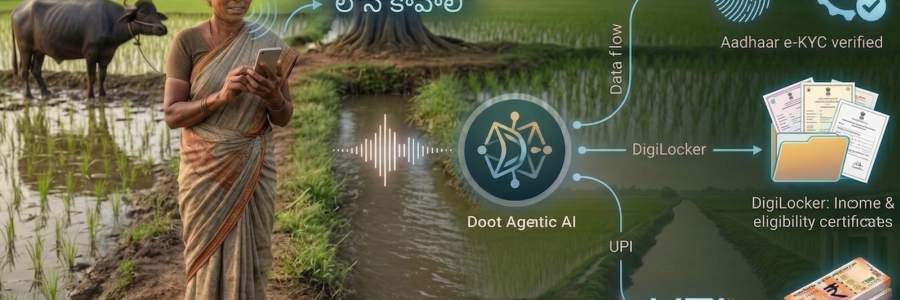
Doot would act as a personal assistant on smartphones, speaking all Indian languages. It navigates forms, schemes, and banking on the user's behalf. [A rural woman wanting a buffalo loan wouldn't need to fill paperwork. The agent would handle the entire application process through India's DPI stack.]
How does Doot handle multiple languages?
The agent is designed to speak all major Indian languages natively, not just translate. [A Telugu-speaking user in the Krishna delta would interact entirely in Telugu.] This removes literacy and language as gatekeepers, which currently exclude millions from digital services.
What stops middlemen from exploiting this?
Because the AI agent acts solely in the user's interest, it could reduce dependence on intermediaries who charge fees. [Village-level agents sometimes take cuts from subsidy applications.] Doot's architecture is designed so the user's intent is directly translated into action without third-party interference.
How does it work without internet access?
The white paper envisions offline-capable interactions using lightweight models on basic smartphones. [A user in a low-connectivity village could queue requests that sync when signal returns.] India's expanding 4G and 5G coverage also helps, but the design accounts for patchy rural connectivity.
What changes if paperwork isn't a barrier?
If procedural friction vanishes, millions locked out of welfare could access schemes they already qualify for. [A farmer eligible for a government subsidy but unable to read the form could finally claim it.] This shifts wealth distribution by removing invisible barriers between citizens and existing benefits.
Who benefits most from removing paperwork?
Rural women, elderly citizens, and semi-literate populations stand to gain most. [Women like Lakshmi in Andhra Pradesh currently can't access livestock loans despite qualifying.] These groups face the highest procedural friction, so an AI intermediary creates the largest marginal improvement for them.
Could this reshape rural credit access?
Yes. If an AI agent can assemble loan applications and connect users to bank schemes, rural credit could expand significantly. [A buffalo purchase funded through a government scheme becomes viable without a bank visit.] This could unlock entrepreneurship in areas where banking infrastructure is thin.
What if welfare uptake suddenly spikes?
Government budgets for welfare schemes often go unspent because eligible citizens don't apply. [Some state schemes see less than half their allocated funds disbursed.] If Doot drives higher uptake, governments may need to scale funding, creating a positive pressure loop for fiscal planning around actual demand.
Why build on India's DPI for this AI agent?
India's digital public infrastructure, including Aadhaar and UPI, already connects over 1 billion people. Building Doot on this stack avoids starting from scratch. [UPI processes over 10 billion transactions monthly.] The proposal leverages this foundation so the AI agent can verify identity, access records, and transact seamlessly.
Why use India's DPI instead of private APIs?
India's DPI stack is universal and government-backed, ensuring interoperability. [Aadhaar covers over 1.3 billion residents.] Private APIs would fragment access and create vendor lock-in. Building on DPI means one agent can handle banking, health records, and education without needing separate corporate partnerships.
How many Indians lack digital access today?
Despite rapid growth, roughly 300 million Indians still lack smartphones. [Rural smartphone penetration trails urban areas significantly.] The proposal acknowledges this gap, but India's device costs are falling fast. Affordable smartphones under 5,000 rupees are expanding the addressable population each year.
What makes this different from chatbots?
Most chatbots answer questions. Doot is designed to act, completing forms, submitting applications, and transacting on the user's behalf. [Rather than telling Lakshmi which scheme to apply for, it would file the application itself.] This shift from information to agency is the core architectural difference.
Source: livemint.com