world · 2026-07-07
Asia's World Cup Flop Triggers Exits
5334f601-b48e-4a2d-b894-5864624c4fda
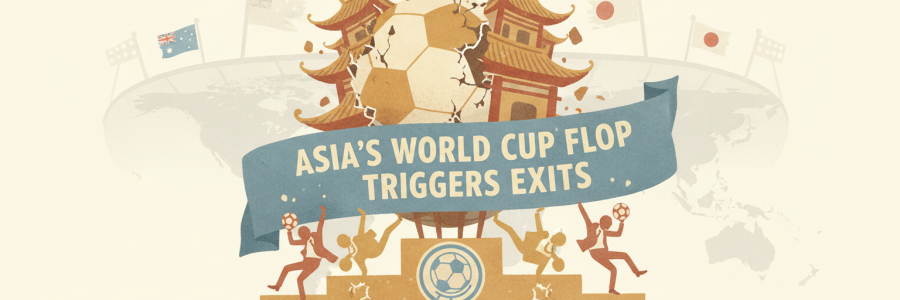
Asian football chiefs are resigning after the continent won just 3 out of 29 matches at the expanded 48-team World Cup in USA, Canada, and Mexico.Only Australia and Japan escaped group stages, both losing in the round of 32. No Asian team has reached a World Cup quarterfinal since South Korea's 2002 semifinal run.South Korea's FA president, Saudi Arabia's FA president, Jordan's coach, and South Korea's coach have all quit. Futures of Qatar and Iraq coaches remain uncertain.
Why did 7 of 9 Asian teams fail in groups?
Asian sides won just 3 of 29 matches. Iran drew all three games but still went out. Uzbekistan and Jordan lost every match. Japan was strongest, beating Tunisia 4-0, but a 96th-minute Brazil goal ended their run. Most teams lacked knockout-stage experience, facing better-drilled opponents from Europe, South America, and a surging Africa bloc that sent 9 teams through.
How did Japan lose to Brazil so late?
Japan led Brazil 1-0 at halftime in the round of 32. Brazil, five-time champions, equalised and then scored a 96th-minute winner. Coach Moriyasu said the team proved it "can compete on the world stage" but acknowledged the gap in closing out matches against elite sides. Japan's tournament included a 4-0 win over Tunisia.
What went wrong for Iran despite no losses?
Iran drew all three group games, meaning they finished with 3 points. In the expanded format's tighter groups of three or four, three draws can leave a team on the wrong side of goal difference or head-to-head tiebreakers. Iran's defensive solidity was not matched by attacking output, a structural problem coach Carlos Queiroz has faced before.
Did any Asian team outperform expectations?
Australia arguably overperformed. Coach Tony Popovic had already signed a contract extension before the tournament. The Socceroos beat Turkey, reached the round of 32, and lost to Egypt only on penalties. As the AFC's last surviving team, they carried the continent's hopes further than any other Asian side this cycle.
Could expanded format have helped Asia more?
The expansion from 32 to 48 teams gave Asia 9 spots, up from 4 or 5 previously. But more berths meant weaker qualifiers entering. Uzbekistan and Jordan were World Cup debutants with no tournament pedigree. By contrast, Africa's 9 qualifiers all advanced from groups. More seats did not translate to deeper runs for Asia.
What does Saudi's exit mean for 2034 plans?
Saudi Arabia hosts the 2034 World Cup. A group-stage exit in 2026, just 8 years before, exposes how far the domestic league's lavish spending on stars like Ronaldo has not translated to national team depth. FA president Al-Misehal's resignation creates a leadership vacuum during the most critical planning period for a host nation.
Does South Korea's FA crisis run deeper?
Chung Mong-gyu had been president since 2013, a 13-year tenure. South Korea's own president criticised the football setup publicly, rare political intervention. Coach Hong Myung-bo resigned days before Chung. The crisis echoes a pattern: South Korea has not matched its 2002 semifinal since, and structural reform of youth development has stalled despite K-League investment.
How does AFC plan to close the gap?
AFC president Sheikh Salman acknowledged the gap remains "tight at the absolute top tier." Historically, Asian football federations invest in foreign coaches (Cannavaro for Uzbekistan, Sellami for Jordan) rather than building domestic coaching pipelines. Until academies produce players who compete in Europe's top 5 leagues at scale, knockout-round success will remain rare. Japan's model of exporting players to Bundesliga and La Liga clubs is the closest template.
Who beyond coaches pays for this failure?
Son Heung-min, Asia's biggest football star, posted a public apology saying he was "indescribably hurt." South Korea's president publicly criticised the team. Saudi Arabia's FA president Al-Misehal resigned, jeopardising the kingdom's football investment strategy ahead of hosting the 2034 World Cup. Sponsors and broadcasters who bet on Asian teams reaching knockout rounds face diminished returns.
Why did Africa outperform Asia so starkly?
Africa sent 9 teams through group stages versus Asia's 2 out of 9. African leagues have less money than Saudi or Japanese leagues, but African players are deeply embedded in European club football. Over 300 African-born players competed in Europe's top 5 leagues last season, giving national teams match-hardened squads. Asia's player export pipeline outside Japan and South Korea remains thin.
Will these resignations actually change things?
FA president resignations often lead to cosmetic reshuffles, not structural reform. After South Korea's 2018 group exit, a coaching change produced no lasting improvement. Genuine reform requires overhauling youth academies, referee development, and domestic league competitiveness. Japan's 20-year investment in its J-League academy system is the rare example of a resignation-era crisis producing durable structural change.
How does this affect Asian football economics?
Asian football broadcasting rights and sponsorship deals are priced partly on World Cup performance. South Korea's group exit and Saudi Arabia's failure reduce the commercial value of national team properties. For example, kit sponsors like Nike and Adidas negotiate bonuses tied to knockout-round appearances. Fewer deep runs mean lower commercial payouts, reducing federation budgets for grassroots development.
Source: thehindu.com