economy · 2025-07-05
Australia's Visa Fee Hike Hits Indians
5b96045c-7d74-4229-b66c-deab5bd436c7
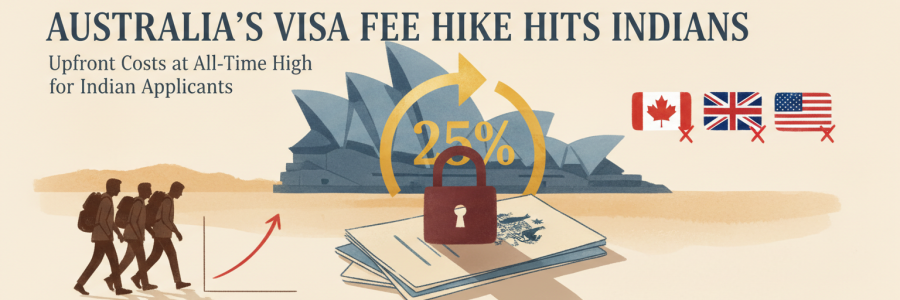
Australia raised its Student Visa (Subclass 500) fee 25% to AUD 2,500 (~₹1.65L), effective Jul 1, 2026. This is the second straight annual hike.Combined with tuition, health insurance, and a minimum AUD 29,710 (~₹19.6L) proof-of-funds requirement, the upfront cost barrier is at an all-time high for Indian applicants.Indian students, the largest source of international enrolments in Australia, now face steeper non-refundable visa costs, while Canada, UK, and the US are simultaneously tightening their own student visa regimes.
What changed in Australia's new visa fees?
The Subclass 500 student visa fee jumped from AUD 2K to AUD 2.5K, a 25% hike. Just a year earlier it rose from AUD 1.6K. The post-study Temporary Graduate Visa (Subclass 485) also climbed from AUD 4.6K to AUD 5.75K. Both fees are non-refundable, so a rejected application now costs ~₹1.65L upfront.
How much has the total upfront cost risen?
Two years ago, a student paid AUD 1.6K for the visa alone. Today it is AUD 2.5K, a 56% cumulative jump. Add mandatory OSHC health cover (~AUD 600/year for a two-year course) and the proof-of-funds threshold of AUD 29,710, and the minimum documented outlay before tuition exceeds AUD 33K (~₹21.8L). That is roughly 15% more than in 2024.
Why are these visa fees non-refundable?
Visa processing involves background checks, biometrics, and document verification, costs that Australia's Home Affairs department incurs regardless of outcome. Making the fee non-refundable also serves as a screening mechanism: it discourages speculative applications from people testing the system without genuine intent. Immigration economists call this a 'seriousness signal', similar to how non-refundable booking deposits work.
What does Australia's proof-of-funds cover?
The AUD 29,710 threshold approximates one year of basic living expenses in cities like Melbourne or Sydney, covering rent, food, transport, and utilities. Students must show these funds sitting in a bank account or via a loan sanction letter before applying. The figure is updated annually to reflect Australian cost-of-living inflation, which ran ~4% in 2025.
Could students just shift to Canada or UK?
Not easily. Canada capped study permits and more than doubled its proof-of-funds threshold to CAD 22,895. The UK hiked its visa fee to £558 and restricted dependents. The US is adding a new $250 Visa Integrity Fee for 2027. Every major English-speaking destination is raising barriers simultaneously, leaving students with fewer affordable alternatives.
Are other countries also raising barriers now?
Yes. Canada ended its fast-track Student Direct Stream and capped total study permits. The UK raised maintenance-funds requirements and barred most master's students from bringing dependents. The US plans fixed-duration visas from 2027, replacing the open-ended Duration of Status model. The common driver is domestic political pressure over housing shortages and population caps.
What alternatives exist beyond the Big Four?
Germany still charges zero tuition at public universities and has relatively low visa fees (~€75). Ireland, the Netherlands, and New Zealand offer English-taught programs with lower combined costs. However, post-study work rights vary widely. Germany's 18-month job-seeker visa is generous, while New Zealand recently tightened its post-study work permits.
How does currency movement affect the bill?
The rupee's level against the Australian dollar materially changes the real cost. At ₹55/AUD (mid-2024), the old AUD 1.6K fee was ~₹88K. At today's ~₹66/AUD, the new AUD 2.5K fee is ~₹1.65L, nearly double in rupee terms. A 5% rupee depreciation alone adds ~₹8K to the visa fee without any policy change.
Who in India feels this fee hike the most?
Tier 2 and tier 3 city families sending a first-generation student abroad bear the heaviest burden. For a family in, say, Lucknow budgeting ₹25-30L total for an Australian master's, a ₹1.65L non-refundable visa fee plus ~₹19.6L in mandatory proof-of-funds is a significant share of savings. Loan-dependent students face the sharpest squeeze.
Which Indian income segments are priced out?
Families earning ₹8-15L annually, common in salaried middle-class households, now must set aside over a month's gross income just for the visa fee. For context, SBI's education loan data shows the median borrower family income for Australia-bound students is ~₹12L. The fee hike pushes marginal applicants, those just meeting the threshold, toward cheaper destinations or domestic options.
Do education loans cover visa fees too?
Most Indian education loan products from banks like SBI, Bank of Baroda, and Credila do cover visa fees as part of the total cost of attendance. However, the loan typically disburses after the visa is granted, so students must front the non-refundable fee from savings or a personal loan. If the visa is rejected, the student absorbs the loss entirely.
Could this shift demand to Indian colleges?
Possibly at the margin. IIMs and top private universities like Ashoka and Plaksha have seen rising interest from students who might have gone abroad. But the primary draw of Australian degrees, post-study work rights leading to permanent residency, has no domestic equivalent. The shift is more likely to redirect students to cheaper destinations like Germany than to Indian institutions.
Source: livemint.com