economy · 2026-07-11
BofA Sees 50 bps RBI Rate Hike by Dec
09f305dd-0b72-416a-b0c4-982d7c2f2340
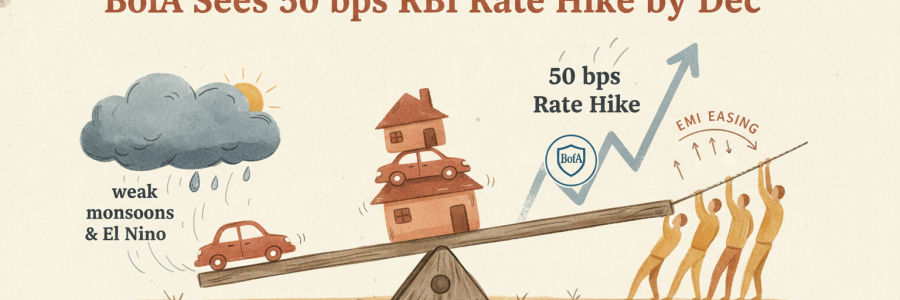
BofA Securities expects a cumulative 50 bps rate hike starting Dec 2026, driven by domestic inflation risks from weak monsoons and El Nino.If hikes materialize, borrowers who just got relief from recent cuts would see EMIs rise again, reversing months of easing.Home and vehicle loan borrowers, NBFCs in retail and MSME lending, and rural economies dependent on monsoon outcomes face the most pressure.
Why does BofA expect hikes despite cooling CPI?
BofA projects FY27 CPI at 4.8%, below earlier estimates. But it flags below-normal monsoon rainfall and rising El Nino probability as triggers for food inflation in H2 FY27. Since food makes up ~46% of India's CPI basket, a bad monsoon alone can push headline inflation above RBI's 4% target, forcing rate action.
What's driving BofA's upgraded GDP forecast?
BofA raised its FY27 GDP forecast to 6.9% from 6.5%, citing stronger consumption and investment demand. Govt capex spending plus improving terms of trade and softer global commodity prices are supporting growth. The current account deficit narrowing to 1.2% of GDP from lower oil prices also helps.
How do food grain stocks cushion inflation?
India holds food grain buffer stocks through FCI warehouses. When vegetable or cereal prices spike due to weather, the govt can release wheat or rice from these stocks to cool prices. In 2023, the govt released ~50L tonnes of wheat via open market sales to tame bread and flour inflation.
Could the monsoon alone derail the rate path?
In 2023, an uneven monsoon pushed tomato prices above ₹200/kg and overall food inflation past 8%. Since food is ~46% of CPI, a single bad crop season can add 100-150 bps to headline inflation. RBI has historically responded to sustained food-driven inflation with rate hikes, as in 2013 and 2022.
How much could a 50 bps hike add to EMIs?
On a ₹50L home loan at 8.5% over 20 years, a 50 bps hike raises the EMI by roughly ₹1,500 to ₹1,700/month. For vehicle loans, the impact per ₹10L borrowed is ~₹300/month. SBI and HDFC Bank had just passed on earlier cuts. Those reductions would effectively reverse.
Why did BofA pick Dec 2026 as the start date?
Dec 2026 aligns with when H2 FY27 food inflation data becomes visible in CPI readings. Kharif crop damage from a poor monsoon shows up in Oct-Nov food prices. RBI needs 2 to 3 months of data to confirm a trend before acting. So Dec is the earliest hike window if monsoon disappoints.
How does the 50 bps split across meetings?
BofA expects a cumulative 50 bps, likely split as two 25 bps hikes across Dec 2026 and Feb 2027 policy meetings. RBI has historically preferred 25 bps increments for predictability. In 2022, however, it opened with an off-cycle 40 bps emergency hike when inflation surged past 7%.
Could RBI act earlier if El Nino hits hard?
Yes. In Jun 2008 and May 2022, RBI called off-cycle meetings to hike rates when inflation spiked unexpectedly. If El Nino triggers severe crop failure by Aug-Sep and CPI crosses 6%, RBI could convene an emergency MPC meeting before Dec. The framework mandates action if CPI stays above 6% for three quarters.
Which NBFCs are most exposed to this shift?
NBFCs focused on retail and vehicle finance, like Bajaj Finance and Shriram Finance, face higher funding costs because they borrow from banks at market rates. Unlike banks with low-cost CASA deposits, NBFCs pass rate hikes almost fully to borrowers. BofA flagged liability management and pricing discipline as key risks.
How do NBFCs fund themselves differently?
Banks like SBI fund ~43% of lending through savings and current accounts (CASA) at 3-4% interest, insulating them from rate hikes. NBFCs lack deposit franchises and rely on market borrowings, NCDs, and bank credit lines priced near repo rate. A 50 bps hike flows almost entirely into NBFC funding costs.
Which borrower segments get hit hardest?
Unsecured personal loan and microfinance borrowers face the steepest impact. These segments already pay 18-26% interest. A 50 bps hike on a ₹3L personal loan at 18% adds ~₹100/month, but delinquency risk rises sharply. In 2022-23, microfinance NPAs at firms like Fusion Finance climbed after rate hikes.
Could some NBFCs benefit from rate hikes?
Gold loan NBFCs like Muthoot Finance can benefit. When rates rise, borrowers shift from unsecured loans to cheaper secured gold loans. Muthoot's AUM grew 25% in FY23 partly because rate hikes made personal loans expensive. NBFCs with fixed-rate legacy portfolios also earn wider spreads temporarily.
Source: economictimes.indiatimes.com