economy · 2026-07-06
Cheap Oil Gives RBI Room to Cut Rates
d6de5b40-19d0-4283-80e9-e3dccf25338f
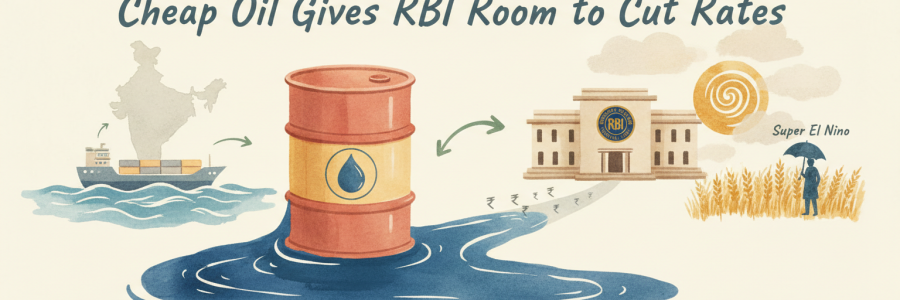
Standard Chartered says falling crude prices give India's RBI more room to prioritize growth over inflation control.India imports ~85% of its crude. Cheaper oil shrinks the import bill and eases balance-of-payments pressure, widening the rate-cut window.A 63% chance of Super El Nino in Q4 could reverse gains by spiking food and energy prices, hitting Indian consumers and farmers.
How much has crude fallen and what drove it?
Brent crude has dropped ~15% from its 2025 highs, driven by weak Chinese demand and OPEC+ supply increases. India imports ~85% of its oil. Every $10/barrel fall saves India roughly $15Bn on its annual import bill. Standard Chartered calls this the widest easing window for RBI since 2020.
How does cheaper crude reduce India's inflation?
India imports ~4.5Mn barrels/day. Crude feeds into transport fuel, fertilizers, and plastics, so cheaper oil lowers input costs across sectors. Diesel price cuts reduce freight costs, which flow into food prices. In 2020, cheap crude helped India's CPI inflation drop below 5% for several months.
Does RBI always cut rates when oil falls?
Not automatically. RBI weighs core inflation, rupee stability, and fiscal deficit alongside oil. In 2019, oil fell but RBI delayed cuts because food inflation spiked. The current window is wider because both oil and core inflation are softening. RBI has already cut 75 basis points since Feb 2025.
How large is India's annual crude import bill?
India spent ~$150Bn on crude imports in FY25, making oil the single largest import item, roughly 25% of total imports. A $10/barrel price drop saves ~$15Bn annually, enough to narrow the current account deficit by ~0.4% of GDP. Saudi Arabia and Iraq supply over 40% of India's crude.
Could El Nino undo this relief for India?
Standard Chartered estimates a 63% probability of Super El Nino forming in Q4 2026. This would cut crop yields through extreme heat and drought while spiking electricity demand for cooling. India's 2023 El Nino pushed tomato prices up 400% in weeks. A repeat could force RBI to pause or reverse any rate cuts.
What food prices could El Nino spike first?
Vegetables and pulses are most vulnerable. India's 2023 El Nino pushed tomato prices from ₹40/kg to ₹200/kg within weeks. Onions and cereals followed. These items carry heavy weight in India's CPI food basket, roughly 40% of total CPI, so spikes transmit quickly into headline inflation.
How does El Nino affect electricity demand?
Extreme heat forces households and offices to run AC and coolers longer. India's peak electricity demand hit a record 250 GW in May 2024 during a heat wave. Higher power demand increases coal and gas consumption, pushing energy prices up. This creates a feedback loop, heat raises both food and energy inflation simultaneously.
Has India built buffers against El Nino shocks?
India's strategic petroleum reserve holds ~5.3Mn tonnes, roughly 9.5 days of import cover, far below the IEA's recommended 90 days. The govt expanded buffer stock schemes for onions and pulses after 2023. But buffer stocks cover only a fraction of demand. A severe El Nino would still overwhelm these buffers within weeks.
Who gains most from RBI easing, and who doesn't?
Heavy energy importers like India, Thailand, and the Philippines gain the most easing room. Borrowers with floating-rate loans, such as home loan holders, benefit directly from rate cuts. But South Korea and Singapore face AI-driven demand inflation, so their central banks may hold rates higher, diverging from India's path.
Why are Korea and Singapore diverging?
Both economies are experiencing an AI-driven investment boom. Samsung and TSMC are building chip fabs, pushing up wages and commercial real estate. This demand-pull inflation runs independently of oil prices. Standard Chartered expects the Bank of Korea to hold rates at 2.75% even as RBI cuts further.
How do floating-rate borrowers benefit?
About 75% of Indian home loans are floating-rate. When RBI cuts the repo rate, banks lower their MCLR or external benchmark rates. A 50 basis point cut on a ₹50L, 20-year home loan reduces EMI by roughly ₹1,700/month. SBI and HDFC Bank have already passed through earlier 2025 cuts to borrowers.
Could cheap oil weaken the rupee instead?
Paradoxically, yes. Cheaper oil can weaken the rupee if it signals global recession, triggering capital flight from emerging markets. In 2020, oil crashed but the rupee still fell from 71 to 76/$ as foreign investors pulled $16Bn from Indian equities. RBI typically intervenes with forex reserves to prevent sharp depreciation.
Source: economictimes.indiatimes.com