economy · 2026-11-03
Commercial LPG and jet fuel get costlier
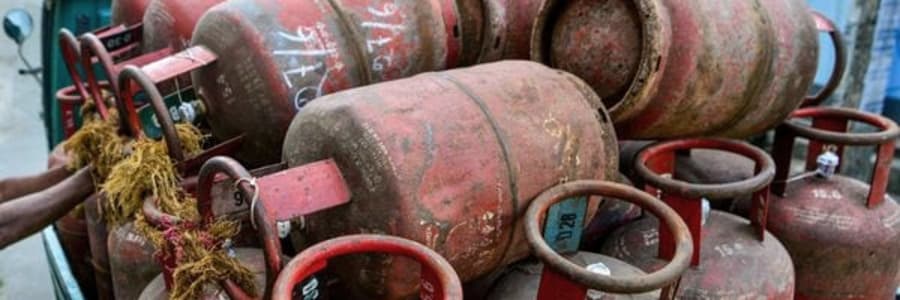
Photo: via mint
India raised prices of commercial LPG and jet fuel, but left household LPG unchanged. This shows the government keeps household fuel cheap while letting businesses bear the full cost of high global crude.
Why did commercial LPG and jet fuel prices rise again?
These are market-priced fuels, revised on the first day of each month to follow international benchmarks, so they rise when world crude stays high on the West Asia conflict. Domestic LPG and vehicle fuels are government-protected, so they stay flat. Businesses pay the pain: a 19-kg commercial cylinder now costs ₹2,820, and jet fuel ₹138.50 a litre, the fourth straight rise.
How do the oil companies absorb the cost of protected fuels?
The oil firms book the gap between their cost and the capped selling price as an under-recovery loss. For 2025-26, the government approved ₹30,000 crore in compensation, paid in 12 monthly instalments to IOCL, BPCL, and HPCL (Indian Oil, Bharat Petroleum, and Hindustan Petroleum). The companies also carry a negative buffer, BPCL's stood at ₹12,318.52 crore as of March 2026, which shrinks only as compensation arrives.
Why only businesses pay the full cost of high crude?
The government shields households from global price swings while commercial fuels follow international benchmarks. India imports about 60% of its LPG need, and domestic prices are linked to Saudi CP, the benchmark. While the Saudi CP rose 21% from July 2023 to November 2025, the domestic LPG price fell 22%. That gap cost oil companies ₹40,000 crore, of which the government approved ₹30,000 crore compensation. The full cost is passed on to businesses instead, because they can absorb it and the state keeps household fuel cheap.
Can airlines pass this on to passengers?
Airlines have room to pass costs on, but they do not have to. ATF makes up 40 to 45 percent of an airline's operating costs, and it is a market-priced fuel, so each rise directly hits the bottom line. Yet the government has kept airfares under watch and has asked airlines and ticketing agents to keep prices reasonable. In practice, fares respond to demand and competition as much as to fuel, so carriers absorb part of the rise. Our read: with festive-season demand strong, expect higher fares on busy routes, not across the board.
Why are airlines ordering planes while fuel keeps rising?
Carriers are betting on the long term, not just on current fuel costs. ATF has been about 47% higher than pre-COVID levels, yet still 8% lower than last year, and it makes up 40-45% of operating expenses. IndiGo, Akasa, and Air India have placed large orders for narrow-body and wide-body aircraft anyway. The bet is on rising passenger demand and fleet efficiency. ATF is also a volatile, fluctuating input, not a fixed cost, so airlines plan around it. Our read: the orders signal confidence in demand growth, not in fuel prices falling.
Who ultimately pays when commercial fuel gets costlier?
The bill lands on the businesses that buy these fuels: restaurants, hotels, caterers, and food outlets face higher costs for commercial LPG, and airlines bear ATF at 40-45% of their operating expenses. These businesses can choose to absorb the cost, pass it on to customers, or switch to alternatives. Evidence shows many commercial kitchens are already switching to biomass pellet burners to cut fuel costs, and while the government asks airlines to keep fares reasonable, fares ultimately respond to demand and competition. Our read: the burden falls unevenly, with the most competitive and least flexible businesses the hardest hit.
Can small airlines survive these fuel cost rises?
Smaller carriers are the most exposed. Financial distress has already hit select airlines, with SpiceJet facing payment defaults to lessors and Go Airlines ordered into liquidation, while larger airlines are cushioned by parent company backing or internal reserves. Engine reliability problems also grounded about 133 aircraft, nearly 16 percent of the fleet, adding cost pressure. Fuel alone does not decide survival, but it widens the gap. Our read: the weakest carriers will struggle to keep flying without new capital.
Why can't the government just cap ATF prices like it caps household LPG?
ATF has been market-determined since April 2001, so the government does not set its price the way it caps domestic LPG. It does, however, keep a watch on airfares and has asked airlines and ticketing agents to keep prices reasonable, with fares on monitored routes moderating in 2024. The state also earns from ATF through excise duty and a VAT that ranges from 0% to 29% across states. Our read: capping jet fuel would force the government to either forgo that tax revenue or compensate airlines, a cost it has chosen to avoid by leaving ATF to the market.
What could finally break the cycle of rising fuel prices?
Commercial kitchens are already switching from LPG to biomass pellet burners (ovens that burn compressed plant waste) to cut costs, and airlines are placing large aircraft orders despite ATF running at 40% of operating costs. Sustainable aviation fuel is projected to undercut fossil jet fuel in India after 2030, as renewable power costs fall. Our read: the switch depends on whether fuel prices stay high enough to justify the upfront investment.
What is the real cost of protecting household fuel?
The real cost lands as losses on the state-run oil marketers. For 2025-26, the government approved ₹30,000 crore in compensation, paid in 12 monthly instalments, but the companies have a negative buffer that grows when actual losses exceed compensation. BPCL's negative buffer stood at ₹12,318.52 crore as of March 2026, up from ₹10,446.38 crore a year earlier, even after five instalments of ₹3,164.15 crore were recognised. The scheme only shrinks the buffer when compensation arrives, not when losses occur.
Why does the government protect households but not restaurants?
Households are voters; restaurants are businesses. Domestic LPG is a political necessity, so the government caps its price, absorbing losses like the ₹40,000 crore in 2025-26 (a figure that needs a source). Commercial LPG, however, is market-determined and tracks international benchmarks, so restaurants pay the full cost of global price swings, with no government shield.
Why don't higher jet fuel costs just push up airfares?
Airfares are not set by fuel costs alone. The government monitors fares that airlines and online agents charge, and has told carriers to keep increases reasonable, with fares in 2024 moderating on routes it tracked. Airlines absorb part of the cost pressure through their own margins, while fuel's share of operating costs stays around 40-45%. ATF carries state VAT of up to 29%, so local taxes also factor into the final price passengers pay. Our read: fares will rise, but slower than fuel costs, because the regulator watches them.
Do airlines have a real alternative to jet fuel?
Not yet. Sustainable aviation fuel (SAF) is projected to undercut fossil jet fuel in India after 2030 as renewable power costs fall, but until then airlines absorb the 40-45% of operating costs that fuel eats up. Even so, carriers like IndiGo and Air India are ordering aircraft, betting on long-term demand. Our read: the switch to SAF will happen only if fuel prices stay high enough to justify the switch.
Why would an airline keep ordering planes when jet fuel keeps getting costlier?
The airlines are betting that fuel costs will not stay this high forever and that demand will grow faster than fuel eats into margins. IndiGo raised money and is moving into long-haul flights with wide-body orders, while Akasa Air and Air India have placed large Airbus and Boeing orders. ATF, though still about 40% of operating costs, was actually 8% lower in 2024-25 than the year before. Our read: these carriers are pricing in the switch to cheaper sustainable aviation fuel after 2030, ordering planes now that will still be flying then.
What would break the airline industry's dependence on imported fuel?
India's refineries like MRPL sell ATF domestically through a joint venture set up to market aviation fuel at Indian airports, rather than exporting it, and still earn 47% more than pre-COVID prices despite fuel being 8% lower than 2024-25 levels. The projected shift is to power-and-biomass-to-liquids sustainable aviation fuel, which undercuts fossil jet fuel after 2030 as renewable power costs fall under long-term rupee-denominated power purchase agreements. Our read: cheaper SAF, not pipeline expansion, is what breaks the dependence.
Could fuel costs alone drive an airline out of business?
Fuel has pushed carriers to the edge before. In FY 2024-25, SpiceJet defaulted on payments to aircraft lessors and faced legal proceedings, raising ₹3,000 crore through a share sale to stay afloat, while Go Airlines, already in insolvency, was ordered to liquidate. ATF prices, though 8% lower than the prior year, remained 47% above pre-COVID levels, and engine problems grounded 16% of the fleet. Our read: high fuel plus operational shocks, not fuel alone, is what breaks a carrier.
Why does the fuel price change hit different states differently?
The price bolts shown in the article are base prices posted by the oil companies, before state-level taxes are added. ATF carries a value added tax that states set anywhere from 0% to 29%, and commercial LPG is also subject to local taxes, so the same national hike lands differently depending on where a restaurant or airline refuels. Delhi's ATF price is the benchmark, but Mumbai or Bengaluru pay more because their states levy higher VAT. This is why a uniform monthly revision still shows up as different pump prices across the country.
Why not let domestic LPG prices rise and save the ₹30,000 crore?
If domestic LPG prices rose to match global rates, a household cylinder would cost more than its current subsidised price, an unpopular move for voters. Instead, the government absorbs the loss and compensates state oil companies, ₹30,000 crore in 12 monthly instalments, keeping homes cheap while businesses pay market rates. The fiscal cost is accepted because the political cost of higher kitchen fuel is steeper.
Why are prices rising just before the festive season?
The November hike lands as restaurants, hotels and catering businesses see peak festive demand, so the oil companies can pass the cost on without losing volume. Commercial LPG and ATF are both market-priced, reset monthly against international benchmarks and the rupee, so the timing is less about demand and more about where global crude stands. Our read: the government lets business fuel rise when it knows demand is strong enough to absorb it, keeping the political heat off household cylinders.
Can restaurants keep passing these fuel costs to diners?
Yes, for now. Commercial LPG and ATF are market-priced, so oil companies reset them monthly against global benchmarks and the rupee without any political cap. Restaurants and airlines faced about 40% of operating costs in fuel, yet airfares moderated in 2024 relative to 2023 on monitored routes, according to the civil aviation ministry, meaning carriers absorbed costs rather than fully passing them on. Our read: as long as festive demand is strong, businesses will mostly pass costs through, but airlines are nearing the limit of what fares can bear.
What stops restaurants and airlines from simply passing on the higher fuel prices?
Competition and demand shape their pricing. Food outlets risk losing customers if they raise menu prices too much, while airlines operate in a market where fares have already moderated in 2024 relative to 2023 on monitored routes, which means carriers absorbed some costs. Fuel eats up 40-45% of an airline's operating expenses, so there is little room to absorb more. Our read: the real constraint is that fuel is one of many costs, so passing it through fully would price them out of the market.
What is really driving the price of commercial fuel, then?
The price of commercial fuel is set by global benchmarks, not by the Indian government. Commercial LPG is linked to the Saudi CP (a global LPG benchmark), and ATF is market-determined based on international prices and the rupee-dollar rate. India imports about 60% of its LPG, so local prices follow global swings. When global prices rise, commercial fuel rises with them; when they fall, as they did in July and August 2025, the drop is passed on. The political cap applies only to household LPG, not business fuel.
If fuel costs are hitting airlines this hard, why are they ordering more planes?
Carriers are betting on rising travel demand, not falling fuel costs. ATF prices in FY 2024-25 were still about 47% higher than pre-COVID levels, and fuel eats up 40-45% of operating expenses. Yet IndiGo, Akasa Air, and Air India have placed large aircraft orders, and IndiGo is adding business class and long-haul routes. The bet works only if passenger growth outpaces the fuel burden. Our read: airlines are positioning for market share now, expecting fuel efficiency and scale to protect margins later.
Source: livemint.com