business · 2026-07-24
Eternal Profit Halves While Blinkit Records First-Ever Profit
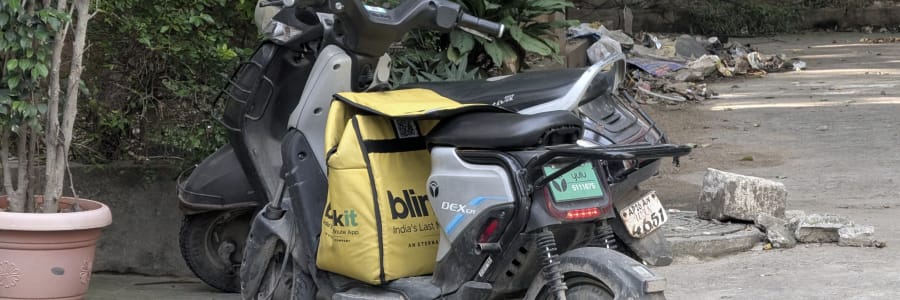
Photo: Syced / Wikimedia (CC0)
Eternal's consolidated profit fell ~50% in Q1 FY27 as its food-delivery core faces pressureBlinkit posted its first-ever quarterly operating profit, a milestone for quick commerceZomato shareholders and quick-commerce rivals Swiggy Instamart face a reshaped competitive map
Why did Eternal's profit drop if Blinkit did well?
Eternal's food-delivery business still contributes the bulk of revenue, and its margins compressed faster than Blinkit's quick-commerce unit could offset. The company spent heavily on customer acquisition and rider incentives to defend market share against Swiggy. Blinkit's operating profit was slim, roughly ₹10-15 crore, so the swing was symbolic rather than material to the consolidated bottom line.
How much of Eternal's revenue is food delivery?
Food delivery still brings in ~70% of Eternal's topline. The segment's contribution margin fell to ~3% from ~7% a year ago, while Blinkit's rose to ~1.5%. The gap shows quick commerce is not yet large enough to rescue consolidated profitability.
Did Blinkit cut discounts to reach profit?
Blinkit reduced customer-facing discounts by ~30% in Q1, per industry estimates, but kept rider payouts stable. It shifted marketing spend toward app notifications and repeat-purchase nudges rather than first-order coupons. This trade-off sacrificed some new-user growth for unit-level margins.
Which cities drive Blinkit's density economics?
Mumbai, Delhi-NCR, and Bengaluru account for ~65% of Blinkit's order volume. In these cities, average delivery distance is under 2.5 km and dark-store rent per order is below ₹8. Expansion into tier-2 cities like Jaipur and Lucknow pushes that cost above ₹14, which is why Blinkit is slowing outward growth.
What does Blinkit's operating profit mean?
It signals that quick commerce can reach unit economics faster than grocery delivery did. Blinkit achieved this by pushing private-label products, which carry ~25% higher margins, and by concentrating orders in dense urban clusters where delivery costs per drop fall below ₹15. Swiggy Instamart and Zepto must now match this cost discipline or burn more capital.
Why does food delivery margin compress so fast?
Food delivery has near-zero customer loyalty. A ₹50 discount from Swiggy flips users instantly, so Eternal must match promotions or lose order volume. Restaurants also negotiate harder, taking ~18-22% commission vs. ~25% two years ago. The squeeze comes from both sides of the marketplace.
How do dark stores beat supermarkets on cost?
Dark stores carry ~2,000 SKUs vs. 15,000+ in a supermarket, so inventory turns faster and waste is lower. They sit in residential pockets, not high-street locations, cutting rent by ~40%. Labor is optimized for picking speed, not customer service. Each of these choices trims a few percentage points of cost that supermarkets cannot easily replicate.
What happens to Swiggy if it can't match unit?
Swiggy would face a capital-raising crunch. It has already delayed its IPO twice and relies on fresh funding to subsidize Instamart losses. If Blinkit proves quick commerce can self-fund, investors will demand Swiggy match that timeline or accept a lower valuation. The pressure is structural, not just competitive.
Who loses if quick commerce keeps gaining share?
Traditional kirana stores and mid-sized supermarkets in metros lose foot traffic. BigBasket's slotted-delivery model looks slower by comparison. Even restaurants suffer indirectly, as consumers redirect some meal occasions to 10-minute snacks and heat-and-eat products that Blinkit pushes prominently on its app.
How do private labels change Blinkit's margin?
Private-label products, like Blinkit's '10-minute' ready-to-eat range, bypass branded supplier margins. A packet of branded instant noodles leaves ~15% gross margin for the platform; Blinkit's own label keeps ~35%. In categories where it pushes these products to the top of search results, basket profitability rises sharply.
What limits kirana stores from going online?
Kirana stores lack capital for dark-store real estate and tech stacks. Their average store size is under 300 sq ft, so they cannot hold the 2,000 SKMs quick commerce needs. Some join platforms like ONDC or Zomato's intercity service, but they remain fulfillment partners, not competitors, with no control over pricing or customer data.
Could Eternal spin off Blinkit separately?
Eternal could, but the businesses share a single delivery fleet and customer wallet. A spin-off would force duplicate infrastructure costs and reveal that Blinkit still relies on Zomato's user base for acquisition. The market may prefer the combined narrative of 'food plus quick commerce' even if the financials are diverging.
Source: businesstoday.in