business · 2026-07-10
Fidji Simo Steps Down as OpenAI's No. 2
d198b57f-7fed-4089-9a0e-beaaaad9be3f
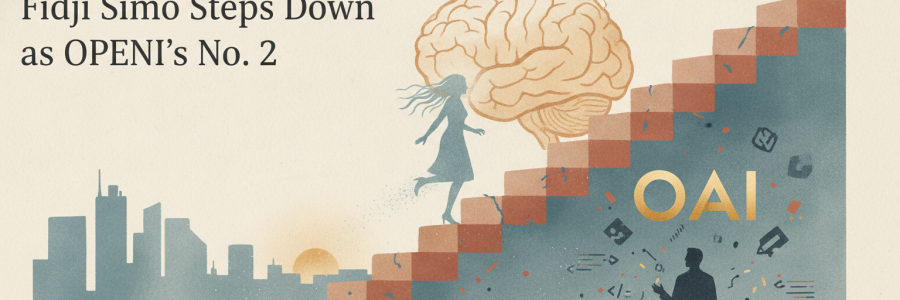
Fidji Simo is leaving her full-time role as OpenAI's CEO of Applications, citing a prolonged neuroimmune condition relapse, and will shift to a part-time advisory role.Her exit creates a leadership vacuum at a company valued at $852Bn that is eyeing an IPO, with four senior executives having departed or shifted roles since April.Sam Altman must now find a successor while OpenAI trails Anthropic in coding tools and ChatGPT's consumer revenue growth has cooled.
Who might replace Simo at OpenAI?
Denise Dresser, OpenAI's chief revenue officer since Dec 2025, is the likeliest candidate. She previously ran Slack as CEO for two years and spent 14 years at Salesforce. Co-founder Greg Brockman has been covering product strategy during Simo's leave. But neither held the consolidated authority Simo had over COO, CFO, and CPO functions.
What role did Simo hold before joining OpenAI?
Simo was CEO of Instacart from 2021, leading its 2023 IPO. Before that she spent over a decade at Meta, including running the Facebook app. That combination of consumer product experience and IPO execution made her uniquely suited to prepare OpenAI for going public.
How did Altman's own role change under Simo?
When Simo joined in May 2025, Altman stepped back from day-to-day business operations to focus on research, compute, and safety. Her departure reverses that division of labor. Altman now must re-absorb operational oversight or quickly find someone else, splitting his attention from technical priorities at a critical scaling phase.
Why did OpenAI create Simo's role in 2025?
OpenAI had grown rapidly but lacked a single executive layer between Altman and the COO, CFO, and CPO. The CEO of Applications role was created to consolidate those functions. This structure is common pre-IPO. Instacart, for example, centralized ops under a COO before its 2023 listing to streamline investor-facing governance.
Why does this vacancy hit harder pre-IPO?
Public companies need a stable C-suite to pass investor due diligence. Simo had consolidated business and product ops under one role, with CFO Sarah Friar, COO Brad Lightcap, and CPO Kevin Weil all reporting to her. All three have since left or been reassigned. For an $852Bn-valued company, that is 4 out of 5 top operating executives gone in roughly three months.
What specific revenue targets did ChatGPT miss?
OpenAI has not disclosed exact targets, but internal goals reportedly assumed continued rapid consumer growth. ChatGPT's paying subscriber base cooled late last year relative to those projections. For context, OpenAI was on track for ~$12.7Bn in annualized revenue by mid-2025, so even a modest miss against aggressive forecasts can reshape strategy.
How do pre-IPO executive exits affect valuation?
Investor confidence depends heavily on management continuity. When WeWork lost key executives before its planned 2019 IPO, its valuation collapsed from $47Bn to under $10Bn. The mechanism is straightforward: underwriters price leadership risk into the offering, and institutional investors discount companies with thin or unstable C-suites.
Could OpenAI delay its IPO over this?
It is possible. Companies typically want a stable leadership team for 6 to 12 months before filing. OpenAI's current executive bench is thin for an $852Bn valuation. However, if Altman fills the role quickly, perhaps elevating Dresser, the timeline could hold. Delaying would also mean missing a favorable AI-sector IPO window.
How does this affect OpenAI vs. Anthropic?
ChatGPT's consumer growth missed internal revenue targets late last year, pushing OpenAI to lean into coding tools. But Anthropic's Claude currently leads in that segment. Simo was driving consumer strategy. Without her, OpenAI risks losing focus on both fronts. The new GPT-5.6 models launched the same day are explicitly framed as targeting Anthropic.
Where does Anthropic specifically lead OpenAI?
Anthropic's Claude outperforms in developer-facing coding tools, the segment OpenAI is now pivoting toward. Enterprise developers have adopted Claude for code generation and debugging tasks. OpenAI's new GPT-5.6 models, Sol, Terra, and Luna, plus ChatGPT Work, are explicitly designed to close this gap in multi-step professional workflows.
How is OpenAI's talent war shaping equity terms?
OpenAI shortened its equity vesting cliff from 12 months to 6 in Apr 2025, then eliminated it entirely in Dec. Employees now vest from day one. This matters structurally because AI engineers can command $1Mn+ total compensation packages. The zero-cliff model reduces flight risk but accelerates dilution, a tension investors will scrutinize pre-IPO.
Who are OpenAI's remaining key executives?
Beyond Altman, the bench includes CFO Sarah Friar, President Greg Brockman, CRO Denise Dresser, and Brad Lightcap in a special projects role. For a company with $852Bn valuation, that is roughly 5 named senior leaders. By comparison, Google had over 15 senior VPs when it went public at a far lower valuation.
Source: techcrunch.com