business · 2026-03-23
Flipkart Bets on Quick Commerce for IPO
95da0817-1308-4e36-b6cb-b2dd68241b1d
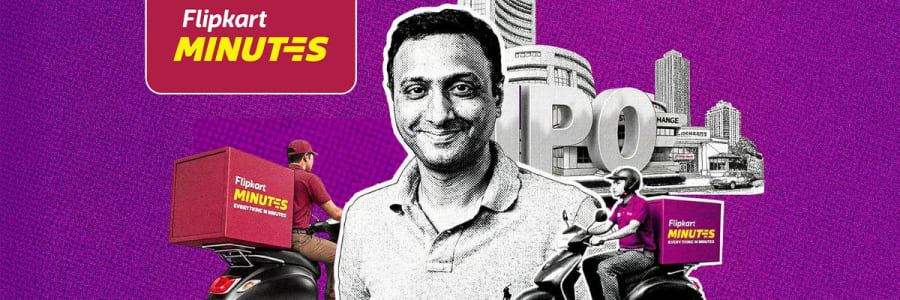
Flipkart Minutes is central to the company's IPO narrative, mirroring how Swiggy and Zomato leaned on quick commerce for public market appealIndia's quick commerce market is projected to grow from $6.1 Bn in 2024 to $40 Bn, and Flipkart's reverse flip to India aligns with this boomPublic investors now favor high-frequency, retention-driven categories over traditional ecommerce growth curves
How does quick commerce structurally differ?
Quick commerce drives far higher order frequency and retention than traditional ecommerce. Customers order groceries or essentials weekly versus buying electronics monthly. This creates compounding engagement loops. Public investors prize these metrics. [Blinkit now drives more of Zomato's valuation growth than food delivery does.]
How do order frequencies compare across models?
Quick commerce customers may order 3 to 4 times per week versus once or twice monthly on traditional platforms. This frequency compresses customer acquisition cost payback periods dramatically. [Blinkit users in top metros reportedly order more frequently than Zomato food delivery users.]
Why do investors value retention over GMV?
High retention signals predictable revenue, which lowers risk premiums in DCF models. Investors pay higher multiples for recurring, habitual spend versus lumpy, seasonal purchases. [Zomato's stock re-rated upward as Blinkit's cohort retention data improved over 2024 and 2025.]
What margins does quick commerce need?
Quick commerce needs dense order clusters per dark store to cover last-mile costs within 10 to 30 minutes. Contribution margins turn positive only above a threshold of roughly 1,000 daily orders per store. [Zepto claimed contribution-positive unit economics across its top 200 dark stores.]
Why did Flipkart redomicile to India now?
Flipkart's reverse flip from Singapore to India is a legal prerequisite for an Indian IPO. The timing also positions it within India's quick commerce boom cycle, letting it pitch Flipkart Minutes to domestic investors who already understand the category. [Swiggy's IPO leaned heavily on Instamart's growth story.]
What does reverse flip mean for Flipkart?
A reverse flip moves Flipkart's domicile from Singapore back to India. This restructures the holding entity so Indian exchanges can list it. The process involves regulatory approvals and can take months. [PhonePe completed a similar reverse flip before its India valuation round.]
How does IPO timing affect its valuation?
Listing during a quick commerce boom lets Flipkart command a premium multiple. If markets cool or competitors consolidate first, the window narrows. IPO timing relative to peer performance matters significantly. [Swiggy's IPO priced modestly partly because Zomato had already set public market benchmarks.]
Does Walmart's backing shape the IPO pitch?
Walmart's 77% ownership gives Flipkart institutional credibility but raises questions about free float and governance independence. Public investors will scrutinize how much autonomy Flipkart retains on capital allocation. [Walmart's backing helped Flipkart sustain losses longer than peers like Snapdeal could.]
What can Flipkart learn from Swiggy's IPO?
Swiggy showed that a secondary business line can anchor IPO positioning. Instamart became Swiggy's growth narrative despite food delivery being larger. Flipkart can similarly foreground Minutes over its legacy marketplace. [Zomato listed on food delivery but saw Blinkit become its primary valuation driver post-listing.]
How does Minutes compare to Blinkit or Zepto?
Minutes is still scaling while Blinkit operates over 700 dark stores and Zepto has raised aggressively. Flipkart's advantage is its existing user base, but dark store density takes time to build. [Blinkit had roughly 2 years of operational head start over Flipkart Minutes.]
Can Flipkart's existing infra help Minutes?
Flipkart's existing logistics network, supplier relationships, and customer data can accelerate Minutes' category expansion. Shared warehousing reduces fixed costs per order. [Flipkart's grocery supply chain from Supermart already covers many SKUs relevant to quick commerce.]
What risks does a late entry carry?
Late entrants face entrenched customer habits and saturated dark store real estate in top metros. Acquiring locations near high-density demand clusters becomes costlier. [Zepto and Blinkit have already locked premium warehouse leases in cities like Mumbai and Bengaluru.]
Source: inc42.com