business · 2025-07-07
Govt Sells 5% Cochin Shipyard Stake via OFS
641e1ef9-2f23-4b2d-b0ca-d5c8197b81a8
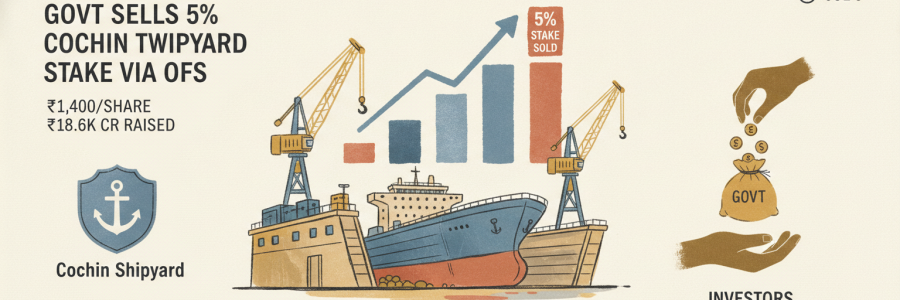
Centre launches OFS of up to 5.04% in Cochin Shipyard at a floor price of ₹1,400/share, a ~7% discount to Monday's close of ₹1,505.This is the 7th disinvestment deal in FY27, raising total proceeds to ~₹18.6K Cr, still only ~31% of the ₹80K Cr full-year target.Retail investors can bid on Jul 8. Govt retains ~63% stake post-sale, keeping majority control. Cochin Shipyard's defence and maritime order book stays intact.
How is the 5.04% stake split in this OFS?
The 5.04% has two layers: a base offer of 2.52% of paid-up equity, plus a 2.52% green-shoe option exercised only if demand exceeds the base. Institutional investors bid on Jul 7, retail on Jul 8. This structure lets DIPAM maximize proceeds if demand is strong, similar to the recent NHPC and Coal India OFS deals.
What's the green-shoe option's trigger point?
The green-shoe activates only when bids exceed the base 2.52% offer. DIPAM decides after Day 1 institutional bidding whether demand justifies releasing the additional 2.52%. In Cochin Shipyard's case, that doubles total shares sold from ~6.6Mn to ~13.3Mn. The Coal India OFS in FY27 similarly exercised its green-shoe after oversubscription.
How does OFS bidding actually clear prices?
OFS uses a price-priority auction. Bidders submit quantity and price (at or above ₹1,400 floor). After bidding closes, shares are allocated top-down from highest bid price. The final clearing price (cut-off) becomes the minimum at which all accepted bids settle. In NHPC's OFS, the cut-off was ~2% above floor, reflecting strong demand.
Why split institutional and retail into 2 days?
SEBI mandates this two-day structure for PSU OFS deals. Day 1 lets large institutions (mutual funds, insurers like LIC) set price discovery through competitive bids. Day 2 reserves at least 10% of the offer for retail investors at or below the institutional clearing price, ensuring small investors aren't crowded out by block trades.
Can six more OFS deals close a ₹55K Cr gap?
Six prior OFS deals raised ~₹18.6K Cr, averaging ~₹3.1K Cr each. At that pace, roughly 18 more deals would be needed to hit ₹80K Cr, far more than six. But the target includes ₹6.4K Cr already from asset monetisation. Larger candidates like Coal India (2% raised ₹5.5K Cr) could move the needle faster if repeated.
Which PSU sales could close the biggest chunks?
The largest remaining govt-held PSU stakes by market value include SAIL (~65% govt stake), BPCL (~53%), and Hindustan Aeronautics (~72%). A 5% BPCL OFS alone could raise ~₹6K Cr at current prices. Coal India remains repeatable since govt still holds ~60% after its recent 2% sale.
Has any year hit the full disinvestment target?
India has rarely hit disinvestment targets. In FY24, the target was ₹51K Cr but only ~₹16.5K Cr was raised. FY18 was an exception, when the govt exceeded its ₹72.5K Cr target largely through ONGC's acquisition of HPCL, a strategic sale worth ~₹37K Cr. OFS-only years consistently undershoot.
Does ₹80K Cr include strategic sales or just OFS?
The ₹80K Cr target combines disinvestment (stake sales via OFS, IPOs) and asset monetisation (leasing roads, airports, warehouses via NMP). Strategic sales, where govt transfers management control like Air India to Tata, are separate but rare. Most proceeds come from minority OFS deals that keep the PSU label intact, limiting per-deal size.
Who gains from a 7% discount floor price?
Institutional investors benefit most. The ₹1,400 floor is ~7% below the ₹1,505 market close, giving them an instant discount for large block purchases. Retail investors bidding on Jul 8 also get access at or near the floor. For Cochin Shipyard employees, dilution is minor since govt retains ~63%, preserving PSU status and job security.
Does a 7% discount signal weak demand outlook?
Not necessarily. OFS floor discounts of 5-10% are standard to attract institutional buyers committing large capital. Coal India's OFS was at ~4% discount, GIC's at ~6%. The discount compensates for liquidity risk of absorbing a large block. If clearing price rises well above ₹1,400, it signals demand was stronger than the discount implied.
How does this affect Cochin Shipyard's order book?
An OFS is a secondary sale by the promoter (govt), so Cochin Shipyard receives zero new capital from the transaction. Its ₹22K Cr order book spanning defence corvettes, autonomous vessels, and LNG-fueled ships remains unchanged. The company's capex is funded through internal accruals and debt, independent of govt stake sales.
Could employees lose PSU benefits post-sale?
No. Govt retains ~63% post-OFS, well above the 51% threshold for PSU classification. Employees keep all central govt benefits, pension eligibility, and reservation quotas. PSU status changes only upon strategic disinvestment below 51%, as happened with Air India. DIPAM has signaled no intent to reduce control below majority in Cochin Shipyard.
Source: livemint.com