economy · 2026-07-02
GST Hits ₹1.95L Cr but Imports Drive It
cca43ba5-0e40-49e1-9f0e-0de72c0f58bf
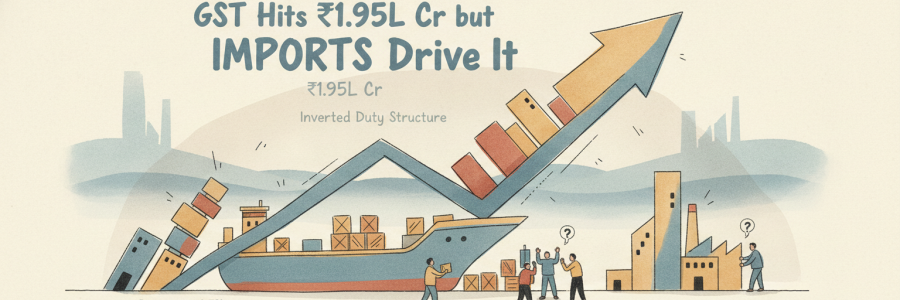
June 2026 GST revenue grew ~14% to ₹1.95L Cr, the highest growth rate in 13 months, but import taxes drove the bulk of that surge.Domestic transaction revenue grew just 6.5%, its share falling from 74% to 69% of total GST, marking 10 straight months where import growth outpaced domestic.Manufacturers face inverted duty structures, while EY and Deloitte flag that India may be importing goods it should be making domestically.
What exactly is driving the import tax surge?
Tax experts are split. EY's Saurabh Agarwal says India may be importing goods it should manufacture domestically. Deloitte's Mahesh Jaising notes rising imports of raw materials and intermediates feeding manufacturing. PwC's Pratik Jain adds that commodity price inflation has also lifted import values, making the picture muddier.
How fast did import commodity prices rise?
PwC's Pratik Jain points to broad commodity price increases inflating import values. For example, global crude, metals, and chemical input prices have climbed over the past year. When import values rise, so does the IGST collected at customs, even if physical import volumes stay flat. Price and volume effects must be separated.
Which PLI schemes have unutilised funds?
Several PLI schemes have seen slow uptake. The scheme for specialty steel, for instance, disbursed a fraction of its ₹6,322 Cr outlay by mid-2025. EY's Agarwal argues redirecting such idle funds toward sectors where imports are surging, like electronics components, could build domestic capacity and reduce the import-GST imbalance.
Are raw materials or finished goods driving it?
Deloitte's Jaising suggests raw materials and intermediates dominate, reflecting active domestic manufacturing that simply needs imported inputs. India's electronics assembly sector, for example, imports chips and display panels for final assembly. If finished goods imports were dominant instead, it would signal weak domestic production, a far more concerning pattern.
Could this import tilt signal a Make in India gap?
Import GST has grown in double digits for 16 straight months, outpacing domestic revenue for 10. Domestic collections' share dropped from 74% to 69% in one year. EY's Agarwal suggests redeploying unutilised PLI scheme funds to scale high-value manufacturing. Without that, India risks structurally depending on imports for goods it could produce.
How does the inverted structure hurt margins?
When input tax rates exceed output rates, manufacturers accumulate excess input tax credits they cannot fully offset. Refund processes are slow. A textile maker paying 18% GST on yarn but collecting 5% on fabric absorbs the gap. Over time this raises working capital needs and squeezes margins, especially for smaller firms.
Why hasn't the Sept 2025 fix worked?
The Sep 2025 rationalisation merged some rate slabs but inadvertently widened gaps in certain chains. For example, reducing finished goods rates without equally cutting input rates deepened inversions in sectors like footwear and fertilisers. Fixing this requires item-by-item calibration across thousands of HSN codes, a politically and technically complex task.
What would bringing fuel into GST change?
PwC's Jain calls ATF and natural gas "low-hanging fruit" because their revenue implications are small. Bringing ATF into GST would let airlines claim input credits on fuel, their single largest cost at ~40% of operating expenses. IndiGo alone could save hundreds of crores annually. Passenger fuels like petrol remain politically untouchable for now.
Which sectors face the inverted duty problem?
The inverted duty structure, worsened after Sep 2025 rate rationalisation, hits manufacturers whose inputs are taxed higher than finished products. BDO's Karthik Mani notes businesses also want a single pan-India GST registration instead of state-wise filings. Real estate, petroleum, and liquor remain outside GST entirely.
Who bears the cost of state-wise registration?
Pan-India companies like an e-commerce seller operating across 28 states must maintain 28 separate GST registrations, each with its own returns and audits. BDO's Mani estimates compliance costs for mid-sized firms run into ₹15-25L annually just for multi-state filings. A single registration would collapse this into one return cycle.
Could an amnesty reduce GST litigation?
BDO's Mani advocates amnesty for routine reconciliation mismatches, minor differences between buyer and seller filings caused by timing or rounding. Currently, even ₹100 discrepancies can trigger show-cause notices. Grant Thornton's Mishra notes refunds grew 28.4%, suggesting the system is improving. Amnesty would free courts and officers for genuine fraud cases.
How have GST refund timelines improved?
Grant Thornton's Mishra highlights a 28.4% rise in refunds as evidence of better taxpayer facilitation. Early GST years saw refunds take 6-12 months. Automated processing now clears many claims within 30-60 days. For exporters like pharmaceutical firms claiming zero-rated refunds, faster turnaround directly improves cash flow and reduces dependence on bridge financing.
Source: thehindu.com