business · 2026-07-10
How Meta's Cloud Play Reshapes Ambani-Adani
28ed0808-ed57-42b1-8474-8d1ab831b493
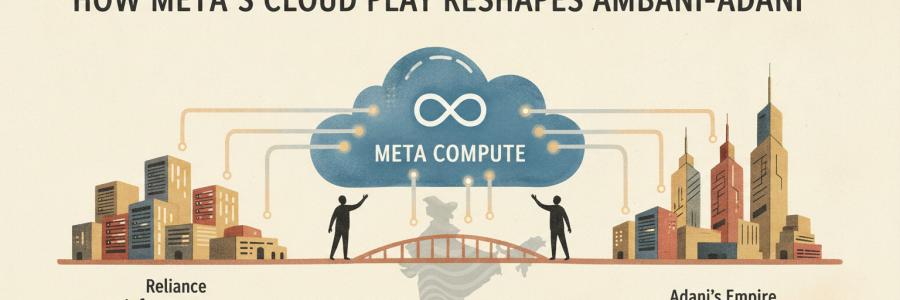
Meta plans to lease excess AI compute capacity to enterprises via 'Meta Compute,' entering the cloud market dominated by AWS, Azure, and Google Cloud.India is the first battleground because data sovereignty rules make a local Reliance-Meta joint venture attractive to regulated sectors like banking and defence.Ambani's Reliance and Adani's infrastructure empire now compete directly for hyperscale data centre dominance, reshaping India's AI infrastructure landscape.
What exactly is the Reliance-Meta deal structure?
Reliance and Meta formed a joint venture called Reliance Enterprise Intelligence, with Reliance holding 70% and Meta 30%. Their first project is a 168MW data centre in Gujarat. The structure keeps AI engines and enterprise data on Indian soil, giving Reliance operational control while Meta provides the compute technology and its Llama AI models.
Why did Meta pick Reliance over Adani?
Meta bought 9.99% of Jio in 2020 for ~$5.7Bn, establishing a prior relationship. Ambani offers both the telecom distribution network through Jio and access to its massive customer base. Adani brings physical infrastructure like power and land, but lacks Reliance's software and consumer platform layer, which Meta needs for conversational commerce via WhatsApp.
How does Adani's Google deal compare in scale?
Adani partnered with Google to build hyperscale server farms, positioning himself as infrastructure provider rather than cloud operator. His $100Bn AI compute push includes the world's largest single-location clean energy project in Gujarat. But Ambani's planned facility is reportedly 3x the size of Singapore, suggesting Reliance aims to surpass Adani's capacity if completed.
What role does Meta's Bengaluru chip team play?
Meta employs engineers in Bengaluru designing proprietary AI chips. Custom silicon reduces dependence on Nvidia and lowers per-token compute costs. In cloud economics, the chip defines margin structure. Companies like Google with its TPU chips and Amazon with Graviton processors have shown that owning chip design lets a cloud provider undercut rivals by 20-30% on specific workloads.
Could this dent AWS and Azure in India?
AWS, Azure, and Google Cloud dominate general-purpose enterprise storage. But they face regulatory friction in India's regulated sectors, where moving sensitive data to US-centric clouds triggers compliance scrutiny. The Reliance-Meta JV sidesteps this by keeping data sovereign. For banking or defence clients, that compliance shortcut could matter more than AWS's broader feature set.
What makes data sovereignty a dealbreaker?
India's RBI requires all payment data stored domestically. SEBI imposes similar rules for market data. When a bank uses AWS, it must verify data residency, audit access logs, and sometimes maintain parallel local backups. Each compliance layer adds cost and legal risk. A domestic JV eliminates this friction entirely, because the data never leaves Indian jurisdiction.
How do compliance costs compare across clouds?
A mid-sized Indian bank using AWS or Azure typically spends 15-20% of its cloud budget on compliance, including data residency audits, encryption mandates, and regulatory reporting. Reliance-Meta's JV could collapse these costs by offering a pre-certified domestic stack. For comparison, Indonesia's Bank Mandiri saved ~18% on cloud costs after switching to a locally compliant provider.
Could India mandate local AI processing next?
India's Digital Personal Data Protection Act 2023 already restricts cross-border data transfers. The govt has signaled interest in AI-specific regulation. If India mandates that AI models processing citizen data must run on domestic servers, foreign cloud providers would need to rebuild their AI inference stacks locally. This structural risk is precisely why Reliance-Meta's onshore positioning could become a regulatory moat.
Which Indian industries would switch first?
Banking and healthcare face the strictest data localization rules. RBI's 2018 directive already requires payment data stored in India. Defence contractors face even tighter restrictions. These sectors currently use on-premise servers or navigate complex compliance layers with foreign cloud providers. A domestic AI-capable cloud from Reliance-Meta offers them a simpler path.
Will WhatsApp commerce drive Meta's cloud demand?
Zuckerberg recently hired an Indian fintech leader to run WhatsApp globally, signaling intent to expand into commerce and payments. India's WhatsApp has ~500Mn users. If even 5% of small businesses adopt AI-powered digital storefronts through WhatsApp, that generates massive compute demand, which flows directly through the Reliance-Meta JV's Gujarat data centre.
How does Muse Spark differ from ChatGPT?
Muse Spark is Meta's proprietary AI engine built specifically for conversational commerce, not general-purpose chat. It handles product discovery, order processing, and customer service within messaging apps. Unlike ChatGPT, which serves broad knowledge queries, Muse Spark is optimized for transaction completion. Indian developers already experienced with Meta's Llama models can integrate it into WhatsApp-based storefronts.
Who loses if Reliance-Meta succeeds?
India's IT services giants like TCS, Infosys, and Wipro face the most structural pressure. Their business model relies on selling human labor for software tasks. If Indian enterprises can deploy AI-powered tools through a domestic Reliance-Meta cloud at lower cost than outsourced development, demand for traditional IT services contracts shrinks. The shift from labor arbitrage to compute arbitrage undermines their core economics.
Source: livemint.com