world · 2026-07-10
India, Australia Seal Uranium Deal
dfd8a97d-8ace-4e0d-b21b-4b9e0da47dd5
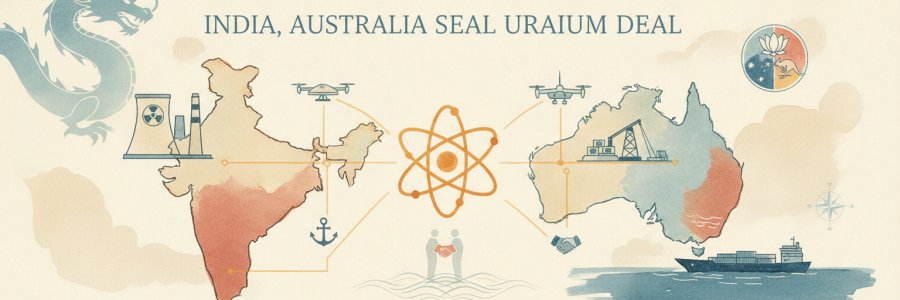
India and Australia signed 18 pacts covering uranium supply, maritime security, critical minerals, and defence cooperation during PM Modi's visit to Australia.The uranium deal, 12 years after the original nuclear pact, directly supports India's clean energy push and reduces dependence on limited fuel sources.Indian nuclear plants, defence startups, and coast guard operations gain new partnerships, while both nations counter China's Indo-Pacific expansion.
What does the uranium deal actually unlock?
The 2014 civil nuclear cooperation pact set the legal framework, but commercial uranium supply required separate terms. This new agreement lets Australia export uranium to fuel India's reactors. India operates 23 nuclear reactors producing ~8 GW. Australian uranium could help India scale toward its 22.5 GW target by 2031.
How much uranium does India currently import?
India imports uranium primarily from Kazakhstan, Canada, and Russia. Domestic production from Jaduguda mines in Jharkhand covers only ~30% of reactor needs. Adding Australia, which holds the world's largest reserves at ~1.7Mn tonnes, diversifies supply and reduces concentration risk from any single supplier.
Which Indian reactors could use Australian fuel?
Pressurized heavy water reactors like those at Tarapur and Kudankulam use imported uranium. India's 23 operational reactors span 7 sites. Australian uranium would likely feed NPCIL's fleet of PHWRs, which are designed to run on natural uranium, making Australian supply a direct technical fit.
Does this change India's nuclear capacity targets?
India targets 22.5 GW nuclear capacity by 2031, up from ~8 GW today. Secure uranium supply is a prerequisite. Without enough fuel, reactors run below capacity. NPCIL's Gorakhpur plant in Haryana, for instance, has faced delays partly due to fuel procurement uncertainty. Reliable Australian supply removes one bottleneck.
Why did this deal take 12 years to finalize?
The 2014 pact established cooperation in principle, but commercial supply terms, safeguards protocols, and pricing required prolonged negotiation. Australia, holding ~30% of global uranium reserves, had a long-standing export ban to non-NPT signatories. India's waiver from the Nuclear Suppliers Group in 2008 helped, but bilateral terms still needed years of technical and political alignment.
What specific safeguards held up the deal?
Australia requires IAEA safeguards on all exported uranium, ensuring it is used only for peaceful purposes. India's unique status outside the NPT meant bilateral verification protocols had to be custom-designed. The 2008 NSG waiver allowed trade in principle, but Australia's own Uranium Export Policy needed a country-specific amendment passed in 2014.
Could India have reached its targets without it?
Technically yes, but at higher cost and greater supply risk. Kazakhstan's Kazatomprom supplies ~40% of global uranium. Relying heavily on one or two sources leaves India exposed to price spikes or geopolitical disruptions. Australian supply adds a stable, allied-nation source, reducing procurement risk for NPCIL's expansion pipeline.
How do other uranium exporters view this deal?
Canada's Cameco and Kazakhstan's Kazatomprom already supply India. Australia's entry increases competition among exporters, potentially improving India's bargaining position on long-term contracts. For Australia, India represents a growing market. Global uranium demand is rising as countries like Japan and France restart reactors post-Fukushima.
Who beyond power plants benefits from this?
Defence startups gain access through the new India-Australia Defence Innovation Corridor, which connects firms across both countries. The Indian Coast Guard signed a cooperation agreement with Australia's Maritime Border Command for joint domain awareness. Critical minerals supply chains benefit India's EV battery and semiconductor ambitions.
What defence startups could benefit here?
The Defence Innovation Corridor links Indian firms with Australian counterparts. Indian startups like Tonbo Imaging (electro-optics) and Ideaforge (drones) could access Australian testing facilities and co-development funding. Australia's defence procurement budget exceeds A$50Bn, creating export opportunities for Indian firms with compatible technologies.
How does the maritime pact counter China?
The maritime roadmap allows expanded aircraft deployments from each other's territories and joint patrols. Australia's Cocos Islands sit near key Indian Ocean chokepoints. Combined with India's Andaman and Nicobar base, this creates a surveillance arc across sea lanes where Chinese naval activity has increased 3x since 2020.
What critical minerals does India need most?
Lithium, cobalt, and rare earths top India's list. Australia produces ~50% of global lithium. India imports nearly all its lithium, critical for EV batteries. The new critical minerals corridor aims to secure long-term supply agreements. For context, India's lithium demand is projected to grow 10x by 2030 as Tata, Ola, and others scale EV production.
Source: thehindu.com