world · 2026-07-09
India, Australia Sign Nuclear, Defence Pacts
1f710223-f40f-4dc4-bec8-7d96b5712329
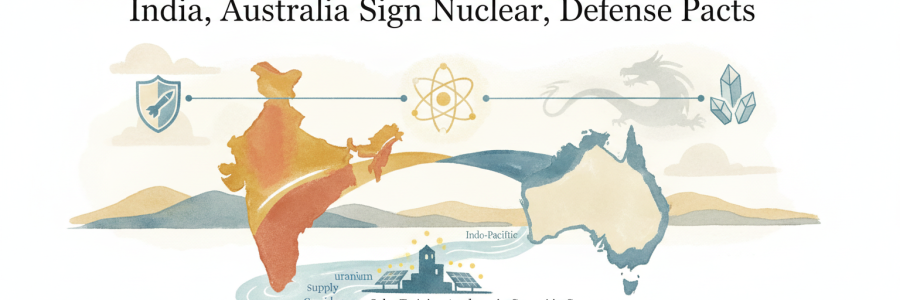
Modi and Albanese signed nuclear energy, defence, and critical minerals pacts at the third annual India-Australia Summit in Melbourne.The uranium supply deal gives India its first stable corridor from Australia, accelerating carbon-reduction goals amid rising Indo-Pacific tensions with China.Defence startups in both countries gain a new innovation corridor, while Gujarat gets a rooftop solar training academy for women and youth.
What does the uranium pact actually unlock?
Australia holds ~30% of global uranium reserves but had no formal supply agreement with India. The new pact creates a stable procurement corridor, reducing India's reliance on Kazakhstan and Canada. India operates 23 nuclear reactors and plans to triple capacity by 2031. Assured Australian uranium supply makes that expansion timeline credible.
How much uranium does India import annually?
India imports ~1,500 tonnes of uranium annually, meeting roughly half its reactor fuel needs domestically. The rest comes primarily from Kazakhstan, Canada, and Russia. Australian supply could replace or supplement these, reducing concentration risk. For context, India's 23 reactors consume about 900 tonnes per year, with the gap stockpiled for planned expansions.
Which reactors would use Australian uranium?
India's pressurized heavy water reactors (PHWRs) at sites like Kudankulam and Kakrapar can use natural uranium fuel. The planned 700 MW PHWRs under construction would be primary recipients. Australia's uranium would need to comply with India's IAEA safeguards agreement, meaning it can only fuel civilian reactors, not the military program. 10 of India's 23 reactors are under safeguards.
Could India have sourced uranium elsewhere?
Yes, but at higher cost and concentration risk. Kazakhstan supplies ~40% of global uranium. Canada's Cameco is another major seller. Both face their own geopolitical pressures. Australia's advantage is geological abundance and political alignment. Diversifying across three or more suppliers is standard practice in nuclear fuel procurement, similar to how refiners diversify crude sources.
Why sign these deals now, not a year ago?
Two forces converged. China's military assertiveness in the South China Sea intensified through 2025, and the US-Iran conflict disrupted Strait of Hormuz shipping for over four months. Both threats hit India's energy and trade routes. For example, Indian crude imports via Hormuz faced higher insurance costs. Signing now locks in supply chain alternatives before disruptions worsen.
What trade already flows under the existing ECTA?
India-Australia ECTA, signed in 2022, eliminated tariffs on 96% of Australian exports to India. Two-way trade reached ~$28Bn in FY25, up from ~$20Bn pre-ECTA. Australian wine, coal, and alumina flow in. Indian textiles, pharmaceuticals, and IT services flow out. The new CECA aims to cover services, investment, and remaining non-tariff barriers that ECTA left untouched.
Does this counter China's Pacific influence?
Directly. China operates or funds port infrastructure across the Pacific, from Hambantota in Sri Lanka to Solomon Islands. The Australia-India maritime roadmap targets joint patrols and intelligence sharing across the Indian Ocean. Australia's AUKUS submarine deal with the US and UK covers the Pacific flank. India's Quad membership covers the Indian Ocean side. Together they bracket China's maritime expansion routes.
How does Hormuz disruption change the calculus?
Over 4.5 months of Hormuz disruption raised insurance premiums for Indian tankers by 30 to 50%. India imports ~85% of its crude oil, with ~60% transiting Hormuz. The disruption made alternative energy sources, including nuclear, strategically urgent. A single blocked week at Hormuz costs Indian refiners like IOC and BPCL roughly $500Mn in spot-market premiums and rerouting delays.
Which Indian defence startups stand to gain?
The Defence Innovation Corridor connects Indian startups like Tonbo Imaging and ideaForge with Australian counterparts. Shipbuilding firms such as Mazagon Dock could benefit from joint repair and maintenance contracts. The Gujarat rooftop solar academy under PM Surya Ghar Yojana targets women and youth, creating a trained installer workforce for India's 10Mn rooftop solar target.
What will the solar academy in Gujarat do?
The academy trains women and youth to install and maintain rooftop solar panels under PM Surya Ghar Yojana. India targets 10Mn rooftop installations. The bottleneck is not panels but trained installers. Gujarat was chosen because it already leads Indian states in rooftop solar capacity at ~4.5 GW. Similar models in Germany's Solar Academy produced 50K certified technicians over a decade.
How does the defence corridor actually work?
The corridor creates a formal channel for co-development. Indian defence startups pitch technology, Australian firms contribute testing infrastructure and market access. For example, ideaForge's surveillance drones could be adapted for Australian border patrol. Revenue sharing and IP frameworks are negotiated bilaterally. India's defence production policy already allows 100% FDI, so Australian firms can invest directly in Indian manufacturing.
Could PACTS reduce India's chip import bill?
India's semiconductor imports exceed $10Bn annually. PACTS targets joint R&D in chip design and supply chain diversification away from Taiwan and China. Australia's rare earth deposits, like Lynas's Mount Weld mine producing ~10K tonnes of rare earth oxides annually, feed chip manufacturing. If India can process these domestically at facilities like the planned Dholera fab, the import bill could drop by 15 to 20% over a decade.
Source: indianexpress.com