business · 2026-06-20
India Commissions 3 Homegrown Warships
2803c7b4-1b00-436a-a632-0b4aaf589c8c
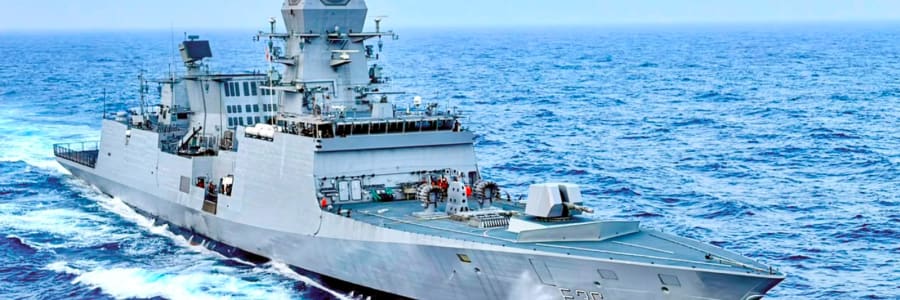
PM Modi will commission three indigenously built naval ships in Kolkata on Jun 21: stealth frigate Dunagiri, survey vessel Sanshodhak, and anti-submarine craft AgrayDunagiri is the fifth Project 17A stealth frigate, equipped with BrahMos missiles and medium-range surface-to-air missile systemsAll three platforms are built domestically, signaling India's push to reduce dependence on foreign defence imports
Why does India build frigates domestically?
India's defence policy requires self-reliance in critical platforms. Importing a stealth frigate like Dunagiri would cost more and create foreign dependency. By building at GRSE (Kolkata) and MDL (Mumbai), India retains design IP, keeps ~₹20K Cr in domestic shipyards, and builds exportable capability over time.
What makes Project 17A stealthy?
Project 17A frigates use a hull shape that minimizes radar cross-section, making them harder to detect. Superstructure angles deflect radar waves. Compared to older Shivalik-class ships, the 17A design reduces radar signature significantly. Infrared suppression in exhaust systems further lowers visibility to heat-seeking sensors.
Why build at GRSE instead of importing?
GRSE in Kolkata has built warships since the 1960s. Domestic construction keeps ~60% of project cost within India versus ~15% retained when importing. It also means India controls maintenance timelines. France's Rafale jets, by contrast, require foreign vendor support for major overhauls, creating supply chain vulnerability.
How does BrahMos boost these frigates?
BrahMos is a supersonic cruise missile with ~290 km range, developed jointly with Russia. It can strike naval targets at Mach 2.8, giving the frigate a standoff attack capability most regional navies lack. India has exported BrahMos to the Philippines, making it both a tactical weapon and a defence export asset.
What do these ships mean for Indian yards?
Commissioning three ships simultaneously signals growing capacity at Indian shipyards like Garden Reach Shipbuilders (GRSE). Each vessel generates thousands of ancillary jobs. GRSE's order book has grown ~3x in the last decade, and sustained naval orders help it compete for export contracts in Southeast Asia and Africa.
Which Indian shipyards benefit most?
GRSE and MDL split the 7-frigate order. GRSE builds 3 hulls, MDL builds 4. GRSE's revenue crossed ~₹3.8K Cr in FY24, with naval orders comprising over 80% of its backlog. Cochin Shipyard also benefits indirectly through component supply chains and technology transfer from these programs.
Could these ships boost defence exports?
India exported BrahMos missiles to the Philippines in 2022 and is in talks with Vietnam and Indonesia. Domestically built frigates demonstrate platform integration capability. If India can offer a full package, frigate plus BrahMos, it competes with South Korea and Turkey in the ~$500Mn corvette-frigate export segment.
What jobs do naval orders create?
A single frigate project generates ~5K direct jobs at the shipyard plus thousands more across ~100 ancillary suppliers. GRSE alone employs ~3.5K workers. Similar to Gujarat's Pipavav shipyard, which created 200+ ancillary businesses over a decade, sustained naval orders anchor entire industrial clusters around the yard.
How many Project 17A frigates are done now?
Dunagiri is the 5th of 7 planned Project 17A frigates. 4 are built at MDL Mumbai, 3 at GRSE Kolkata. With 5 now commissioned, India is on track to complete the full class by ~2028. For comparison, the older Shivalik-class had only 3 frigates. The 17A program nearly doubles India's modern frigate fleet.
How many ships has India built recently?
India commissioned aircraft carrier INS Vikrant in 2022 and has launched multiple corvettes and destroyers since 2020. The Navy currently operates ~130 ships and aims for 170 by 2035. Commissioning 3 ships in a single ceremony is rare, signaling that production timelines at GRSE and MDL are accelerating.
What share of defence gear is now local?
India's domestic defence procurement share crossed ~68% in FY24, up from ~54% five years earlier. The govt targets 75% by 2025. Naval platforms are a key driver. For context, India still imports ~90% of submarine propulsion systems, so self-reliance varies sharply across categories.
How does India compare to top builders?
India builds fewer than 1 in 100 large commercial vessels globally. But in military shipbuilding, it ranks among the top 10 nations. South Korea and China dominate commercial shipping. India's strength is mid-size warships. The 17A program positions India closer to Turkey and South Korea in the frigate export market.
Source: indianexpress.com