world · 2026-11-24
India pledges $1.6 billion to help Nepal rebuild after floods
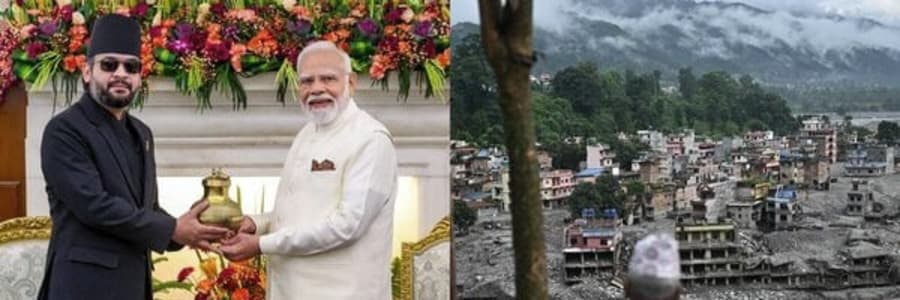
Photo: via mint
India announced a $1.62 billion aid package to help Nepal recover from deadly floods. That covers only about a third of the damage, leaving a big rebuilding gap as India and China compete for influence.
How much damage did the floods cause in Nepal?
Nepal's government estimated the floods caused $4.7 billion in losses. A separate damage assessment put rebuilding costs at around $4.78 billion, roughly 723.67 billion Nepali rupees. The August 26 floods killed more than 1,500 people, left over 5,200 missing, and destroyed about 7,570 houses. India's $1.62 billion package covers about a third of the estimated damage.
How many people were affected by the floods?
The Red Cross estimated more than 93,000 people were affected, while Nepal's disaster agency NDRRMA said 1.6 million people were affected across five districts. In the two worst-hit rural municipalities in Rasuwa district, 3,702 households (14,461 people) remained isolated, with roads, electricity and communication cut for up to six days. The Nepali army treated 2,740 people for injuries.
Who are the missing and where were they from?
By 5 October, 5,285 people were missing in Nepal, including 650 foreign nationals from 38 countries. Among them were 189 Indians, 188 Nepali tourists, 65 Americans, 55 Malaysians, 54 Ukrainians, 37 Chinese, 33 Australians, 33 Latvians, 32 British and 30 Canadians. A group of 77 Isha Foundation pilgrims from 19 nationalities were at Gyirong Port, and 9 South Koreans working at a hydropower site were missing.
How were rescuers searching the tunnels?
At the Upper Trishuli 3A Hydropower Station tunnel, rescuers carried out a controlled explosion on 31 August to reach 933 missing workers. The Nepali Army dug a 10-metre-deep hole with two excavators to clear water and mud. Two survivors were pulled out on 4 September, and a Chinese national the next day. Drones searched tunnels, and students from Pulchowk Campus built an automated debris-removal machine. Nepal ended formal search on 5 October.
Why is identifying bodies so hard in Nepal?
Nepal has little experience processing DNA at such scale, and a lack of cold storage forced authorities to temporarily bury many unidentified bodies, a practice some families said disregarded Hindu funeral rites. The government sought DNA-testing help from the US, Disaster Victim Identification support from Singapore, and high-capacity equipment from China. India sent an 18-member forensic team. Families abroad had to undergo DNA profiling and email results to police, a slow process.
How many bodies are still unidentified?
As of 1 October, only 112 bodies had been identified. By 26 September, 1,044 bodies had been buried, 1,334 bodies had DNA sampled, and 2,060 people had DNA sampled. No published count splits out how many bodies remain unidentified or unclaimed. Under Nepal's Civil Code, missing persons are usually presumed dead only after 12 years, though relatives of disaster victims can seek an earlier judicial declaration of death.
Why are so many foreigners still missing?
Many foreigners were swept away at border crossings, hydropower sites and tourist routes when the flash flood hit without warning. A week after the floods, Nepal's Foreign Ministry said 324 foreign nationals had been rescued and about 590 from 39 countries were still missing. Some later made contact, including five tourists who emailed or called authorities. Identifying bodies is slow: more than 1,400 bodies had been recovered, and Nepal has little experience processing DNA at this scale.
What help are families of the missing getting?
The government said it would pay 15,000 Nepali rupees per month to families whose homes were damaged, and the Nepal Electricity Administration pledged 50,000 rupees plus a subsistence allowance to families of missing employees. Authorities used DNA testing and photographs, uploading body photos into a public online database for families to search. Some families, unable to recover remains, held symbolic funerals using effigies made of kusha grass.
What exactly is in India's aid package?
India's package is 24,000 crore Nepali rupees ($1.62 billion). It breaks into a 5,600 crore rupee grant for rebuilding roads, bridges and other infrastructure, plus an 18,400 crore rupee line of credit, a loan Nepal must repay, for energy projects. That loan is rupee-denominated, so Nepal borrows in Indian currency, not dollars.
Why is India giving aid as both a loan and a grant?
India's package pairs a $377 million grant for post-disaster reconstruction with a $1.24 billion line of credit for energy projects. The grant meets urgent rebuilding needs, while the rupee-denominated loan backs longer-term development and strengthens ties with Nepal, where India competes with China for influence. The split was announced in a joint statement.
How does this aid compare to India's earlier flood aid to Nepal?
No published figures cover India's earlier flood aid to Nepal, so a direct comparison is not possible. Al Jazeera called Monday's $1.62 billion package one of India's largest-ever relief commitments. The announcement came during the new Nepali prime minister's first bilateral trip abroad.
What conditions are attached to the line of credit for energy projects?
The joint press release does not specify any conditions on the rupee-denominated line of credit of INR 11,500 crores (NPR 18,400 crores) for energy projects. It says specific projects and modalities will be finalized through mutual consultations.
How does China's role affect India's aid decision?
China has invested in Nepali airports, highways and hydropower in recent years, and Nepal has leaned toward Beijing at times. India is Nepal's largest trading partner, supplying over 60% of its imports. Monday's package, announced during the new Nepali prime minister's first trip abroad, signals Delhi remains the indispensable neighbour, with the loan portion kept in rupees rather than dollars.
Why did India pledge such a large aid package?
Al Jazeera reports the package comes as New Delhi boosts ties with Nepal, where it competes with China for influence. The announcement followed talks between India’s PM Modi and Nepal’s PM Shah, who was on his first bilateral trip abroad since taking office. China has expanded its presence in Nepal with investments in airports, highways and hydropower, though landlocked Nepal still depends heavily on India for fuel and other essentials. India also imports around 1,200 MW of electricity from Nepal.
How much has China invested in Nepal?
According to an ORF analysis, Nepal received US$4.5 billion in Chinese investments, grants, and loan packages between 2000 and 2017, including pledges that have not all materialised. This is less than what India, Bhutan, and the Maldives received in the same period. The Associated Press reports China has invested in airports, highways and hydropower projects, but gives no newer amounts. No recent totals are published in the sources.
Are any of China's BRI projects in Nepal completed?
As of June 2024, none of the nine projects under China's Belt and Road Initiative in Nepal have been completed, according to ORF. Two hydropower projects were handed to Indian companies. The Madan Bhandari university was built with Nepal's own money. China's promise to build the Budhi Gandaki Hydropower Project also remains unfulfilled, with the project suspended.
Why have China's BRI projects in Nepal stalled?
ORF analysts attribute the delays to political instability: the party in power decides which projects proceed, causing frequent changes. Nepal sought more grants instead of loans, and China's lending conditions were seen as opaque with high interest rates. Some projects were handed to Indian firms, and terrain and financing issues stalled others, like the Budhi Gandaki hydropower project. A CSEP expert, Austin Lord, says that project has remained suspended due to COVID-19, political contestation, and poor communication with the Chinese contractor.
How has India's influence changed China's projects?
India's influence has directly slowed Chinese BRI projects in Nepal. Analysts note both Phukot Karnali and Tamor hydropower projects were handed to Indian companies, and the Kathmandu/Terai Madhesh Fast Track Road remains in limbo. India's 2018 decision to bar electricity imports from firms with any Chinese investment deterred such projects. Political rivalry with India also factored into Nepal's pivot to China in 2016, but India's pushback has stoked delays.
Will India's aid package slow Chinese projects further?
Sources do not say whether India's aid package will affect Chinese BRI projects. They show BRI projects are already slowed by political instability and India's influence, including India's 2018 decision not to import electricity from companies with any Chinese investment. An analyst from Griffith University expects Chinese BRI engagement to reach lower levels in 2026 with fewer megadeals, but does not link this to India's aid.
Source: livemint.com