world · 2026-07-06
India Revives Chabahar Rail as Iran Thaws
251048de-07f2-4bcd-9e39-47971cc1611d
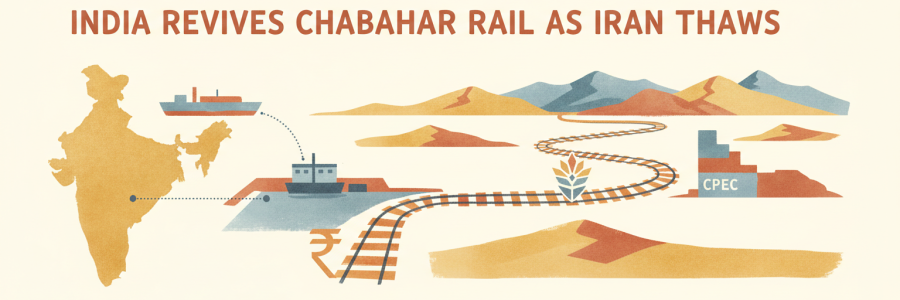
India plans to fast-track a 700km rail link from Iran's Chabahar port to Zahedan, investing $400-500Mn to bypass Pakistan and reach Central Asia.With US sanctions lifting, Iranian crude could return to India after a 7-year gap, and the rail link would cut shipping costs versus traditional sea routes.Indian exporters gain a land route to Afghanistan and Central Asia, while Iran gets port traffic and funding. Pakistan's CPEC corridor loses a potential competitor's dependence.
What exactly will India's $400-500Mn fund?
India's investment covers both Chabahar port expansion and partial funding of the 700km rail line to Zahedan. The total project costs ~$1.5Bn, with Iran funding the majority. Indian Railways' Ircon signed an MOU with Iran's CDTIC in 2016, but actual construction barely progressed. India now aims to deploy engineering expertise alongside capital.
How does Ircon plan to build in Iran?
Ircon, a govt-owned rail construction firm, has built projects in Malaysia, Bangladesh, and Sri Lanka. In Iran, it would likely deploy Indian engineers with local subcontractors. The 2016 MOU envisioned technology transfer for track-laying and signalling. Desert terrain between Chabahar and Zahedan poses engineering challenges similar to Rajasthan's rail corridors.
What cargo volumes justify this investment?
At 200K TEUs in FY25, Chabahar was near its 100K-TEU quarterly capacity before disruptions. A rail link dramatically lowers per-container costs versus trucking. For comparison, Pakistan's Gwadar handles under 50K TEUs annually. Reaching 500K TEUs annually would likely make the rail line commercially viable based on comparable Iranian rail freight economics.
How does this connect to the INSTC route?
The INSTC is a 7,200km multimodal corridor linking Mumbai to St. Petersburg via Iran, Azerbaijan, and Russia. Chabahar is its southern anchor. Without the Zahedan rail link, cargo must be trucked 700km to reach Iran's national rail grid. Once connected, Indian goods could reach Moscow in roughly 25 days versus 40 by sea through Suez.
Why did this rail project stall for a decade?
US sanctions on Iran, imposed after 2018, froze most cooperation. Indian firms like Ircon couldn't move forward without risking secondary sanctions. The West Asia conflict starting late Feb 2026 further disrupted Chabahar operations just as cargo volumes were recovering. The recent US-Iran peace deal removing sanctions has reopened the window.
Could sanctions snap back and strand this?
US sanctions have historically been reimposed quickly. The Iran nuclear deal collapsed in 2018 after just 3 years. India's investment structure likely includes safeguards. India negotiated a specific Chabahar exemption even during peak sanctions in 2019, suggesting both sides treat this port differently from broader Iran trade.
What makes this cheaper than sea routes?
Sea freight from Mumbai to Central Asia requires routing through Suez, then overland from a Mediterranean port, taking ~45 days. Chabahar plus rail cuts transit to ~15 days. Shipping a container via Chabahar-Zahedan costs roughly 30% less than the Suez alternative, per Indian shipping ministry estimates. Shorter routes also mean lower insurance premiums.
How did Chabahar work before the war?
India Ports Global Ltd operated Chabahar's Shahid Beheshti terminal from 2018. By FY24, it handled wheat shipments to Afghanistan and iron ore imports. Container volumes grew 3x between FY20 and FY24. The US-Israel strikes on Iran in late Feb 2026 halted operations abruptly. Before that disruption, the port was approaching full quarterly capacity.
Which Indian exporters gain from this route?
Indian wheat, rice, and iron ore exporters targeting Afghanistan and Turkmenistan would bypass Pakistan entirely. For example, Chabahar handled 200K TEUs in FY25, mostly Indian cargo. Central Asian nations currently reliant on Russian or Chinese routes gain an alternative. Pakistan's Gwadar port, backed by China, faces a competing corridor.
Who in Central Asia trades with India now?
Uzbekistan and Kazakhstan are India's largest Central Asian trade partners, with bilateral trade around $3Bn combined. India exports pharmaceuticals, tea, and textiles. Currently most goods travel via Iran's Bandar Abbas or through Russia. The Chabahar-Zahedan rail would cut transit times for Uzbek cotton and Kazakh minerals heading to Indian ports.
Does Pakistan lose transit fee revenue?
Pakistan currently earns transit fees on Afghan-bound cargo through Karachi and Peshawar routes. Afghanistan shifted significant wheat imports to Chabahar after Pakistan periodically closed the Torkham border crossing. If Chabahar rail becomes operational, Pakistan's leverage over Afghan trade diminishes, though Karachi remains closer to Kabul for some goods.
Could China's BRI counter this corridor?
China's Belt and Road includes the China-Pakistan Economic Corridor linking Kashgar to Gwadar port. However, Gwadar has underperformed, handling minimal cargo versus projections. China also invested in Iran's rail network separately. India's Chabahar corridor competes directly with CPEC for Afghan and Central Asian trade, creating parallel infrastructure that reduces Chinese monopoly over regional connectivity.
Source: livemint.com