world · 2026-10-26
India, Russia eye $100 bn trade despite big gap
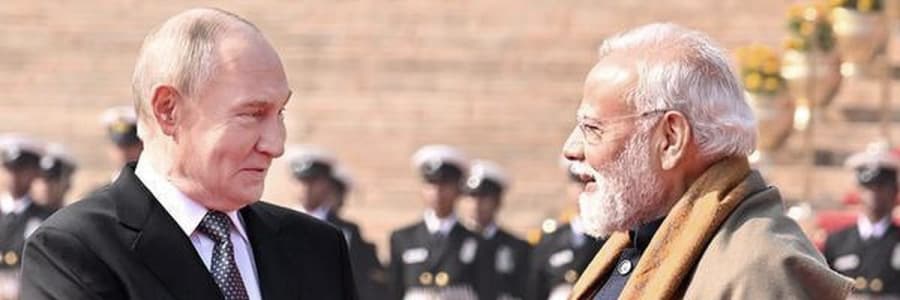
Photo: via The Hindu
India and Russia want trade to hit $100 billion by 2030, up from about $76 billion. The challenge: India sells far less than it buys. Russia must find ways to pay for more Indian goods.
Did Modi and Putin actually agree on anything in Delhi?
Yes on procedure, not on new trade terms. On the BRICS summit's sidelines in Delhi on September 12-13, Modi and Putin directed ministries to expand cooperation, said India's envoy Vinay Kumar. They had already set the $100 billion trade and $50 billion investment targets by 2030 in July 2024. Delhi reaffirmed those, with concrete steps limited to a shared business summit and an industrial exhibition.
How did Russia jump from 31st to 4th among India's trade partners?
The Ukraine war and Western sanctions did it. Russia, cut off from European buyers, began selling discounted crude oil to India. Before 2022, Russia was India's 26th-largest trade partner. By 2024-25 it was among the top five, with trade up 816 percent since 2021-22. India's imports are now mostly oil, which explains the huge trade deficit.
What would actually need to happen for India's exports to Russia to grow?
India has identified about 300 products, but faces high Russian tariffs, certification delays and logistics costs. It is negotiating a free-trade agreement with the Eurasian Economic Union (a bloc led by Russia) and new transport corridors like the Chennai-Vladivostok route to cut shipping distances. Our read: the FTA's fate is the decisive test, it will show whether Russia will genuinely open its market.
How realistic is the $100 billion trade target by 2030?
Modest. Trade hit about $76 billion in 2024-25, but India's exports were only $4.9 billion versus $63.8 billion in imports, mostly discounted crude oil. Progress is slowing, with first-half 2026 trade at $38 billion. To reach $100 billion, India must sharply raise non-oil exports, meaning Russia must open its market to Indian goods via lower tariffs and faster logistics corridors. That remains a large, unresolved task.
Why does Russia want more Indian goods when it already runs a huge surplus?
Russia's surplus is mostly oil money, and that leaves it exposed. The West has sanctioned Russian banks and energy, cutting it off from many European buyers. India is one of the few large economies still trading at scale, and Russia now relies on it as a steady customer for oil and fertilisers. But oil prices fall, as they did in 2025 when bilateral trade dropped 11 percent in the first three quarters. Diversifying into Indian pharmaceuticals, electronics and machinery gives Russia a more stable, less commodity-driven trade relationship it can count on. Our read: Russia needs the $100 billion target as much as India does, because it makes the partnership durable beyond oil.
Can Russia's banks actually pay for more Indian goods?
The FTA with the Eurasian Economic Union is under negotiation, but Russia's banks face Western sanctions that complicate payments. To ease this, India and Russia have been working on strengthening rupee-rouble payment mechanisms, as Prime Minister Modi emphasized at the India-Russia Business Forum. Indian Finance Minister Nirmala Sitharaman has also pushed for rupee trade settlement to help partners facing hard currency shortages. Our read: the payment system is the practical bottleneck, and it will decide whether the $100 billion target moves beyond oil purchases.
What are Russia's own reasons to lower its barriers to Indian goods?
Russia's imports are worth about $208 billion a year, and its own analysts say India accounts for only 1.7% of that. Moscow buys most from China, Kazakhstan and Turkey, a dependence it has reason to dilute. India now supplies rising categories like pharmaceuticals, telecom equipment and electronics to Russia, which faces Western sanctions and needs suppliers it can rely on. Our read: Russia's interest in diversifying its own supply chain is what makes it willing to open its market to India, not just the $100 billion target.
Does Russia actually need India as a supplier, or is it just a convenient buyer?
Russia's dependence runs both ways. It needs India as a steady customer for its oil and fertilisers, but it also needs Indian suppliers for goods it can no longer easily buy from the West due to sanctions. Russia's own analysts note its imports total about $208 billion a year, with India accounting for only 1.7 percent, while China supplies over half. India now provides rising categories like pharmaceuticals, telecom equipment and electronics, which Russia cannot source openly from Europe or the US. Our read: Russia's need for reliable non-Western suppliers is what makes it willing to open its market to India, not just the trade target.
Who else watches how far India and Russia go together?
The United States and the European Union are watching closely. India is in sensitive trade negotiations with both, and hosting President Putin while US tariffs on Indian goods take effect is a balancing act. The US and EU could view deeper India-Russia ties as a reason to slow progress on their own deals with New Delhi. Russia, for its part, sees India as one of the few large economies willing to trade despite Western sanctions, making the partnership strategically valuable beyond commerce.
How does India plan to raise exports to Russia from such a low base?
India's exports to Russia are tiny, about $4.9 billion in 2024-25 versus $63.8 billion in imports, mostly oil. To fix this, New Delhi identified around 300 products in engineering, pharmaceuticals, agriculture and chemicals for promotion. It is also tackling Russia's high tariffs, certification delays and costly logistics, while negotiating a free-trade agreement with the Eurasian Economic Union to open the market.
Why would Russia open its market to Indian goods at all?
Russia's main trade partner is China, which supplied about 55% of its imports in 2024, and Moscow wants to reduce that dependence. India's export basket now includes pharmaceuticals, electronics and machinery that Russia needs, and bilateral trade is diversifying beyond oil. Our read: Russia will bargain hardest on the FTA because opening to India is its cheapest way to lessen Chinese leverage without losing a major buyer of its oil.
How does the $100 bn trade goal hold up if Russia's oil demand falls?
The target rests on oil. Crude and fuels are Russia's main exports to India, and when global oil prices fell, bilateral trade in early 2025 dropped about 11% from the same period of 2024, with the shortfall only partly recovered by year-end. The deficit, over $58 billion in 2024-25, grows or shrinks with oil prices. The leaders' goal assumes sustained oil purchases alongside the export push. Our read: a price shock, not a political one, is the likeliest way the $100 billion mark slips.
What does Russia gain by opening up to India beyond cutting China's leverage?
Russia's imports, about $208 billion in 2024, are dominated by China at 55 percent. India offers a large market for Russian oil and fertilisers, but Moscow also needs machinery, auto parts, and pharmaceuticals, which India exports. Russia's stated goal is to reduce dependence on any single supplier. Our read: Russia will trade market access for political autonomy, using India as a hedge against Chinese dominance in its economy.
What does Russia give up by opening its market to India?
Russia's imports total about $208 billion, and its stated goal is to reduce dependence on any single supplier, with China at 55 percent. Opening to India means shifting some of that import share toward a new partner, which dilutes China's leverage. The trade-off for Russia is accepting Indian goods in sectors where it has alternatives. Our read: Russia's willingness to offer market access in an FTA is a direct measure of how much it values reducing Chinese dominance over its economy.
Can India pay for Russian oil without dollars?
India and Russia are working on rupee-rouble payment mechanisms to bypass US sanctions and dollar-based trade. The push is to settle transactions in national currencies, which would reduce pressure on India's foreign exchange reserves. However, the mechanism has limits: Russia needs to spend those rupees on Indian goods, but India's exports are only about one-thirteenth of its imports, leaving a large rupee surplus that Russia must hold or reinvest. Our read: the payment mechanism is not a workaround but a hostage to the trade imbalance — Russia cannot accept rupees it cannot use, so the FTA and export push are what make the currency arrangement viable.
If Russia opens up, will Indian firms actually fill the gap left by China?
The evidence does not say India will automatically take China's place. Even after five years of rapid growth, India accounted for only 1.7% of Russia's imports in 2024, while China held 55%. Russia's import demand is concentrated in machinery, auto parts and electrical equipment, areas where China is deeply entrenched. India's exports there are growing but from a tiny base. Our read: Moscow is testing India as a hedge, not a replacement, and the FTA will decide whether Indian firms get the tariff advantage needed to compete seriously.
What is India risking by pushing closer trade with Russia?
India is courting Russia while the US and EU have sanctioned it and while talks on an India-EU trade deal are still unfinished. A red-carpet summit for Vladimir Putin risks irritating Washington and Brussels, and could slow those negotiations. India sees the Russia trade as a way to cushion US tariff shocks on its textiles and other exports, but the balancing act is delicate.
Source: thehindu.com