politics · 2026-07-11
India to Fence Myanmar Border for ₹31K Cr
e627be55-62d3-4a33-957f-5cc7dca33bfe
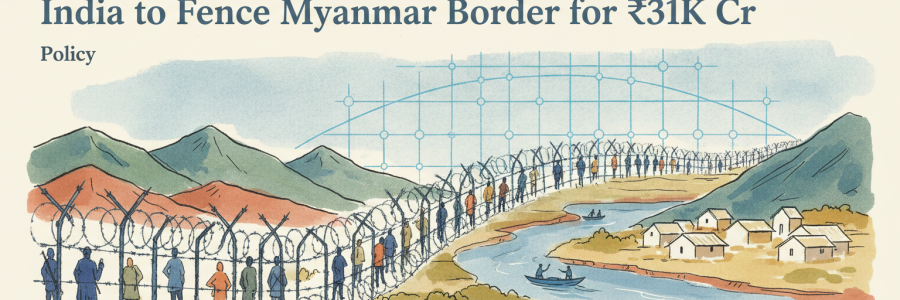
Amit Shah announced fencing of the entire 1,610 km India-Myanmar border at a cost of ₹31K Cr, calling it part of a smart border vision.This is India's first full-length fencing of the Myanmar border, aiming to curb infiltration, narcotics trafficking, and what Shah called unnatural demographic changes.Border district communities, state administrations, and border guarding forces like Assam Rifles face a shift from isolated outposts to an integrated security grid.
What does fencing 1,610 km actually involve?
The project covers India's entire Myanmar border across four northeastern states: Mizoram, Manipur, Nagaland, and Arunachal Pradesh. At ₹31K Cr for 1,610 km, the cost works out to roughly ₹19 Cr/km. Shah described it as part of a smart border system integrating surveillance tech, not just physical barriers. For comparison, the India-Bangladesh border fence cost roughly ₹4-5 Cr/km, suggesting the Myanmar fence includes advanced sensors and terrain-adapted engineering.
How does smart fencing differ from a wall?
Smart fencing uses a layered system: physical barriers, CCTV cameras, thermal sensors, radar, and fiber-optic intrusion detection cables. On the India-Bangladesh border, the BSF's CIBMS (Comprehensive Integrated Border Management System) pilot in Dhubri, Assam, demonstrated this model. Unlike a solid wall, smart fencing can adapt to rivers, hills, and forests where rigid structures are impractical.
What terrain challenges exist on this border?
The India-Myanmar border runs through dense tropical forests, steep mountain ridges exceeding 3,000 m elevation, and fast-flowing rivers in the northeast. Mizoram's section alone has ridgeline terrain where conventional fencing is nearly impossible. Engineers must build access roads before laying fence, a challenge that delayed even the India-Bangladesh project in the Sundarbans riverine stretches.
How does ₹19 Cr/km compare to other borders?
India-Bangladesh fencing cost ₹4-5 Cr/km on mostly flat terrain. The India-Pakistan border fence in Rajasthan's desert cost roughly ₹8-10 Cr/km. At ₹19 Cr/km, the Myanmar border project reflects mountainous terrain, smart-tech integration, and remote logistics. Israel's West Bank barrier cost roughly $2Mn/km (about ₹17 Cr/km at current rates), a comparable figure for tech-heavy fencing.
Why fence the Myanmar border now?
The India-Myanmar border has long operated under a Free Movement Regime allowing border communities to cross 16 km into either country without visas. India suspended this regime in 2024 amid concerns about drug trafficking and insurgent movement, particularly through Manipur and Mizoram. The Manipur ethnic violence since 2023 intensified pressure to seal this border. Narcotics worth thousands of crores flow through this corridor annually, with Moreh in Manipur being a key transit point.
What was the Free Movement Regime exactly?
The Free Movement Regime, established in 2018 as a formal policy, allowed people living within 16 km of the border to cross freely with a one-day border pass. It recognized that ethnic communities like the Nagas and Chin-Kuki-Zo predated the political border. India suspended it in Feb 2024, citing security concerns after Manipur's ethnic violence. Myanmar's military junta also complicated bilateral border management.
How severe is the narcotics corridor here?
The northeast India-Myanmar corridor is a major transit route for heroin, methamphetamine, and yaba tablets originating from Myanmar's Shan State, one of the world's largest drug-producing regions. In 2023-24, Assam Rifles and Manipur Police seized narcotics worth over ₹2,500 Cr along this border. Moreh town in Manipur is the primary entry point, functioning as a gateway for Golden Triangle drugs into South Asia.
Could fencing actually stop cross-border flow?
Physical fencing alone has limited effectiveness on porous, mountainous terrain. On the India-Bangladesh border, despite 3,000+ km of fencing, BSF still reports hundreds of infiltration attempts annually through unfenced riverine gaps. Tunnels are common on the India-Pakistan border despite heavy fencing. Effectiveness depends on patrols, surveillance tech, and intelligence networks working together, which is why Shah emphasized a quadrangular security grid rather than fencing alone.
Who in the border states is affected most?
Communities in Mizoram and Manipur have deep ethnic and familial ties across the border. The Chin-Kuki-Zo peoples, for instance, live on both sides. Fencing would disrupt daily cross-border trade and movement that sustained border villages for decades. Assam Rifles, the primary border guarding force here, shifts from patrolling remote outposts to managing an integrated grid. State govts must coordinate land acquisition across difficult hilly terrain.
Which border communities lose cross-border ties?
The Chin-Kuki-Zo community, spanning Manipur's Churachandpur district and Myanmar's Chin State, has the deepest cross-border ties. Families attend weddings, funerals, and church services across the border regularly. Naga tribes in Nagaland share similar transborder kinship with Myanmar's Sagaing Region. Fencing effectively partitions communities whose social unit predates the 1947 border by centuries.
How will Assam Rifles' role change?
Assam Rifles currently operates as the primary border guarding force on the Myanmar frontier, running small, scattered outposts in remote hill terrain. The shift to an integrated security grid means consolidating into networked command centers with real-time surveillance feeds. This mirrors BSF's CIBMS transition on the Bangladesh border, where the Dhubri sector moved from foot patrols to sensor-monitored corridors.
What is the Demography Mission Shah mentioned?
The Demography Mission, announced by Shah, will study population changes in border districts, identify what the govt calls abnormal growth patterns, and recommend countermeasures. It targets districts in Assam, West Bengal, and the northeast where the govt claims demographic shifts driven by illegal migration. Critics, including opposition parties, argue the mission risks profiling specific religious communities, noting that border-district population data is often shaped by economic migration, not infiltration alone.
Source: indianexpress.com