politics · 2026-07-05
India-UK Trade Pact Rules Kick In Jul 15
6bccdb8d-27e2-4458-9b39-2ebc71c08b08
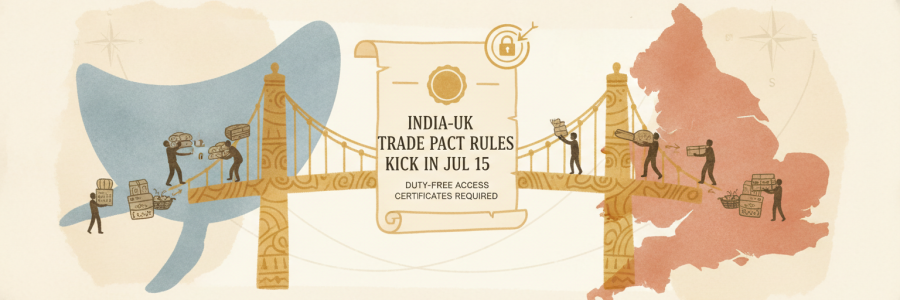
Finance Ministry notified rules of origin for goods under the India-UK CETA, effective Jul 15, requiring certificates to claim duty-free access.Without these rules, third-country goods could exploit preferential tariffs meant only for Indian and UK manufacturers, undermining the pact's integrity.Labour-intensive exporters in textiles, leather, footwear, gems, and marine products stand to gain duty-free access to 99% of UK's tariff lines.
What do the new origin rules require exactly?
Exporters must obtain a certificate of origin from authorised entities proving goods were genuinely manufactured or substantially transformed in India. CBIC's notification specifies that both India and the UK designate bodies to issue these certificates. Without one, exporters cannot claim preferential tariffs even if goods qualify.
How is 'origin' actually determined for goods?
Origin is typically set by a value-addition threshold, often 35-40% of the product's value must be added domestically. For textiles, rules may require yarn-forward processing in India. A Surat exporter shipping fabric woven from Indian cotton clears the bar. One merely stitching imported Chinese cloth likely does not.
Do these rules differ from India's ASEAN pact?
India's ASEAN origin rules were widely criticized for lax enforcement, allowing steel and electronics to be routed via Vietnam. CETA's framework appears stricter, requiring authorized certifiers designated by both govts. The UK's post-Brexit trade regime also imposes tighter verification than older multilateral pacts India joined.
What happens if a certificate is found fake?
If a UK customs authority finds a fraudulent certificate, the importing country can deny tariff benefits and impose full duties retroactively. In extreme cases, exporters face blacklisting. India's DGFT has previously suspended origin-certificate privileges for firms caught misusing ASEAN and Korea FTA routes.
Why can't exporters just claim benefits freely?
Trade agreements grant lower tariffs only to partner-country goods. Without origin rules, a Chinese manufacturer could route products through India, slap on an Indian label, and enter the UK duty-free. This happened under ASEAN pacts before India tightened rules. The framework blocks such third-country routing and protects legitimate Indian manufacturers.
Could third-country routing still happen?
Sophisticated routing is hard to eliminate entirely. Under India's Korea CEPA, steel imports routed via South Korea from China remained a problem for years. CETA adds verification mechanisms and post-clearance audits, but enforcement depends on both countries actively checking. Customs data-sharing between India and the UK will be critical.
How much tariff savings does CETA unlock?
UK tariffs on Indian textiles currently average 10-12%. With CETA's duty-free access, an Indian garment exporter shipping $1Mn worth of goods saves $100-120K annually. Across sectors, the cumulative benefit could reach hundreds of millions, especially in gems and jewellery where UK duties previously hit 2.5-4%.
What if supply chains span multiple countries?
When raw materials come from a third country, like Australian wool processed in India into fabric, partial-origin rules apply. Typically the final product must cross a tariff-heading change or meet a minimum domestic value-addition threshold. Indian auto-component makers sourcing Japanese steel would need to show enough transformation in India to qualify.
Which Indian exporters gain most from CETA?
Textiles, leather, footwear, gems, marine products, toys, and sports goods gain the most. India's exports to the UK hit $13.44Bn in 2025-26, up ~8.6% YoY. CETA secures duty-free access for 99% of India's exports. Engineering goods and auto components, fast-growing segments, also benefit significantly.
Which labour-intensive sectors are best placed?
Tirupur's knitwear cluster, employing ~400K workers, is well positioned. Its vertically integrated mills handle spinning through stitching domestically, easily meeting origin thresholds. Surat's diamond cutting industry, processing ~90% of the world's diamonds, also qualifies since substantial value is added in India before re-export.
How should firms prepare their supply chains?
Rajat Mohan of AMRG Global advises firms to audit sourcing patterns, value-addition percentages, and documentation now, before Jul 15. Companies should map each product's input origins, ensure suppliers provide traceable invoices, and register with authorized certifying bodies. Firms like Tata Steel's downstream units already run such compliance for Korea CEPA.
Will small exporters manage the compliance?
Small exporters face higher compliance costs proportionally. A Moradabad brassware maker exporting $200K annually may struggle with documentation overhead. Industry bodies like FIEO typically offer training and digital platforms to simplify certificate applications. Govt has historically subsidized compliance costs for MSMEs under earlier FTAs, and similar support is expected here.
Source: thehindu.com