economy · 2026-07-02
India's ₹25K Cr Bet on Alang Ship Recycling
93d50875-ca92-499f-88ac-0cb41b0e0f7b
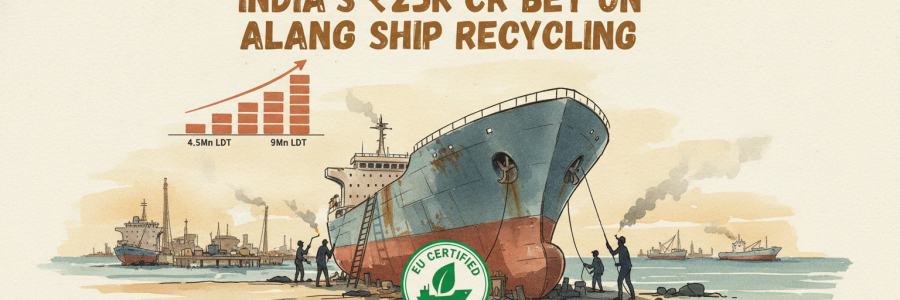
India plans ₹20-25K Cr investment to double Alang's ship recycling capacity from ~4.5Mn to 9Mn LDT, targeting ~50% global market share within a decade.The Hong Kong Convention on green ship recycling took effect this year. EU certification is now mandatory to dismantle European vessels, giving compliant yards a competitive moat.Alang's 128 yard operators, Gujarat's steel re-rollers, and European shipowners seeking compliant disposal sites stand to gain or lose from the upgrade.
What specific upgrades are Alang yards getting?
Of Alang's 128 plots, 115 are now compliant with the Hong Kong Convention. The Centre released ₹53.5 Cr from the Ferrous Scrap Development Fund for infrastructure upgrades. 34 yards have applied for EU certification, with inspections completed at three. Capacity targets would double throughput to ~1,000-1,200 ships/year from ~500-600 today.
How does the ₹25K Cr Maritime Fund work?
The Maritime Development Fund has two parts: a ₹20K Cr investment fund for direct project financing and a ₹5K Cr interest subvention facility that subsidizes loan costs. Ship recycling projects at Alang can tap both. The fund was announced last year as part of India's broader $8Bn maritime ecosystem push.
What does HKC compliance actually require?
HKC requires yards to manage hazardous materials like asbestos, PCBs, and heavy metals during dismantling. Each ship must carry an Inventory of Hazardous Materials before recycling begins. Yards need concrete flooring to prevent soil contamination, proper drainage, and worker safety infrastructure. These are structural costs that smaller yards in Bangladesh often skip.
Why did Gujarat govt commit only ₹1K Cr?
Gujarat's ₹1K Cr share is roughly 4-5% of total planned investment. States typically fund land acquisition and local infrastructure like roads and water supply, while the Centre and private sector cover the heavier industrial upgrades. Gujarat's Pipavav port development followed a similar split, where state investment in connectivity unlocked larger private capital.
Can Alang actually compete with Bangladesh?
Industry executives like Nitin Kanakiya of Triveni Shipbreakers warn that capacity utilization has been declining for years. Bangladesh and Pakistan offer lower labor and regulatory costs. Kanakiya argues demand for re-rolled steel plates collapsed after the 2014 BIS Quality Control Order, so boosting downstream steel demand should come before adding recycling capacity.
What steel demand gap is Kanakiya flagging?
Before 2014, Alang's recycled steel plates were re-rolled and sold directly to construction. The BIS Quality Control Order mandated ISI-marked steel, eliminating demand for non-certified re-rolled plates. This removed a key revenue stream. Without strong domestic steel scrap demand, yard operators struggle to pay competitive prices for end-of-life ships.
How do Bangladesh yards undercut Alang today?
Bangladesh's Chittagong yards operate on tidal mudflats with minimal environmental infrastructure. Labor costs are roughly 30-40% lower. Crucially, they face no equivalent of India's BIS quality mandate on output steel, so they sell recycled plates directly into local markets at higher margins. However, Chittagong yards are not HKC-compliant, which locks them out of the growing green-compliance segment.
Could lower capacity utilization sink the plan?
Alang's current utilization is well below its ~4.5Mn LDT capacity. Adding capacity to 9Mn LDT without first filling existing yards risks stranding investment. The structural fix is the ₹4K Cr Shipbreaking Credit Note Scheme, which pays yard operators 40% of scrap value per recycled ship. The first credit note was issued in May 2026, effectively subsidizing demand to fill yards.
Which shipowners benefit from EU compliance?
European shipowners are the primary target. The EU Ship Recycling Regulation requires vessels flagged in EU nations to use approved yards. Only 3 Alang facilities have completed EU inspections so far. Minister Sonowal and EU Commissioner Roswall met this week to push Indian yard inclusion on the EU's approved list, potentially unlocking hundreds of European vessels annually.
How many EU-flagged ships retire each year?
Roughly 700-800 large vessels globally are scrapped annually. European-flagged ships represent a significant share because the EU has one of the world's oldest merchant fleets by average vessel age. Currently most EU ships go to Turkey's Aliaga yards, the only non-EU facilities on the approved list. Alang's EU certification could redirect hundreds of these vessels to India.
What does the 40% credit note actually cover?
The credit note equals 40% of the assessed scrap value of a recycled vessel. A yard that dismantles a ship worth ₹10 Cr in scrap receives a ₹4 Cr credit note usable against purchase of a new Indian-built ship. This links recycling incentives to shipbuilding demand, creating a circular loop. The scheme sits under the Shipbuilding Financial Assistance Policy.
Who are Alang's biggest private yard operators?
Alang has roughly 128 plots operated by firms ranging from large players like Priya Blue Industries and Leela Ship Recycling to smaller family-run operations. Priya Blue was among the first Indian yards to pursue Hong Kong Convention compliance. The top 10-15 operators handle the majority of tonnage, while smaller yards often lack capital for environmental upgrades.
Source: livemint.com