politics · 2026-07-10
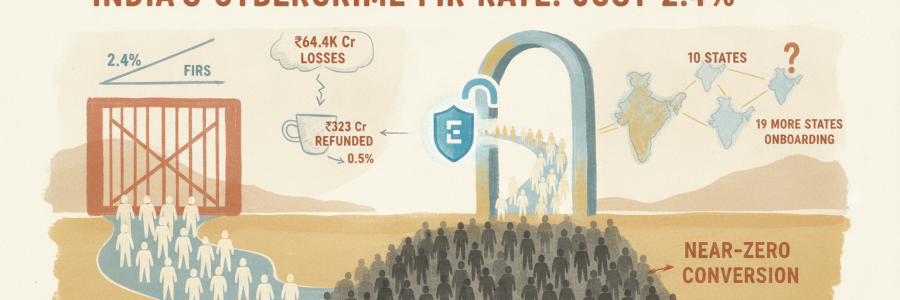
India's Cybercrime FIR Rate: Just 2.4%
94af358f-76ce-4400-b963-ee7bddc8d148
Of 98L cybercrime complaints since 2019, only 2.3L FIRs were filed. A new E-Zero FIR system auto-converts complaints above ₹10L into FIRs.Reported losses total ₹64.4K Cr, but only ₹323 Cr has been refunded to victims. That is less than 0.5% of total losses, exposing a massive recovery gap.Victims in 10 states now have E-Zero FIR access. 19 more states are being onboarded, but millions of complainants in uncovered states still face near-zero FIR conversion.
Why were only 2.3L FIRs filed from 98L cases?
Police stations traditionally required victims to file FIRs in the jurisdiction where the crime originated, not where the victim lives. For cyber fraud routed through multiple states, this created jurisdictional deadlocks. Most complaints on the 1930 helpline were logged but never converted. The E-Zero FIR system bypasses this by auto-generating FIRs for losses above ₹10L.
What made jurisdictional disputes so common?
A single cyber fraud often routes through accounts in 5 or more states. Under Indian law, an FIR must be filed where the crime occurs, but digital crimes have no single location. A victim in Kerala whose money lands in a Jharkhand mule account faces refusal from both state police forces. E-Zero FIR assigns the case to the victim's local police by default.
How does the 1930 helpline actually work?
When a victim calls 1930, operators log the complaint and immediately alert the victim's bank to freeze the suspect transaction. The system connects to 1,596 banks via the Citizen Financial Cyber Frauds Reporting and Management System. Speed matters because funds typically move through 3 to 4 mule accounts within 30 minutes. Delays of even an hour make recovery nearly impossible.
Do other countries auto-generate cyber FIRs?
The UK's Action Fraud portal centralizes cyber complaints but does not auto-generate police reports. Singapore's ScamShield app blocks scam calls and SMSes proactively. India's E-Zero FIR is unusual in auto-converting complaints into formal police cases above a threshold. Most countries still require manual police action to initiate investigation, creating similar bottlenecks.
Could victims realistically recover lost money?
Recovery is structurally difficult. Of ₹64.4K Cr in reported losses, ₹10.7K Cr was frozen as lien in bank accounts, but only ₹323 Cr, roughly 3% of frozen funds, was actually refunded. Fraudsters move money through mule accounts within minutes. Even when funds are frozen, legal proceedings to release them to victims take months or years.
Why is only 3% of frozen money refunded?
Frozen funds sit in lien until a court orders their release. Victims must file separate civil or criminal proceedings to claim refunds. Courts require proof linking frozen funds to the specific victim's loss, which is hard when money has been split across dozens of accounts. In one Delhi case, ₹12L was frozen but took 14 months to return because three victims claimed the same pool.
What are mule accounts and how many exist?
Mule accounts are bank accounts, often opened with stolen or rented identities, used to receive and forward stolen money. India's suspect registry has flagged 31.6L suspect identifiers. The MHA froze 12.1L mule accounts. Fraudsters recruit rural account holders, paying ₹500 to ₹2,000 per transaction. RBI's subsidiary recently signed an MoU with MHA to crack down on this supply chain.
How do banks decide which transactions to flag?
Banks on the NCRP system receive automated alerts when a complaint names a specific account or transaction ID. The system cross-references the suspect registry's 31.6L flagged identifiers. If a receiving account matches, the bank places an automatic debit freeze. But banks have only a 2 to 4 hour window before funds move onward. Smaller cooperative banks often lack real-time integration, creating gaps.
Which states lack E-Zero FIR access today?
E-Zero FIR currently covers Delhi, Haryana, Odisha, MP, Uttarakhand, Goa, Chandigarh, West Bengal, Rajasthan, and Assam. Major states like UP, Maharashtra, Tamil Nadu, and Karnataka are not yet live. Since UP and Maharashtra together account for a large share of cybercrime complaints, their absence leaves millions without auto-FIR coverage.
How does E-Zero FIR change policing workload?
Auto-generated FIRs force local police to investigate cases they previously ignored. In Haryana, cyber cell officers reported a 3x increase in assigned cases after E-Zero FIR launched. Without additional staffing, each officer handles more cases with the same resources. MHA plans to train police as cyber commandos, but current capacity is thin. Most state cyber cells have fewer than 50 trained officers.
Do uncovered states have any alternative system?
States without E-Zero FIR rely on manual processes. A victim in UP must convince local police to register an FIR, which rarely happens for online fraud. Some states run their own cyber helpdesks, but these lack integration with the national banking freeze system. Tamil Nadu's separate portal, for instance, cannot trigger automatic bank lien the way the NCRP-connected system does.
What training do cyber commandos receive?
MHA's cyber commando program trains police officers in digital forensics, blockchain tracing, and dark web monitoring. Trainees learn to trace cryptocurrency transactions and identify fraudulent UPI payment chains. The program targets 5,000 trained commandos across states. Comparable programs in Telangana's Cyberabad unit have shown results, with that unit recovering ₹15 Cr in 2024 alone.
Source: indianexpress.com