tech · 2026-06-28
India's First Hydrogen Train Hits Tracks
4d431e8d-9ae8-4a36-9e78-6631a33a036f
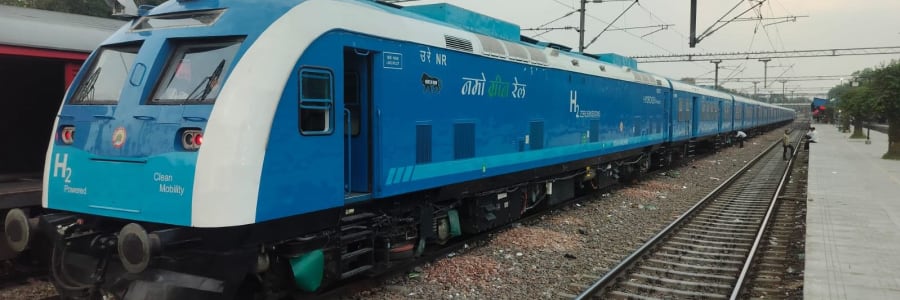
Indian Railways ran its first hydrogen train on the Delhi-Jind route on Friday, testing emergency braking and oscillation before commercial launch.India becomes the 5th country, after Germany, Sweden, Japan, and China, to operate hydrogen-powered trains on its rail network.Northern Railway's Jind-Sonipat corridor and Shakurbasti depot are the first facilities to handle this zero-emission rolling stock.
How does a hydrogen train actually produce power?
Hydrogen fuel cells combine hydrogen gas with oxygen to generate electricity, which drives the train's motors. The only byproduct is water vapour, not diesel exhaust. This 10-coach trainset uses two Driving Power Cars of 1,200 kW each, totalling 2,400 kW. Indian Railways calls it the world's most powerful hydrogen trainset on broad gauge.
What fuel cell tech does this train use?
The train uses Proton Exchange Membrane (PEM) fuel cells, the same type Toyota uses in its Mirai car. PEM cells operate at lower temperatures, around 80°C, enabling faster start-up. Hydrogen stored in onboard tanks flows through the cell stack, and the resulting electricity powers traction motors directly, with batteries buffering peak demand.
How does 2,400 kW compare to a diesel train?
A typical diesel DEMU on Indian Railways produces roughly 1,400 to 1,800 kW. At 2,400 kW, this hydrogen trainset exceeds that by 30-70%, making it capable of hauling 10 coaches at 75 kmph on level track. For context, Germany's Coradia iLint, the world's first commercial hydrogen train, runs at only 1,000 kW with 2 coaches.
Can this tech scale to faster trains?
The 75 kmph cap reflects current fuel cell power density and safety certification limits, not a permanent ceiling. Hydrogen trains globally max out around 140 kmph. Scaling speed requires larger or denser hydrogen storage tanks and more powerful cell stacks. Japan's JR East is testing a hybrid hydrogen-battery train targeting 120 kmph, suggesting incremental gains are feasible.
Why pick Jind-Sonipat for this first route?
The Jind-Sonipat section in Haryana is a relatively short, low-traffic corridor on Northern Railway's Delhi Division. That makes it ideal for controlled testing at the approved max speed of 75 kmph without disrupting trunk routes. Shakurbasti depot in Delhi, already a maintenance hub, handles scheduled upkeep, keeping logistics simple for a first-of-its-kind rollout.
Why not just electrify this route instead?
Electrifying a rail line costs roughly ₹3-5 Cr per km for overhead wiring and substations. For low-traffic branch lines like Jind-Sonipat, the traffic volume rarely justifies that capital outlay. Hydrogen trains can run on existing unelectrified track with zero infrastructure changes beyond a fuelling station, making them ideal for India's roughly 21,000 km of non-electrified routes.
What does hydrogen fuel cost vs diesel per km?
Currently, green hydrogen costs ₹300-400 per kg in India, and a train this size consumes roughly 80-100 kg per trip. That works out to ₹24K-40K per trip versus ₹15K-20K for diesel on comparable DEMU runs. The cost gap narrows as India's National Green Hydrogen Mission targets ₹100/kg by 2030 through electrolyser scale-up.
Could this change India's green hydrogen demand?
Indian Railways consumes roughly 2.6 Bn litres of diesel annually. If even 10% of non-electrified routes shift to hydrogen, that creates demand for roughly 50K-70K tonnes of green hydrogen per year. Companies like Reliance, Indian Oil, and NTPC, already investing in electrolyser capacity, would gain a guaranteed institutional buyer, anchoring their production economics.
Who beyond passengers benefits from this trial?
Indian locomotive and component manufacturers gain a reference project. The trainset was designed and built domestically under the Atmanirbhar Bharat push. Companies like BEML and Indian Railway's own RDSO developed the technology. Success here could open orders for hydrogen rolling stock across other non-electrified routes, estimated at roughly 35% of India's rail network.
Who manufactures the coaches domestically?
RDSO led the design, with integration at Indian Railways' own Integral Coach Factory in Chennai. Key fuel cell components were developed with technology partners, though Railways has not named the cell stack supplier. BEML and other PSU coach builders could handle serial production if orders expand beyond this pilot trainset.
Which rail workers need retraining for this?
Diesel loco pilots and maintenance crews at Shakurbasti depot are the first cohort. Hydrogen trains require entirely different skills: handling pressurised hydrogen storage at 350-700 bar, fuel cell diagnostics, and high-voltage battery management. RDSO has started certification courses. For context, Germany's Deutsche Bahn retrained roughly 200 technicians before Coradia iLint entered service.
Could freight trains adopt hydrogen next?
Freight is harder. A loaded freight train on Indian Railways needs 4,000-5,000 kW, roughly double this trainset's output. Hydrogen storage weight also cuts into payload capacity. Battery-hydrogen hybrids could work for lighter freight on branch lines, but heavy trunk freight will likely stay electric. Mining companies like Coal India, which rely on rail freight, are watching closely.
Source: indianexpress.com