economy · 2026-07-09
India's June CPI Likely Crossed 4% Target
e810f5fb-75c9-4834-8a68-13b9001ac9aa
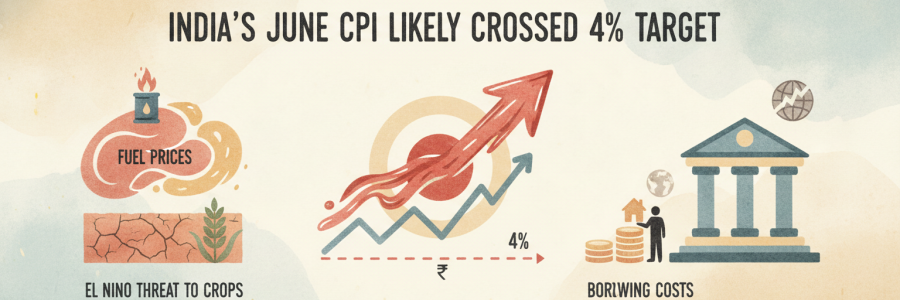
A Reuters poll of 37 economists forecasts Jun CPI at 4.3%, breaching RBI's 4% target for the first time in 16 months.Food, fuel, and the US-Iran war are driving costs higher. El Nino threatens crop output, and fuel retailers hiked prices four times in May alone.RBI held rates at 5.25% in Jun, but most surveyed economists expect at least one hike by year-end, raising borrowing costs for firms and homebuyers.
What drove the jump from 3.93% to 4.3%?
Three forces converged. State fuel retailers raised prices four times in May, lifting transport costs. Food prices firmed as early monsoon patterns weakened. The US-Iran conflict pushed global crude above recent averages. Societe Generale's Kunal Kundu notes these are category-specific pressures, not broad-based inflation.
Why did fuel retailers hike prices four times?
State-owned retailers like IOC, BPCL, and HPCL absorbed losses when global crude spiked. The four May hikes recovered margins after months of holding prices steady pre-election. Each ₹1/litre diesel hike adds ~0.03 percentage points to CPI through transport cost pass-through.
How much does food weigh in India's CPI?
Food carries ~46% weight in India's CPI basket, roughly 3x its weight in the US CPI. This means a 10% spike in vegetable prices alone can push headline CPI up by ~0.5 percentage points. Tomato and onion price swings routinely move national inflation readings.
What role does the US-Iran war play here?
The US-Iran conflict disrupted tanker routes near the Strait of Hormuz, where 9 in 10 barrels headed to Asia pass. India imports ~85% of its crude. Brent crude rose above recent averages, raising input costs for refiners like Reliance and IOC, feeding into domestic fuel and freight prices.
Could this breach force RBI to hike rates?
RBI held at 5.25% in Jun, but a majority of polled economists already expected at least one hike by year-end before this data. A 4.3% print would strengthen the case. For context, each 25 bps hike adds roughly ₹1,500/year to a ₹50L home loan EMI at 20-year tenure.
At what CPI level would RBI be forced to act?
RBI's mandate requires CPI to stay within 2-6%, targeting 4%. Sustained readings above 4.5% with rising core inflation would likely trigger action. In 2022, RBI began emergency hikes when CPI hit 7.8%. Current core at ~3.95% gives some buffer, but food and fuel trends could erode it.
How wide is the WPI-CPI gap right now?
WPI hit 9.15% in Jun vs CPI at 4.3%, a gap of nearly 5 percentage points. WPI gives fuel ~15% weight vs ~7% in CPI. Historically, a WPI-CPI gap this wide narrows within 2-3 quarters as manufacturers pass input costs forward. FMCG firms like HUL typically lead price hikes.
Would a hike stall India's growth momentum?
India's GDP growth remains above 6%, giving RBI room for a modest 25 bps hike without killing momentum. In 2018, RBI hiked twice during a 7%+ growth phase with minimal drag. The real risk is consecutive hikes. Capital-intensive sectors like real estate and auto see demand soften first.
Who faces the sharpest cost squeeze here?
Farmers face a double bind: El Nino threatens yields while input costs rise from pricier fuel and transport. Truckers absorb higher diesel costs. Homebuyers risk EMI increases if RBI hikes. Wholesale inflation at 9.15% squeezes manufacturers like small FMCG firms who cannot fully pass costs to consumers.
Which farming regions face the worst El Nino?
El Nino historically hits rice-growing regions hardest, particularly eastern India and Karnataka. The 2015 El Nino cut rice output by ~3%, spiking prices 12%. Pulses are equally vulnerable. If Jun-Sep monsoon rainfall falls 10% below normal, vegetable supply from Maharashtra's rain-fed farms drops sharply.
Can small manufacturers pass on 9% WPI hikes?
Most cannot. Small FMCG and textile manufacturers operate on 8-12% gross margins. A 9% input cost jump absorbs nearly the entire margin. Larger firms like HUL raise MRPs within weeks. Small players in Surat's textile cluster or Ludhiana's hosiery units typically delay 3-6 months, absorbing losses first.
How do truckers cope with repeated fuel hikes?
India's 12Mn truckers operate on razor-thin margins of ₹2-3/km. Each ₹1/litre diesel hike cuts net margins by ~15%. Fleet operators pass costs via higher freight rates within 2-4 weeks, but single-truck owners absorb losses. The All India Motor Transport Congress estimated a ₹5/litre hike triggers 5-7% freight inflation.
Source: economictimes.indiatimes.com