tech · 2026-07-06
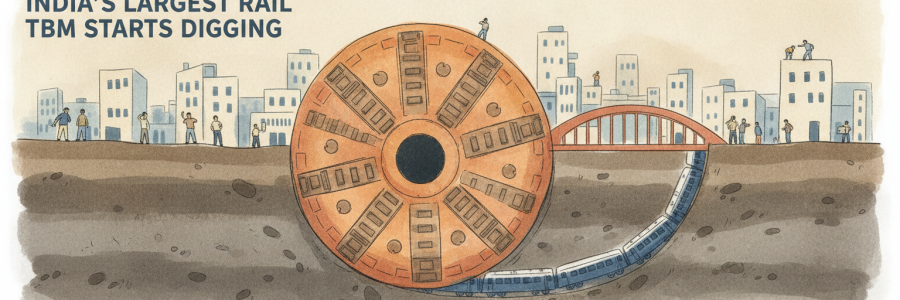
India's Largest Rail TBM Starts Digging
83603b8c-a8ac-408e-9b32-15d877c6aa7f
A 13.6m-diameter tunnel boring machine began excavating a 6km single-tube tunnel from Vikhroli for the Mumbai-Ahmedabad bullet train's 21km underground section.This is the first time India has deployed a TBM this large for rail, boring beneath dense Mumbai neighborhoods, the Mithi River, and multi-storey buildings.Millions of commuters along the Mumbai-Ahmedabad corridor and residents above the tunnel path in Vikhroli, BKC, and Ghansoli are directly affected.
What exactly will this TBM bore through?
The TBM launched from a 56m-deep shaft at Vikhroli will bore a 6km single-tube tunnel through mixed ground beneath multi-storey buildings, roads, and the Mithi River. The tunnel accommodates both up and down tracks. Of the project's 21km underground section, 16km will use TBMs and 5km is already done via the New Austrian Tunnelling Method.
How does a Mixshield TBM handle groundwater?
A Mixshield TBM pumps bentonite slurry to the cutting face, creating a pressurized barrier that holds back groundwater and loose soil. The slurry is cycled to a surface treatment plant, cleaned, and recirculated. This closed loop lets the machine bore safely even 20m below the Mithi River, where water pressure is intense.
Why build one tube for both tracks?
A single large-diameter tube for both tracks costs less in shaft construction and land acquisition than twin smaller tunnels. Delhi Metro's twin-tube approach needs two TBMs and two launch shafts per section. NHSRCL chose one 13.6m tube because Mumbai's constrained urban footprint makes acquiring land for multiple shafts extremely expensive.
What ground conditions sit under Mumbai?
Much of Mumbai sits on reclaimed land, with layers of marine clay, decomposed rock, and basalt. Groundwater levels are high, especially near the Mithi River floodplain. The Mixshield TBM was chosen precisely because it handles this unpredictable mix. Kolkata Metro's East-West corridor faced similar challenges boring under the Hooghly River through alluvial silt.
Why hasn't India used a TBM this big before?
India's prior rail tunnels used smaller TBMs or drill-and-blast methods suited to mountain rock, not soft urban ground. Mumbai's mix of reclaimed land, high groundwater, and dense surface structures demands a 13.6m Mixshield TBM, roughly four storeys tall. For comparison, Delhi Metro TBMs are about 6.5m in diameter, less than half this machine's size.
How does 13.6m compare to global rail TBMs?
The world's largest rail TBM is about 15.6m, used on the Fehmarnbelt tunnel between Denmark and Germany. At 13.6m, Mumbai's machine is globally competitive. London's Crossrail used 7.1m TBMs for twin tubes. Mumbai's single-tube design requires a bigger machine but eliminates the need for two parallel bores.
What slows a project like this the most?
Muck disposal and slurry management are the biggest bottlenecks. The TBM generates thousands of tonnes of excavated soil daily, all hauled through the 56m shaft. In Mumbai's traffic-congested streets, trucking this material out at night is a logistical challenge. The Crossrail project in London used barges on the Thames to move 8Mn tonnes of spoil.
Could this TBM tech apply to other cities?
Any Indian city with soft ground and dense surface development could benefit. Chennai Metro's Phase 2 includes underwater tunnelling near the Adyar River. Kolkata and Pune are evaluating similar corridors. The key constraint is not the TBM itself but the upfront cost, roughly ₹200-400 Cr per machine, and the need for skilled operators who are still scarce in India.
How are residents above the tunnel protected?
NHSRCL installed a real-time monitoring system tracking ground settlement above the tunnel path. Residents near Vikhroli and BKC live directly above the bore line. The TBM uses slurry pressure to prevent cave-ins, and the tunnel lining gets double-layer EPDM gaskets plus hydrophilic seals to block water leakage permanently. A 56m-deep launch shaft was built with its own water and sewage treatment plants to contain surface disruption.
What happens if ground settles unexpectedly?
If sensors detect settlement beyond the 10-15mm threshold, the TBM adjusts face pressure and grouting in real time. During Lucknow Metro construction, unexpected settlement near Hazratganj forced a two-week halt for remedial grouting. NHSRCL's monitoring system tracks surface movement continuously to prevent structural damage to buildings above.
Do residents get compensated for disruption?
Indian law requires compensation if construction causes verified property damage. NHSRCL's environmental clearance mandates a pre-construction survey of buildings within 50m of the tunnel alignment. Mumbai Metro Line 3, which runs a parallel underground route, set a precedent by compensating residents in Girgaon whose walls cracked during boring.
How long until the full 21km is done?
The 5km NATM section is already complete. The TBM sections total 16km, split between multiple machines working from different shafts. At typical urban TBM speeds of 8-12m per day, each 6km stretch takes roughly 18-24 months. The full underground section is targeted for completion by 2028, though monsoon-season slowdowns and logistics delays could push timelines.
Source: indianexpress.com