politics · 2026-07-06
India's New Rural Jobs Scheme Gets ₹25.9K Cr
c357dbb1-56a1-4d6a-add4-408a56a7ad80
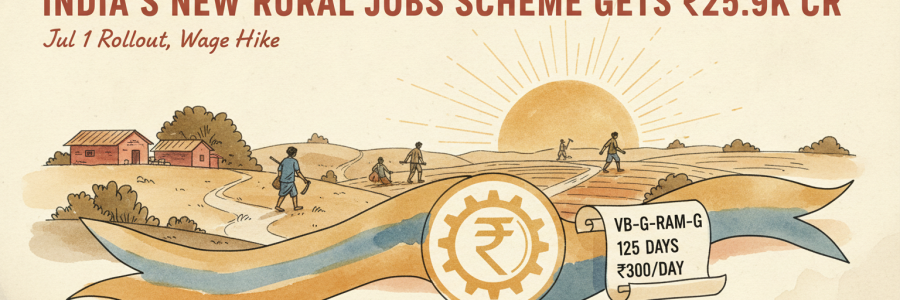
Centre released ₹25.9K Cr to states as VB-G-RAM-G, the replacement for MGNREGA, rolled out nationwide on Jul 1 with no reported disruptions.The scheme raises the wage guarantee from 100 to 125 days per household and lifts the minimum daily wage to ₹300, a ~10% average increase.Lakhs of rural workers in states like Andhra Pradesh, Kerala, and Rajasthan began work in the first week, while Jharkhand and West Bengal lag behind.
What changed from MGNREGA to VB-G-RAM-G?
VB-G-RAM-G replaces MGNREGA's 100-day guarantee with 125 days per household and raises the national average daily wage from ₹298.8 to ₹327.4. No state now pays below ₹300/day. The govt claims it rolled out nationwide in a single day, unlike MGNREGA which took nearly three years to cover all districts.
How does VB-G-RAM-G select which works get done?
Gram sabhas and gram panchayats identify works based on local development needs, a participatory planning model. This mirrors MGNREGA's bottom-up approach but adds area officers led by Joint Secretaries to coordinate with states. For example, a panchayat in Rajasthan could prioritize canal desilting over road work based on monsoon needs.
Who decides the daily wage rate for each state?
The Centre notifies state-specific wage rates annually, often pegged to the Consumer Price Index for Agricultural Labourers (CPI-AL). Under MGNREGA, some states like Bihar had rates as low as ₹245/day. VB-G-RAM-G sets a ₹300 floor, compressing the gap between low-wage and high-wage states like Kerala, which now gets ₹371/day.
How was the single-day rollout achieved?
The ministry pre-deployed area officers and completed IT system migration before Jul 1. MGNREGA launched in 2006 in 200 districts, expanding to all 614 by 2008. VB-G-RAM-G inherited MGNREGA's existing digital infrastructure, including the NREGASoft platform and Aadhaar-linked payment systems, enabling a switchover rather than a fresh build.
Could 25 extra guaranteed days strain budgets?
The jump from 100 to 125 days adds 25% more guaranteed workdays per household. At ₹327.4/day average, each household could now earn up to ~₹40.9K per year versus ~₹29.9K under MGNREGA. States must also provide matching funds, so states like Bihar or UP with large rural populations face higher fiscal commitments.
Does 125 days cover lean agricultural seasons?
Most rural distress peaks during the 4 to 5 month gap between kharif harvest (Oct-Nov) and rabi sowing (Nov-Dec), plus the pre-monsoon dry spell (Apr-Jun). At 125 days, VB-G-RAM-G covers roughly both lean windows. Under MGNREGA's 100 days, states like Rajasthan routinely exhausted the quota before the second lean spell ended.
How do states fund their matching share?
States typically fund their 25-40% share from own-tax revenue or borrowings. Poorer states struggle disproportionately. Bihar, for example, has per-capita own-tax revenue of ~₹4K versus Tamil Nadu's ~₹14K. The Centre's ₹25.9K Cr first instalment covers only the central share, so fiscally weak states may delay wage payments if they cannot mobilize matching funds quickly.
What if states can't pay wages within 15 days?
Under MGNREGA, delayed wages triggered automatic compensation at 0.05% of unpaid wages per day. VB-G-RAM-G retains a 15-day payment mandate. If a state misses it, the liability for compensation falls on the state govt, not the Centre. In 2023-24, nearly 40% of MGNREGA wage payments were delayed beyond 15 days, per a LibTech India analysis.
Why are Jharkhand and West Bengal lagging?
Jharkhand has not yet formally notified the programme or completed budgetary provisions. West Bengal and Odisha still have gram panchayats that are not operational under the new scheme. Some states also have pending RBI account formalities. By contrast, Andhra Pradesh and Kerala generated employment on day one, Jul 1.
Which states have the highest rural demand?
Rajasthan, Tamil Nadu, and Andhra Pradesh have historically been the top three MGNREGA demanders, generating over 30% of total person-days. Demand correlates with drought vulnerability and landlessness rates. Rajasthan alone accounted for ~15% of MGNREGA person-days in FY25, driven by semi-arid conditions that limit private farm employment for 6+ months.
How do wages compare to market farm labour?
In most states, MGNREGA wages lagged market farm wages by 20-40%. For instance, market rates for farm labour in UP were ~₹400/day while MGNREGA paid ₹245. VB-G-RAM-G's ₹300 floor narrows this gap but does not close it. The scheme functions as a wage floor rather than a competitive alternative, which is by design to avoid crowding out private farm hiring.
Could VB-G-RAM-G reduce rural migration?
MGNREGA reduced seasonal migration by ~10-15% in high-uptake districts, per a 2019 IGIDR study of Maharashtra and Rajasthan. VB-G-RAM-G's extra 25 days could deepen this effect by covering the second lean season. However, construction-sector wages in cities like Surat or Bengaluru still run 2x to 3x scheme wages, so migration for longer stints is unlikely to stop.
Source: livemint.com