world · 2026-07-07
Iran Hits Ships in Hormuz, Tests US Deal
2141e6d6-2e47-4366-9211-a467ceeba57c
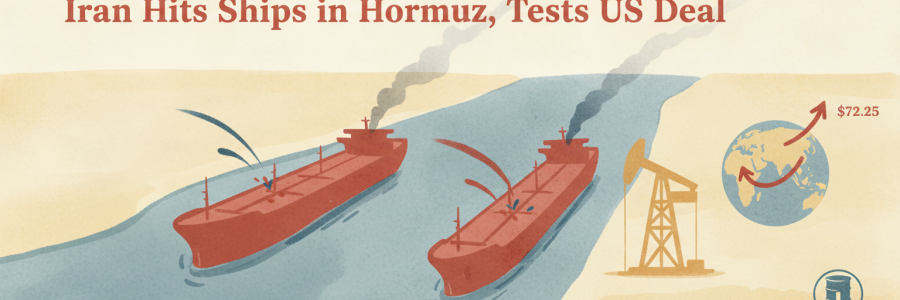
Iran fired at least two missiles at commercial ships in the Strait of Hormuz on Monday, damaging both vessels but causing no casualties.The attack tests a late-Jun interim peace deal with the US that established a 60-day negotiating window. Brent crude rose 0.4% to ~$72.25/barrel.Indian refiners face renewed supply risk. India imports ~80% of its crude, and 9 in 10 tankers through Hormuz head to Asia.
What exactly did this attack hit and where?
Two commercial ships were struck about 8 nautical miles east of Limah, Oman. Both suffered significant damage but no casualties. The UK Maritime Trade Operations center confirmed at least one was a tanker hit by an unknown projectile. Iran has not claimed or denied the strikes.
Why did the attack happen during a ceasefire?
The interim deal paused hostilities but did not resolve core disputes. Iran's leadership is in transition after Khamenei's assassination in late Feb. Hardline factions may see attacks during the funeral suspension as leverage before talks resume. The timing pressures Trump ahead of the NATO summit in Ankara.
Who controls ship traffic near Limah, Oman?
Oman's navy monitors its territorial waters near Limah, but the Strait's narrowest point is just 33 km wide, shared between Iran and Oman. The UK Maritime Trade Operations center and US Fifth Fleet in Bahrain coordinate commercial ship tracking. No single nation fully controls traffic flow.
Has Iran attacked Hormuz shipping before?
During the 2019 tanker crisis, Iran attacked six commercial vessels in the Gulf of Oman over two months. Before that, the 1980s Tanker War saw hundreds of ships hit. The Feb 2026 conflict briefly shut Hormuz almost entirely, the most severe disruption since the 1980s.
Could this collapse the 60-day US-Iran deal?
The late-Jun interim deal gave the US and Iran 60 days to negotiate lasting peace. This attack lands during a suspension of talks for Supreme Leader Khamenei's funeral, with burial set for Jul 9 in Mashhad. Major unresolved issues include Iran's frozen assets, Hormuz transit fees, and nuclear ambitions. Qatar said talks would resume after funeral ceremonies.
What specific issues block a lasting deal?
Three major obstacles remain. First, Iran wants ~$100Bn in frozen assets unfrozen. Second, Iran demands transit fees from ships using Hormuz, a claim no prior deal has conceded. Third, Washington insists on nuclear constraints Iran has resisted since exiting the 2015 JCPOA framework.
How long can India manage if Hormuz stays risky?
India's Strategic Petroleum Reserve holds roughly 9.5 days of consumption across Visakhapatnam, Mangalore, and Padur facilities. Combined with commercial stocks, India has ~65 days of import cover. But refineries run continuously. Jamnagar processes ~1.4Mn barrels/day and cannot simply shut down without costly damage to equipment.
What role does Qatar play in these talks?
Qatar hosts both US and Iranian negotiators in Doha, serving as a neutral intermediary. Kushner and Witkoff met Qatari officials there last week. Qatar played a similar mediating role during the 2015 Iran nuclear talks and the 2023 Gaza hostage negotiations, leveraging its diplomatic ties with both Tehran and Washington.
How exposed are Indian refiners to Hormuz?
India imports roughly 4 out of every 5 barrels it consumes, and the Strait of Hormuz carries crude from Iraq, Saudi Arabia, Kuwait, and the UAE. Reliance's Jamnagar refinery and Indian Oil's facilities depend on this corridor. Even brief disruptions spike shipping insurance and spot crude costs for Indian refiners.
Who in India gets hit first by rising crude?
Oil marketing companies like Indian Oil, BPCL, and HPCL absorb initial price shocks before passing costs to consumers. In the Feb-Mar 2026 spike, these three firms collectively held pump prices steady for ~3 weeks, accumulating under-recoveries. Upstream producers like ONGC also face windfall tax adjustments when prices rise.
Do Indian refiners hedge against Hormuz risk?
Large refiners like Reliance use futures contracts on ICE Brent to lock in crude costs 1 to 3 months ahead. Indian Oil hedges roughly 30-40% of its import volume. But hedging covers price risk, not physical supply disruption. If tankers cannot transit Hormuz, no futures contract delivers actual crude to Jamnagar's dock.
Could India reroute crude away from Hormuz?
Only partially. India sources ~15% of crude from non-Hormuz routes, mainly from West Africa and the Americas. Rerouting via the Cape of Good Hope adds ~15 days and $2-3/barrel in shipping costs. Russia's Arctic exports bypass Hormuz but face Western sanctions complications. No alternative fully replaces the 20Mn barrels/day that transit Hormuz.
Source: thehindubusinessline.com