world · 2026-03-21
Iran Now Controls Hormuz Ship Traffic
2d8bac40-d4a5-4b1f-b33f-a396471dad07
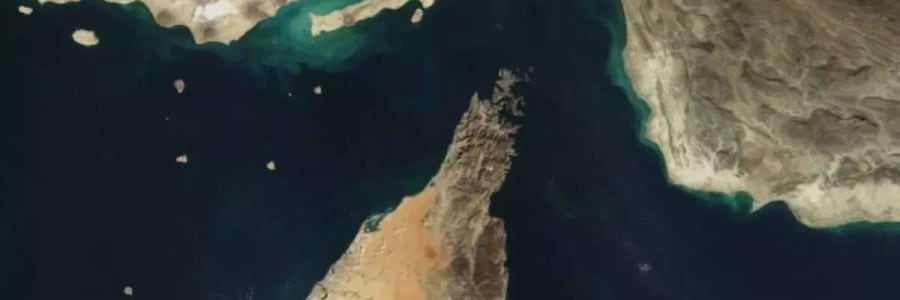
Iran guided an Indian LPG tanker through the Strait of Hormuz last week via radio contact, verifying the ship's flag, crew nationality, and route before granting passage.Two Indian ships crossed after New Delhi's diplomatic engagement with Tehran.Analysts say Iran is building a traffic control system, letting friendly vessels pass while leaving others exposed.This gives Tehran leverage over global energy prices by deciding who transits the strait safely.
What makes Iran's escort system a structural shift in how global energy chokepoints are controlled, rather than just a wartime measure?
Traditional naval blockades are binary, you close a strait or you don't. Iran is instead creating a permissions-based transit system, deciding ship by ship who passes. This turns Hormuz into a toll gate rather than a war zone. [Indian LPG tankers got pre-approved routes while other nations' ships face uncertainty.] That is a governance claim over international waters.
What historical precedent exists for a nation claiming traffic control over an international strait?
International law under UNCLOS guarantees transit passage through straits. Iran's system echoes Turkey's Montreux Convention control over the Bosphorus, but without a treaty. [Turkey can restrict warship tonnage through the Bosphorus.] Iran is asserting similar control unilaterally, creating a legal gray zone.
How does Iran technically enforce this system with its naval capabilities?
Iran uses a combination of fast patrol boats, coastal radar, and radio communication. [During the Indian tanker crossing, the navy collected flag, crew, and route details by radio.] Iran does not need a large navy to monitor the narrow 21-mile-wide strait effectively.
What happens to insurance premiums for ships that transit without Iran's approval?
Ships transiting without pre-approval face sharply higher war-risk insurance premiums. [Premiums for Hormuz transit reportedly jumped to 1-2% of hull value during escalations.] For a supertanker worth $100 million, that is $1-2 million per crossing, enough to reroute trade entirely.
How does India's diplomatic channel with Iran for ship passage interact with its ties to the US and Israel?
India imports roughly 85% of its crude oil, much of it through Hormuz. New Delhi engaged Tehran diplomatically to secure passage, but this cooperation could complicate India's deepening defense ties with the US and Israel. [India's crew nationality was verified by Iran's navy before transit.] Balancing these relationships becomes harder as the strait becomes politicized.
What is India's diplomatic framework for securing this passage, and does it come with concessions?
India likely leveraged its continued oil trade with Iran and non-alignment stance. [India was among the last to reduce Iranian oil imports under US sanctions.] The diplomatic channel probably involves assurances of neutrality rather than formal concessions, but it creates implicit obligations.
How does this affect India's energy costs compared to nations without Iran approval?
Indian ships with pre-approved routes avoid war-risk insurance surcharges and rerouting costs. [Ships diverted around Africa's Cape of Good Hope add 10-15 days and significant fuel costs.] Nations without Iranian approval face both, giving India a relative cost advantage on energy imports.
What signal does India's cooperation send to Gulf allies like Saudi Arabia and the UAE?
Saudi Arabia and the UAE may view India's Iran channel pragmatically, since stable oil flows benefit them too. But it signals India will not join a US-led confrontation against Iran. [India's $50 billion annual Gulf trade depends on balancing both sides.] This complicates any coalition-building effort.
Why does Iran's ability to selectively approve ships give it more leverage than simply blocking the strait entirely?
A full blockade would unite the world against Iran and trigger military intervention. Selective approval creates ambiguity. Friendly nations get safe passage. Adversaries face risk without a clear act of war to respond to. [Oil prices spiked on fears alone, giving Tehran market leverage without firing a shot.] It is coercion without escalation.
What fraction of India's LPG imports transit the Strait of Hormuz?
India imports roughly 60% of its LPG, and a significant share transits Hormuz from Gulf producers. [Qatar and Saudi Arabia are top LPG suppliers to India.] Even brief disruptions to 1-2 million tonnes monthly could cause domestic cooking fuel shortages and price spikes.
How would prolonged selective control affect global LNG and LPG spot prices?
Selective control creates a two-tier market. Approved nations get stable supply while others face spot price volatility. [Asian LNG spot prices have historically spiked 30-50% during Gulf tensions.] This bifurcation could fragment global energy pricing into geopolitical blocs.
What alternative routes or sources could reduce India's Hormuz dependency?
India is diversifying through US LNG imports, East African sources, and expanded domestic production. [India signed long-term LNG deals with US exporters like Cheniere Energy.] Pipeline projects from Russia and expanded refinery capacity also reduce Hormuz dependency, but full diversification takes years.
Source: economictimes.indiatimes.com