tech · 2026-11-13
Is that viral monkey video real? No, it's AI
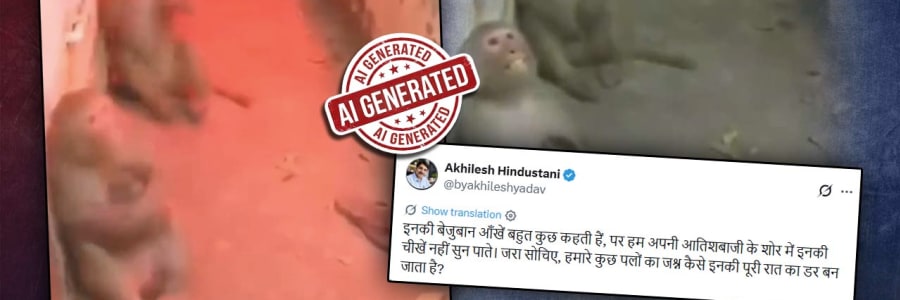
Photo: via BOOM Fact Check
A viral video of monkeys scared by Diwali firecrackers was actually made by AI, not real footage. It got a watermark from OpenAI's tool, and fact-checkers confirmed it before it fooled more people.
Is the video actually AI-generated?
Yes. Fact-checkers at BOOM traced it to a Facebook post from @Love.nature.48 on November 1, 2026, carrying an AI label. At the 2-second mark, the three monkeys jump simultaneously, unnatural for real animals. A SynthID detector then found embedded markers confirming the video was made or edited using OpenAI's tools.
Did CyberPeace also confirm the monkey video was AI?
Yes. CyberPeace, in a separate fact-check, concluded the video was AI-created and not from Diwali celebrations. Its evidence matched BOOM's findings: the original post carried an AI label, detection tools flagged it, and a SynthID watermark confirmed OpenAI's involvement.
How did fact-checkers confirm it was AI?
Fact-checkers at BOOM found three separate clues on November 10, 2026. First, they traced the video to a November 1 Facebook post by @Love.nature.48 that carried an explicit AI-created label. Second, the monkeys jump unnaturally in sync at the 2-second mark, and two detection tools flagged it. Finally, a SynthID watermark detector found embedded markers confirming OpenAI made it.
How do AI detectors and watermarks prove a video is fake?
Statistical detectors like Undetectable AI and Hive Moderation measure visual inconsistencies and output a probability guess, not proof. Watermark detectors like SynthID run a cryptographic test for a signal the AI vendor embedded with a key only the vendor holds. SynthID found embedded markers confirming the monkey video was made or edited using OpenAI. Experts say statistical detectors are a vibe check and can error, while watermarks are more reliable but not foolproof. Our read: watermarks are stronger evidence, but editing can still strip them.
Why is the watermark more reliable than other checks?
The SynthID watermark is a cryptographic signature the AI vendor embeds in its output, readable only by the vendor's detector. Style-based tools like GPTZero (an AI-detection service) guess by measuring word predictability and often misfire. A watermark detector doesn't guess, it reads a deliberate signal, making it the most reliable evidence, though editing can still strip it.
Can AI watermarks be removed or faked?
Yes. Visible watermarks are easy to remove and forge, making them unreliable, as Brookings notes. Invisible markers can be stripped, per Meta's policy page. Advanced methods like SynthID are harder to remove, but detection schemes can be reverse-engineered, allowing sophisticated actors to produce unwatermarked content. The SynthID watermark in the viral video remained intact.
How do watermarks like SynthID resist removal?
SynthID embeds the watermark directly into the content, not as separate metadata, so it survives cropping, filters, frame rate changes, and lossy compression, per Google DeepMind. OpenAI says heavy cropping or compression can make it undetectable. Duke University researchers found small pixel tweaks can fool such detectors. No method is foolproof.
Source: boomlive.in