economy · 2026-11-07
Karnataka's big clean energy plan hits a wall
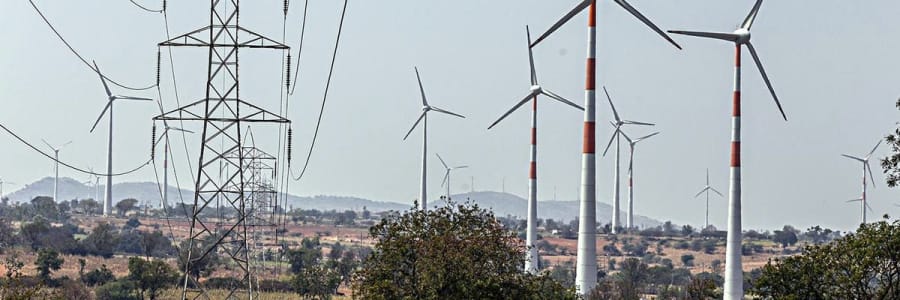
Photo: via The Hindu
Karnataka says it will add 30 GW of renewable energy in five years. But the grid can't store enough power, and land rules slow projects down.
How will Karnataka add 30 GW when it can't meet current demand?
Karnataka already has 23 GW of renewables, up from 16 GW in 2022, and aims to add 5–7 GW yearly. But solar and wind only generate when the sun shines or wind blows. The plan includes about 11,000 MWh of battery storage by 2034-35. Batteries store surplus power and release it when needed, letting the state absorb new capacity without wasting it.
Who pays for the batteries if prices stop falling?
Battery prices fell from about ₹10.83 lakh per MW per month in 2022 to ₹2.02 lakh by summer 2025, helped by government support. But in 2026, lithium, copper and aluminium costs are rising, and Chinese export incentives changed. India imports 85% of its cells, adding 18–22% to landed costs. Our read: the state's 11,000 MWh target depends on prices staying low, so cost overruns will hit the consumer.
What happens when the battery price dips below what the off-taker pays for power?
The battery's economics depend on catching a spread: charging when power is cheap, often around INR 2.50 per kWh, and selling into evening peaks near INR 7.00. If that spread narrows, the floor contract still guarantees a minimum revenue, but the owner keeps less upside, and lenders see a weaker debt case. A swap would fix revenue flat, but then the owner gives away any chance of profit from wider spreads. Our read: if spreads compress, new battery projects in Karnataka struggle to get financed, and the 11,000 MWh target slips.
Who gets paid when the battery does not earn enough from the spread?
The floor contract guarantees a minimum revenue so lenders get repaid even when the evening peak price does not rise enough above the cheap charging price. The floor is built for debt, supporting loans of up to 15 years, while the owner keeps most of the upside if spreads widen. If spreads stay narrow for long, the off-taker pays the difference to keep the battery's revenue at the floor level. Our read: with the 11,000 MWh target riding on these projects, the state's power consumers, not the developers, absorb the cost of bad market outcomes through higher tariffs.
Who decides when the battery charges and discharges?
Under a tolling agreement, the offtaker rents a share of the battery's capacity and dictates its dispatch schedule, while the owner gets a fixed payment with high revenue certainty but strict availability obligations. A top-bottom spread contract instead settles against an index of the highest and lowest priced hours, so the owner must pay the full spread even on days the battery is offline. Our read: Karnataka's 11,000 MWh buildout will face a choice between surrendering operational control for bankability or retaining it and accepting thinner financing terms.
Who ends up owning the risk when a battery contract is signed?
The contract shifts risk between the owner, lender and offtaker. A floor protects the debt case by guaranteeing minimum revenue, leaving upside with the owner. A collar caps that upside to fund the floor. A swap fixes revenue flat, giving away upside entirely. Each structure reallocates the same market risk differently, which is why the choice is a modelling problem before it is a contracting problem. Our read: Karnataka's off-takers will likely push for structures that transfer more risk to developers, who then pass it to consumers through tariffs.
What stops developers from gaming the land conversion rule?
The 2025 amendment grants renewable energy projects automatic land conversion without Deputy Commissioner approval, but it pairs that speed with strict misuse penalties. Violations trigger cancellation of the conversion, forfeiture of fees, confiscation of land, and fines up to ₹1 lakh plus ₹2,500 per day, recorded as an encumbrance on the land record. The High Court also upheld the DC's power to refuse conversions that break existing laws, keeping agricultural land protected even as solar projects get fast-tracked.
What happens to the land if a battery project fails mid-way?
If a renewable energy project violates the 2025 land conversion rules, penalties include cancellation of the conversion, forfeiture of fees, confiscation of the land, and fines up to ₹1 lakh plus ₹2,500 per day. These penalties are recorded as an encumbrance on the land's records, which means the land stays tied to the violation even if it changes hands. Our read: the threat of confiscation makes developers' lenders cautious about financing projects on converted agricultural land, since a dispute could wipe out the collateral backing their loans.
How do batteries get funded when revenue is so uncertain?
Batteries earn from price spreads between hours, which is volatile. Lenders want guaranteed minimum revenue, often through a floor contract (a deal that sets a minimum price) that supports debt for up to 15 years. Without such agreements, projects can't secure cheap loans. Developers trade off upside for certainty: a floor protects the downside, a collar caps revenue, and a swap fixes it flat, each shifts risk between owner, lender and offtaker.
Is it risky to rely on solar and wind when hydropower is failing?
Yes, because both solar and wind only generate when the weather cooperates, not on demand. If drought shrinks hydropower just as Karnataka leans on wind and solar, the gap must be filled by batteries. India needs 208 GWh (gigawatt-hours) of storage by 2030, and Karnataka's planned 11,000 MWh is a small piece of that national picture.
What does 11,000 MWh of battery storage mean?
11,000 MWh is an amount of stored electricity, like litres in a tank. As the energy secretary put it: a battery that can deliver 11,000 MW of power for one hour. (MW is the rate, MWh is the amount.) For scale, India's national plan projects needing 208,000 MWh of battery storage by 2030, so Karnataka's target is a small piece.
Can Karnataka's faster land rules actually speed up solar projects?
The 2025 amendment lets renewable energy projects convert land automatically without the deputy commissioner's approval, but only outside master plan zones. For approval inside these zones, the planning authority verifies and issues digitally signed certificates. Penalties for misuse are steep, including fines up to ₹1 lakh plus ₹2,500 per day and possible confiscation. Our read: faster rules target projects on non-agricultural land in planned zones, leaving contentious farmland conversions slow.
What makes farmland different from the land fast-tracked for solar?
The 2025 amendment gives renewable energy projects automatic conversion without the deputy commissioner's approval, but this applies outside master plan zones. Inside those zones, planning authorities verify and issue digital certificates. Farmland in rural areas falls outside master plans, yet the high court has upheld the DC's power to refuse conversions that violate existing laws, balancing development against agricultural land protection. The automatic route is for non-agricultural land in planned zones; contentious farmland still faces scrutiny despite the time limits. Our read: the fast track shields low-controversy land, not the politically sensitive conversions that actually slow projects.
What keeps a farming community from stopping a solar project near them?
The 2025 amendment streamlines conversion for renewable projects, but it does not override the deputy commissioner's power to refuse conversions that break existing laws, a power the Karnataka High Court upheld in Staney Herald D'Souza v. State of Karnataka. So a solar farm on contested farmland can still be blocked on legal grounds. What changed is process: rulings must come within 15 days, with deemed approval after 30, so delay itself is no longer the weapon it was. Our read: the state bets that speed, not new rights, will settle disputes.
What stops a developer from just claiming farmland is renewable?
The automatic route still requires a notarised affidavit in Forms 21B and 21C, with RTC extracts, mutation register extracts, pre-conversion sketches, khata certificates and master plan extracts, all meant to ensure applications are genuine. Misuse invites cancellation of conversion, forfeiture of fees, confiscation of land, fines up to ₹1 lakh plus ₹2,500 per day, an encumbrance on the land records, and possible criminal prosecution under the Bharatiya Nyaya Sanhita. Our read: the affidavit and document stack, not the DC, is now the gatekeeper against fraud.
What happens when a solar developer picks the wrong farmland?
The penalty structure goes beyond fines: a fraudulent conversion can be cancelled, fees forfeited, and the land confiscated, with the violation recorded as an encumbrance on the land's records and criminal prosecution possible under the Bharatiya Nyaya Sanhita. The Karnataka High Court has upheld the deputy commissioner's power to refuse conversions that break existing laws. Our read: the real cost to a developer is losing the land itself, not the fine, so careful due diligence on land title and zoning is now the project's first risk.
What happens if a solar developer files fake land papers by mistake?
The stakes are severe: fraudulent conversions can be cancelled, fees forfeited, land confiscated, and fines up to ₹1 lakh plus ₹2,500 per day apply, with violations recorded as an encumbrance on the land's records and possible criminal prosecution under the Bharatiya Nyaya Sanhita. Even genuine mistakes with minor errors can trigger scrutiny, since the amendment mandates notarised affidavits and detailed documents like RTC extracts, pre-conversion sketches, and khata certificates. A wrong application isn't just rejected; it can void the conversion entirely. Our read: the state's strict penalties mean developers must treat paperwork as a legal risk, not a formality, or risk losing the project's land itself.
Who loses if an automatic land conversion is misused?
Penalties are designed to deter abuse: cancellation of conversions, forfeiture of fees, confiscation of land, and fines up to ₹1 lakh plus ₹2,500 per day for continued violations, recorded as an encumbrance on the land's records, with possible criminal prosecution under the Bharatiya Nyaya Sanhita. The cost falls on the developer who misuses the fast track. But the broader loser is the legitimate project waiting behind a fraudulent application, since the state's scrutiny tightens after each misuse case. Our read: the penalty structure is meant to keep the fast track credible rather than to compensate affected landowners directly.
Source: thehindu.com