politics · 2026-07-07
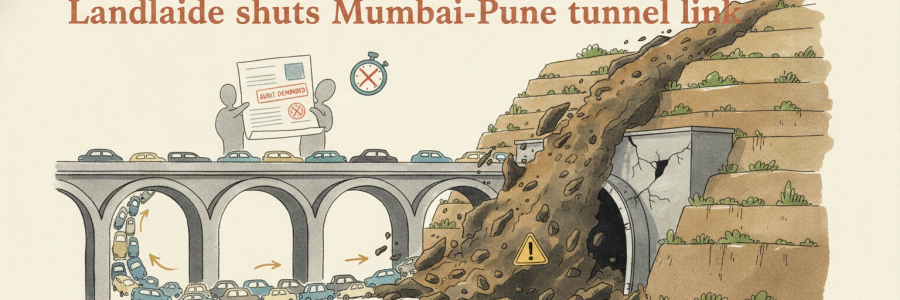
Landslide shuts Mumbai-Pune tunnel link
e8e37500-1fca-4de8-aee4-b7117d6daa26
A landslide near Tunnel 2 on the ₹6.7K Cr Mumbai-Pune Missing Link forced a traffic diversion just two months after CM Fadnavis inaugurated the 13-km stretch.Congress alleges defective tunnel lining and demands an independent audit, claiming the project skipped the 10-12 months of safety testing standard in Europe.Mumbai-Pune commuters faced hours-long jams near Lonavala, and taxi drivers reportedly avoid the route over safety fears.
What exactly triggered the landslide closure?
Heavy rainfall caused a landslide near the exit of Tunnel 2 on the Khopoli-Kusgaon stretch. MSRDC diverted Pune-to-Mumbai traffic starting 4 AM as a precaution. The 13-km route passes through the Sahyadri range, where monsoon-season hill instability is a known risk. The stretch reopened partially after assessment.
How does monsoon water seepage threaten tunnels?
Hill tunnels face hydrostatic pressure as rainwater percolates through rock fissures. If the concrete lining has gaps or cracks, water enters the tunnel structure and weakens it over time. The Sahyadri range receives ~3,000 mm of annual rainfall. Proper waterproofing membranes and drainage channels are standard in tunnel engineering to manage this.
What safety tests did MSRDC actually conduct?
MSRDC has not publicly detailed pre-launch test protocols for the Missing Link. In contrast, India's Atal Tunnel in Himachal Pradesh underwent phased load testing over several months before its 2020 opening. Gadgil's demand for an independent audit suggests MSRDC's internal assessments, if conducted, were not made transparent.
Could the tunnel alignment have avoided this?
Gadgil argued a route with more natural openings, meaning fewer deep-cut tunnels, could have reduced monsoon risk. The chosen alignment runs through six tunnels across the Sahyadri range. Alternative alignments were debated during planning but rejected for being longer. Deep-tunnel routes trade geological risk for shorter distance.
Was the Missing Link opened without testing?
Congress spokesperson Anant Gadgil, himself an architect, claims European tunnels undergo 10-12 months of post-construction testing before public use. The Missing Link was inaugurated on 1 May and opened immediately. Gadgil also cited social media photos showing alleged concrete lining defects inside the tunnels, raising questions about monsoon-readiness.
Is an independent audit legally required here?
No Indian law mandates third-party audits for highway tunnels after construction. The CAG can audit public expenditure, but only after the fact. Congress is demanding a voluntary independent review of both construction quality and the ₹6.7K Cr spending. Without legislative mandate, such audits depend on political will from the ruling party.
How do European tunnels handle post-build testing?
The EU's Directive 2004/54/EC requires extensive pre-opening inspections for tunnels over 500 metres. Austria's Brenner Base Tunnel, for example, runs multi-month ventilation, fire evacuation, and structural stress tests before any public access. These protocols test emergency systems under simulated worst-case scenarios, not just static structural integrity.
What precedent exists for Indian tunnel failures?
India has seen tunnel distress before. The Rohtang Tunnel approach road suffered landslides within its first monsoon season. Kolkata's East-West Metro tunnel faced waterlogging during construction due to subsoil water ingress. These cases show that geological conditions in India, particularly in the Western Ghats and Himalayas, demand monsoon-specific engineering safeguards.
Who bears the cost of rerouted commuters?
Commuters from cities like Sangli headed to Mumbai were stranded near Lonavala from 4 AM, stuck in bumper-to-bumper traffic on the old expressway ghat section. Taxi drivers who ply the Mumbai-Pune route reportedly already avoid the Missing Link. MSRDC urged motorists to skip the route unless travel was essential.
How much time did the diversion add for drivers?
The Missing Link normally saves ~25-30 minutes versus the old ghat route. With bumper-to-bumper traffic through Lonavala city, commuters reported multi-hour delays. One motorist from Sangli was stuck from 4 AM. Net time lost could exceed 2-3 hours versus the Missing Link's normal transit, effectively reversing the project's core benefit.
Do taxi drivers have data backing safety fears?
No systematic data has been published. Gadgil cited anecdotal reports from taxi drivers on the Mumbai-Pune route. Platforms like Uber and Ola could theoretically track route avoidance patterns through GPS data. Without formal complaint records or incident logs from MSRDC, the safety concerns remain qualitative rather than evidence-based.
Could MSRDC face liability for the disruption?
Indian highway authorities typically invoke force majeure for natural events like landslides. MSRDC's liability would depend on whether the landslide resulted from natural causes or construction defects. If an independent audit finds defective lining contributed to the failure, affected commuters or operators could pursue claims under tort law, though such cases rarely succeed in India.
Source: livemint.com