business · 2026-07-04
Manipal Health Gets SEBI Nod for IPO
3535bbf8-13f9-40a8-a66b-e973077feafd
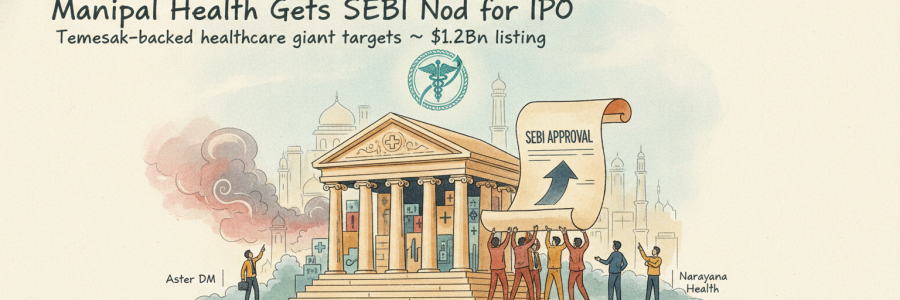
Temasek-backed Manipal Health received SEBI approval for a ~$1.2Bn IPO, targeting a late Jul or early Aug listing.This would be one of India's largest healthcare IPOs, arriving as foreign investors have sold $29.2Bn in Indian shares this year amid Iran war risks.Manipal's 28+ hospitals, Temasek as key backer, and IPO-watching healthcare rivals like Aster DM and Narayana Health all face ripple effects.
Why list now amid a $29.2Bn FII selloff?
Foreign investors have dumped $29.2Bn in Indian equities this year, pushing Nifty 50 down ~7%. Yet Manipal is betting domestic institutional and retail demand can absorb a $1.2Bn offer. India's mutual fund SIP inflows, averaging ~₹25K Cr/month, provide a domestic buyer base that partially offsets FII exits.
How does SEBI approval differ from launch?
SEBI approval means the regulator cleared the Draft Red Herring Prospectus, confirming disclosures meet standards. The company still must pick a launch window, set a price band, and open the book. For example, Hyundai India got SEBI nod weeks before its Oct 2024 listing date.
What is Manipal's bed count and occupancy?
Manipal operates 28+ hospitals with ~7,800 beds across India, concentrated in Karnataka and Maharashtra. Occupancy rates in India's top private hospital chains typically run 65-75%. High occupancy signals pricing power. Apollo Hospitals, by comparison, runs ~8,800 beds at ~68% occupancy.
How did Temasek originally invest in Manipal?
Temasek first invested in Manipal Health around 2015, gradually building a significant minority stake through multiple rounds. The sovereign wealth fund has a pattern of backing Indian healthcare platforms. It also holds stakes in Manipal Education and previously invested in Global Hospitals before its merger with Gleneagles.
Could this IPO reset healthcare valuations?
India's listed hospital chains like Apollo and Max Healthcare trade at 40-60x earnings. A $1.2Bn Manipal IPO would be among the largest healthcare listings, forcing the market to price complex-care demand growth explicitly. If Manipal prices richly, it validates premium multiples across the sector.
What makes this IPO window risky for pricing?
With Nifty down ~7% and FII selling at record pace, the price band must balance Temasek's return expectations against cautious market appetite. If Manipal prices too high, it risks a weak debut like Paytm's 2021 listing, which fell 27% on day one and took years to recover.
How do hospital IPOs perform post-listing?
India's recent hospital IPOs show mixed patterns. Max Healthcare, listed in 2020, rose ~400% over 4 years as post-Covid complex care demand surged. But smaller chains like Krishna Institute of Medical Sciences saw muted gains. The key driver is bed occupancy trajectory and revenue per occupied bed growth.
Does the Iran war affect healthcare demand?
War-driven geopolitical stress historically increases medical tourism demand as patients from Gulf countries seek care in India. Apollo and Fortis saw 15-20% jumps in international patient revenue during prior Middle East conflicts. Manipal's coastal Karnataka hospitals are positioned to capture this inflow.
Who beyond Manipal gains from this listing?
Temasek, holding a major stake, gets a partial exit and a public market valuation benchmark. Rival chains like Aster DM Health and Narayana Health gain comparable transaction data for their own expansion fundraising. Investment banks like Kotak and Morgan Stanley earn advisory fees on the deal.
Which investor category will anchor this IPO?
Domestic mutual funds now manage ~₹65L Cr in assets. Large AMCs like SBI MF and HDFC MF have become anchor investors replacing FIIs. In Hyundai India's IPO, domestic institutions took ~60% of the institutional book. Manipal likely needs similar domestic anchoring given the FII retreat.
How do Manipal's margins compare to Apollo?
Apollo Hospitals runs EBITDA margins of ~14-16%. Manipal's private financials suggest similar margins, but complex care specialties like organ transplants and oncology typically yield 18-22% margins. The IPO prospectus will reveal whether Manipal's specialty mix commands a premium over general hospital peers.
Could rival chains accelerate their own IPOs?
Aster DM Health, which demerged its India business in 2024, and Narayana Health are both weighing expansion fundraising. A strong Manipal debut would give them a fresh valuation benchmark. Conversely, a weak listing could delay plans. CK Birla's CMRI chain has also explored listing options.
Source: economictimes.indiatimes.com