world · 2026-07-04
Millions Gather for Khamenei Funeral
6a7510d1-56e5-42de-aef4-a72d06eec11d
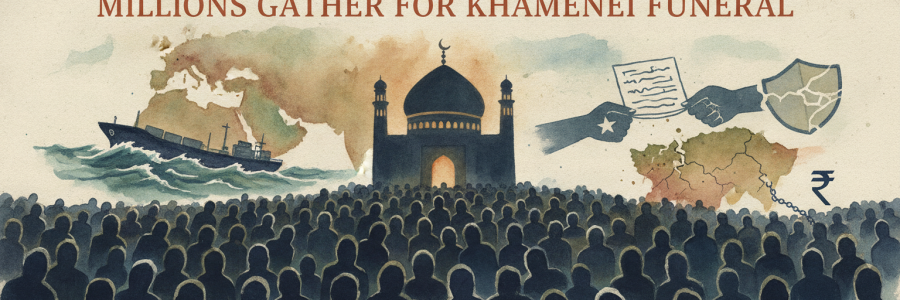
Millions expected in Tehran for the funeral of Iran's Supreme Leader Ali Khamenei, killed amid the ongoing US-Israel war on Iran.The funeral comes as diplomatic efforts around a US-Iran agreement face uncertainty, with Israel potentially undermining the deal.Indian oil imports, diaspora safety, and regional shipping routes face disruption as the Iran conflict escalates.
How did Khamenei's death reshape the conflict?
Khamenei's death removes the singular authority who controlled Iran's military and nuclear decisions. During the 1989 transition after Khomeini's death, succession took weeks. This time, the Revolutionary Guard's role in wartime makes the power vacuum more volatile, with no named successor yet confirmed.
Who is likely to succeed Khamenei?
Iran's Assembly of Experts, an 88-member elected body, formally selects the Supreme Leader. Khamenei's son Mojtaba has been discussed, but IRGC commanders hold de facto veto power. In 1989, Khamenei himself was a relatively junior cleric elevated as a compromise candidate.
What role does the IRGC play in succession?
The Islamic Revolutionary Guard Corps controls Iran's missile program, nuclear sites, and proxy networks like Hezbollah. In wartime, military commanders gain leverage over clerical elites. For comparison, Egypt's military effectively chose presidents after Mubarak's fall in 2011.
How do wartime successions differ structurally?
Wartime successions concentrate power in whoever controls active military operations. Unlike peacetime transitions where institutions negotiate, the commander directing the war effort gains immediate legitimacy. Pakistan's 1999 Kargil crisis, for example, elevated Musharraf precisely because he controlled the active front.
Could the US-Iran deal survive without him?
The US-Iran agreement reportedly aimed to de-escalate strikes and address nuclear concerns. Without Khamenei's authority to enforce compliance on Iran's side, hardliners in the IRGC may reject terms. Israel has signaled it could act to sabotage any deal, making ratification structurally fragile.
What specific terms were in the US-Iran deal?
Reports indicate the agreement covered a pause in US strikes, Iran's nuclear enrichment limits, and humanitarian access. The deal paralleled the 2015 JCPOA structure but added military de-escalation clauses. Without Khamenei's personal endorsement, Iran's negotiating team lacks binding authority.
Has Israel sabotaged similar deals before?
Israel opposed the 2015 JCPOA aggressively. Netanyahu lobbied the US Congress directly against it. Israel also conducted covert operations against Iran's nuclear program, including the assassination of scientist Mohsen Fakhrizadeh in 2020. The pattern suggests active efforts to undermine any new agreement.
Why can't a new leader simply honor the deal?
In Iran's system, only the Supreme Leader can authorize strategic foreign policy commitments. The president and foreign minister negotiate, but the Supreme Leader ratifies. Until a successor is installed with full authority, no Iranian official can credibly commit to long-term terms. This structural gap existed briefly in 1989 too.
Who in India faces the most risk from this?
India imports roughly 10% of its crude from Iran and the Gulf. Roughly 800K Indian workers live in the Gulf region. Companies like Mangalore Refinery depend on Iranian crude. Shipping insurers have already raised war-risk premiums for vessels transiting the Strait of Hormuz.
How are Indian refiners adjusting crude sources?
Indian Oil Corporation and Mangalore Refinery have begun diversifying toward Iraqi and Russian crude to offset Iranian supply risk. India imported ~1.2Mn barrels/day from the Gulf in 2025. Spot crude prices have risen ~15% since hostilities began, adding roughly ₹3-4/litre to India's import cost per barrel.
What happens to Gulf shipping insurance now?
War-risk premiums for Hormuz transit have jumped from ~0.05% to over 1% of cargo value. For a typical VLCC carrying $150Mn in crude, that is $1.5Mn per voyage versus $75K before. Lloyd's of London and Indian insurers like New India Assurance are repricing all Gulf-bound marine cargo policies.
Could India evacuate workers if conflict widens?
India evacuated ~170K citizens from Kuwait during the 1990 Gulf War via Operation Airlift and ~4K from Yemen in 2015's Operation Raahat. The Ministry of External Affairs has activated its crisis management division. Air India Express and Indian Navy vessels are on standby for potential Gulf evacuations.
Source: aljazeera.com