business · 2026-06-28
Neeraj Chopra Confirms Asian Games Bid
34063f20-ad20-4206-8eec-dc6605983912
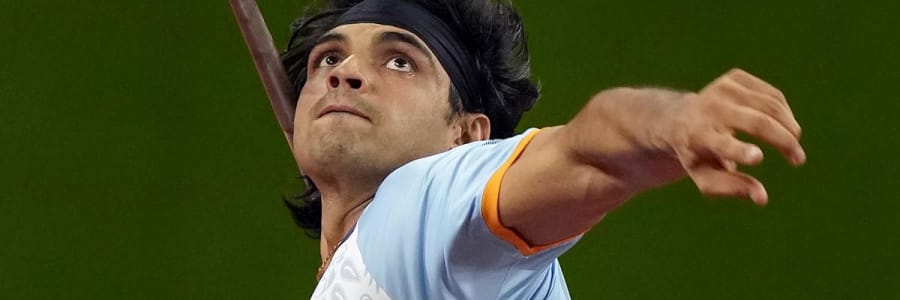
AFI confirmed Neeraj Chopra will defend his javelin gold at the Aichi-Nagoya Asian Games in Sep-Oct, alongside the Commonwealth Games in Glasgow.Chopra threw 85.69m in Doha after a back injury. His 2023 Asian Games gold came at 88.88m, so he is within striking distance of peak form.Rivals like Sri Lanka's Rumesh Tharanga (90m+ thrower) and Pakistan's Arshad Nadeem, the Olympic champion, make the javelin event fiercely competitive.
How close is Chopra's 85.69m to contention?
Chopra threw 85.69m in his season opener at Doha Diamond League, finishing fourth. His 2023 Asian Games gold came at 88.88m. AFI chief Sumariwalla called 85.69m "fantastic" for a first event back from a lower back injury sustained before the Sep 2025 Tokyo Worlds. He needs roughly 3m more to match his own title-winning mark.
What does 85.69m rank globally this season?
Tharanga's 90m+ throw and Diamond League wins place him among the world's top 3 this season. Chopra's 85.69m would rank outside the top 10 globally for 2026 so far. For context, the 2023 Worlds gold was won at 88.17m. Chopra needs significant improvement, but his history shows he typically gains 2-4m between season opener and major championship.
How does Chopra's back injury limit him?
Lower back injuries in javelin are common because the throw generates enormous rotational force on the lumbar spine, roughly 6-8 times body weight at release. Chopra's injury before Tokyo Worlds required months of rehab. Full recovery means rebuilding core stability and hip rotation speed. If either lags, release angle suffers, costing distance. Julius Yego's career declined after a similar back issue.
Has Chopra ever peaked twice in one season?
In 2022-23, Chopra competed at both the World Championships (Aug 2023, gold) and Asian Games (Oct 2023, gold), peaking twice within 8 weeks. That season he had no injury layoff. The current gap between CWG and Asian Games is 7 weeks, similar. His coach Bartonietz typically structures a build phase, competition block, and taper, replicating the periodization model used in German athletics.
Could Chopra peak for both CWG and Asian Games?
AFI has left competition scheduling to Chopra's medical team and coach to plan his peaking strategy. The Commonwealth Games run Jul 23 to Aug 2 in Glasgow, and the Asian Games start Sep 19 in Aichi-Nagoya. That 7-week gap is tight. Managing back-to-back peaks is notoriously difficult. Usain Bolt, for example, often skipped Diamond League events to preserve form for majors.
Why did Nadeem pull out of Doha?
Pakistan's athletics federation and Nadeem's camp gave no official reason for his Doha withdrawal after organisers had announced his name. Nadeem has managed elbow and shoulder issues historically. Missing Doha could be strategic load management before the Asian Games, where he defends gold. His absence removed Chopra's toughest test in that meet.
What makes peaking twice so hard physically?
Javelin athletes peak through a precise chain: neural firing rate, fast-twitch fiber recruitment, and connective tissue elasticity all must align simultaneously. After a major competition, the body needs 3-4 weeks to fully recover micro-tears in shoulder tendons. Compressing two peaks into 7 weeks means the second taper begins before full recovery from the first. Sprinter Shelly-Ann Fraser-Pryce famously struggled with this at back-to-back Worlds and Olympics.
Could India's World Athletics hosting bid help?
India has bid to host the 2029 or 2031 World Athletics Championships and 2028 World U20 Championships, both in Ahmedabad. Competing against London, Munich, and Kenya, a successful bid would bring global athletics infrastructure investment. For Chopra, strong Asian Games results boost India's credibility as a serious athletics nation. World Athletics inspected Ahmedabad's facilities, with a host decision expected after Budapest in Sep 2026.
Who are the rivals Chopra must beat in Japan?
Sri Lanka's Rumesh Tharanga Pathirage broke 90m this year and won two Diamond League titles, including Doha where he beat Chopra. Pakistan's Arshad Nadeem is the reigning Olympic, Asian Games, and Commonwealth Games javelin champion. Nadeem pulled out of Doha on Jun 19, raising fitness questions. A three-way rivalry makes Aichi-Nagoya's javelin final among the most anticipated events.
How does Tharanga's technique differ from his?
Tharanga uses a longer run-up and generates speed primarily through leg drive, similar to Finland's school of throwing. Chopra relies more on a whip-like arm action with a shorter approach. Biomechanically, Tharanga's method suits larger athletes who can sustain velocity across 30m run-ups. Chopra's compact technique is more injury-friendly but has a lower ceiling, which is why 90m has eluded him so far.
What is Nadeem's injury history?
Nadeem has dealt with chronic elbow issues since 2018, requiring PRP (platelet-rich plasma) therapy. He also had shoulder inflammation before the 2024 Paris Olympics, where he still won gold with 92.97m. Pakistan's athletics infrastructure offers limited sports science support, so Nadeem has trained intermittently in Turkey. Recurring elbow stress is common in javelin due to valgus torque at release.
Who funds Chopra's training and rehab abroad?
Chopra's training is funded through multiple streams. The Sports Authority of India's TOPS (Target Olympic Podium Scheme) covers coaching, travel, and medical expenses, roughly ₹1-2Cr annually. JSW Sports, his management partner, provides commercial sponsorship income. His German training base near Offenburg is partially self-funded from endorsement earnings, which reportedly exceed ₹20Cr/year from brands like Tata AIA and Omega.
Source: thehindu.com