business · 2026-10-12
New rivals take on Swiggy and Zomato
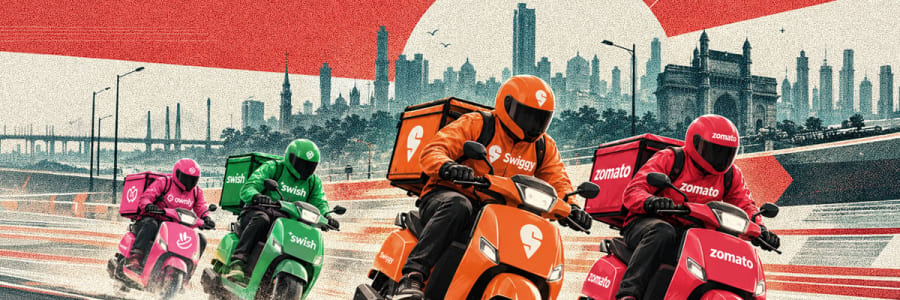
Photo: via Inc42 Media
Rapido, Swish and Flipkart are entering India's food delivery market with lower fees for restaurants. They hope to break Swiggy and Zomato's grip, but their business models are untested at scale.
What have Rapido, Swish and Flipkart actually launched?
Rapido's food delivery app Ownly launched citywide in Bengaluru on March 3, 2026, and now does over 50,000 orders daily there, recently entering Hyderabad. Swish, a 10-minute delivery startup, is testing Swish Go, a marketplace for third-party restaurants, in parts of Bengaluru. Flipkart is still testing Eat In, also in Bengaluru.
Where does Rapido make money on zero commission?
Right now, it doesn't. Rapido's own head of new initiatives told restaurant partners, "In the beginning, we're not going to be earning money." Customers pay a flat ₹30 delivery fee, and that's the only revenue. There's no commission, subscription, or advertising. It's operating as a loss leader, betting its existing bike-taxi network will eventually make the math work.
Any other players apart from Rapido and Swish?
Yes, there's a third player. Flipkart brings 500 million users and 800 dark stores from its quick commerce service, Minutes. It lacks a delivery fleet, so the challenge is converting occasional shoppers into daily food orderers, a hard habit to build. That's a different structural position.
What makes Rapido or Swish think they can succeed where Swiggy and Zomato failed?
Rapido thinks its existing bike-taxi rider network can deliver food without building a new fleet, so it can afford to charge restaurants zero commission. Swish thinks owning its kitchens and delivery lets it keep 25-30% more margin than aggregators. Both are unproven at scale, but that's the bet.
Why would a restaurant switch from Swiggy or Zomato?
Restaurants switch because Swiggy and Zomato deduct 25-32% and 26-35% of each order respectively in commission, advertising and fees. Rapido's Ownly charges restaurants nothing, keeping the full menu price, with customers paying a flat ₹30 delivery fee. That difference, tens of thousands of rupees monthly, is what drives restaurants to try an untested platform.
Is Rapido's rider network a real structural advantage?
Yes, it is real, but it does not guarantee profits. Rapido already has bike-taxi riders in 600+ cities, so Ownly deliveries use the same network instead of building a new fleet. That lowers logistics costs. But the model still loses money on each order, and the advantage depends on the rider network and dedicated customers.
Is any of this sustainable or just VC money burning?
The economics are brutal: Swiggy shut its 10-minute app Snacc in February 2026, and Zomato's parent Eternal dropped Quick and Everyday. Rapido's ₹30 delivery fee doesn't cover the ₹50-60 per order it costs. But Swish says its own kitchens and riders are profitable in dense Bengaluru clusters, which is unproven elsewhere.
Is there a structural advantage or is it just subsidies?
It's partly both, but mostly unproven. Rapido's rider network and Swish's own kitchens are real structural edges. Yet Swish Go delivered an order for ₹461 versus ₹573 on Zomato and ₹628 on Swiggy, a gap that looks like subsidy. Whether those savings survive scale, no one can say yet.
Source: inc42.com