economy · 2026-07-02
Only 2 in 1,000 Indian MSMEs Export
a977a5a3-e7b3-4604-abf0-a826bc30f077
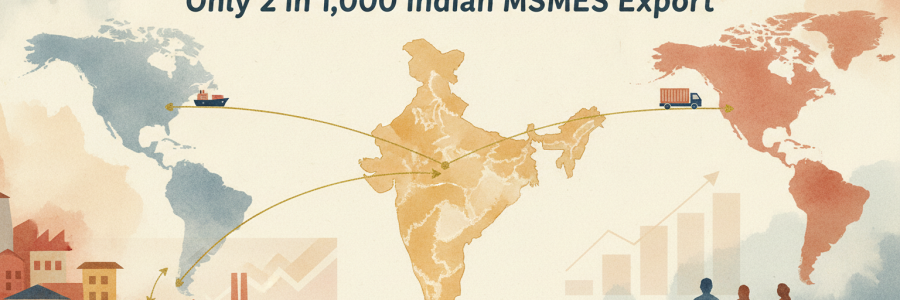
Just 1.7L of India's 8.7Cr MSMEs export, a ratio of roughly 2 in 1,000, despite govt push through Make in India, PLI schemes, and FTAs.This gap means India's export base is dangerously narrow. Losing even a fraction of these 1.7L exporters could visibly dent merchandise shipments.Small manufacturers, artisans, and agri-processors across tier-2 and tier-3 cities miss out on higher-margin global demand they could serve.
Why do so few MSMEs clear the export bar?
Most MSMEs lack export documentation capacity, quality certifications like ISO or FSSAI for food, and access to trade finance. For example, a Tirupur knitwear unit may produce export-grade garments but cannot navigate customs paperwork or afford LC-based financing, keeping it domestic-only.
What makes export paperwork so hard for MSMEs?
An MSME must manage an IEC code, shipping bills, GST refund claims, phytosanitary certificates for agri goods, and origin documentation for FTA benefits. A 10-person Rajkot auto-parts workshop typically has no compliance staff. Each missed document can stall shipments at port for days.
How does trade finance block small exporters?
Export orders typically require a letter of credit or buyer's credit. Banks demand collateral worth 100-150% of the loan. A Surat diamond polisher with ₹50L turnover often cannot pledge enough. RBI's Trade Receivables platform (TReDS) helps, but only ~25K MSMEs are registered on it so far.
Do PLI schemes actually help MSMEs export?
Most PLI schemes set minimum investment thresholds of ₹10-25Cr, designed for mid-to-large firms. For example, the PLI for white goods requires ₹7.5Cr minimum investment. A small Faridabad fan motor assembler earning ₹2Cr/year cannot qualify, so the export incentive bypasses the MSME majority.
How narrow is India's export base vs peers?
China has roughly 5 out of every 100 SMEs exporting. Vietnam's ratio is even higher thanks to FTA-driven supply chains. India's 2-in-1,000 ratio means its $450Bn merchandise export bill rests on a tiny sliver. Broadening this base by even 1% of MSMEs could add tens of billions in exports.
How does Vietnam get more SMEs to export?
Vietnam embedded SMEs into multinational supply chains through FTA commitments. Samsung's Vietnamese factories source ~200 local component suppliers. India's FTAs with ASEAN and Japan have not generated comparable supplier integration because rules-of-origin compliance remains complex for small firms.
What share of India's exports come from MSMEs?
MSMEs contribute roughly 45% of India's total exports, but this comes from just 1.7L units. That concentration means the top few thousand MSME exporters, like Tirupur's large knitwear firms, drive the bulk. The remaining 8.5Cr+ MSMEs contribute almost nothing to foreign exchange earnings.
Could digital platforms close the export gap?
Platforms like Amazon Global Selling and IndiaMART have onboarded ~1L sellers for cross-border trade. But conversion to actual export shipments is low, roughly 10-15%, because sellers still face customs, returns logistics, and certification barriers. A Jaipur block-print seller can list globally but struggles to ship reliably.
Which MSME clusters could export but don't?
Moradabad's brassware cluster, Ludhiana's bicycle makers, and Kolhapur's leather chappal artisans produce globally competitive goods but sell almost entirely domestically. These clusters often lack container-load volumes, quality testing labs, and logistics connectivity to the nearest port.
Which MSME clusters are closest to exporting?
Clusters already meeting domestic quality standards are nearest. Sivakasi's fireworks makers export ~₹500Cr/year but thousands more units could join. Panipat's home textile cluster exports some rugs but most weavers sell only to Delhi wholesalers, missing direct export margins of 20-30% more.
How do peer countries train MSMEs to export?
South Korea's KOTRA agency assigns export mentors to SMEs, covering certification costs and running overseas buyer-matching fairs. Taiwan's ITRI co-develops export-grade products with SMEs. India's DGFT runs awareness camps, but lacks a structured mentorship-plus-subsidy pipeline comparable to these models.
What would doubling MSME exporters mean?
If India doubled MSME exporters to 3.4L, even at an average of ₹1Cr exports each, that adds ₹34K Cr, roughly $4Bn, to merchandise exports. More importantly, it diversifies risk. Currently, if Tirupur's 5 largest knitwear exporters falter, India's apparel export numbers visibly drop.
Source: ndtv.com