economy · 2026-07-11
RBI's $107Bn Dollar Bet Is Now a Problem
360f090e-d370-4864-8384-41a652808071
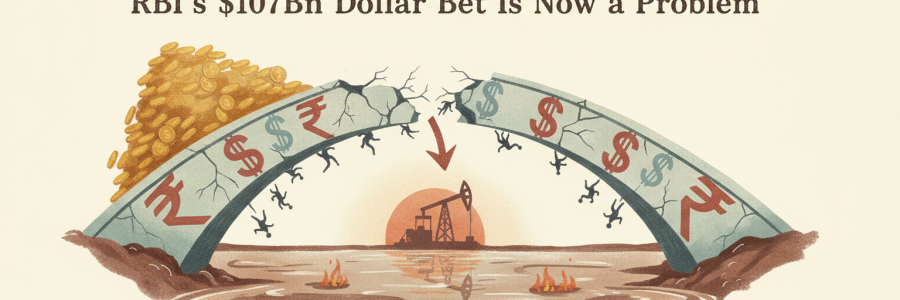
RBI built a record $106.7Bn short dollar forward position to defend the rupee. It now faces costly unwinding that could itself weaken the rupee, just as oil prices rise on US-Iran tensions.This is deferred dollar demand. Settling these contracts means buying dollars with rupees, creating fresh depreciation pressure on a currency already on track for a ninth straight year of losses.Foreign investors watching the unwind pace as a confidence gauge, importers exposed to rupee weakness, and oil companies facing higher costs if the rupee slides further.
How is RBI actually unwinding this position?
RBI trimmed ~$10-15Bn from its offshore short dollar forwards since mid-Jun, using improved sentiment after India relaxed foreign investment rules on govt bonds and cut taxes on debt returns. Last year, it unwound ~$35Bn over six months while letting the rupee move more freely. The rupee weakened 0.8% during that period.
What exactly is a short dollar forward?
RBI commits to sell dollars and buy rupees at a future date, say 3 months out. This supports the rupee without immediately spending foreign reserves. But when the contract matures, RBI must deliver dollars. If it doesn't want to deplete reserves, it rolls the contract forward, deferring the demand.
Why did the book balloon to a record in May?
Three shocks stacked up. Punishing US tariffs on India in 2025 forced heavy intervention. Then the Middle East war early 2026 pushed oil prices up, weakening the rupee further. A resurgent dollar globally meant RBI had to ramp up offshore NDF trading in late 2024. Each shock added $10-20Bn to the book.
How does offshore NDF trading fit in?
Non-deliverable forwards settle in dollars without physical rupee delivery, letting RBI intervene in offshore markets like London and Singapore where speculators trade. RBI deepened its NDF presence in late 2024 to prevent offshore rupee prices from diverging sharply from onshore rates, which can trigger capital flight.
Could the rupee handle shocks without this?
The short forward book is deferred dollar demand. Settling it requires buying dollars, which pressures the rupee downward. If RBI unwinds too fast, it cancels out the benefit of fresh foreign inflows. Too slow, and carrying costs mount. Last year's $35Bn unwind made the rupee the only EM Asian currency to depreciate against the dollar.
How do other EM central banks compare?
Indonesia and Malaysia also use derivatives to manage exchange rates, but RBI's book grew at what economist Rajeswari Sengupta calls a "remarkable" pace, faster than typical EM central banks. Most peers keep net short positions under $20-30Bn. India's $107Bn is roughly 3x Indonesia's peak forward exposure.
What happens if oil spikes during the unwind?
Oil imports are India's single largest dollar outflow, ~$150Bn/year. A $10/barrel spike adds ~$15Bn in annual import costs. If this coincides with RBI buying dollars to settle forwards, the combined demand could push the rupee past 90/$. That is essentially a double hit, imported inflation plus intervention-driven depreciation.
Could fresh inflows cover the unwind cost?
India's recent moves, relaxing foreign investment rules for govt bonds and cutting tax on debt returns, aim to attract enough inflows to cushion the unwind. If $30-40Bn enters bond markets annually, RBI can settle forwards without net dollar drain. But FPI flows are volatile. In 2022, FPIs pulled out ~$17Bn from Indian debt in a single quarter.
Who beyond importers feels the pressure?
Foreign bond investors watch the unwind pace as a signal of RBI confidence. Importers, especially oil companies like IOC and BPCL, face higher costs if the rupee weakens further. Oil prices are already rising on US-Iran tensions. Airlines like IndiGo, which pay for fuel and leases in dollars, also face margin pressure.
Who in India's airline sector gets hit hardest?
IndiGo, with ~60% domestic market share, pays aircraft lease rentals and fuel costs in dollars. A 1% rupee depreciation adds roughly ₹200-250Cr to IndiGo's annual costs. Air India, now under Tata, faces similar pressure but with a larger wide-body fleet, meaning even higher dollar-denominated lease bills.
How do oil marketing companies absorb this?
IOC, BPCL, and HPCL import crude in dollars and sell fuel at govt-influenced prices. When the rupee weakens, their per-barrel cost rises but they cannot always pass it through to pump prices. In Q3 2025, BPCL's marketing margin on diesel fell to ₹1.5/litre from ₹3, largely due to rupee depreciation compressing margins.
Do Indian IT exporters benefit from weakness?
IT exporters like TCS and Infosys earn ~75% of revenue in dollars. A weaker rupee boosts their reported revenue in rupee terms. TCS disclosed that every 1% rupee depreciation adds ~40 basis points to operating margins. However, this benefit is partly offset by higher costs for imported hardware and US-based employee salaries.
Source: economictimes.indiatimes.com