business · 2026-07-07
SEBI Warns Reliance Over Insider Trades
f0769f8e-c52b-4cc7-8d43-1b2b602ba4ee
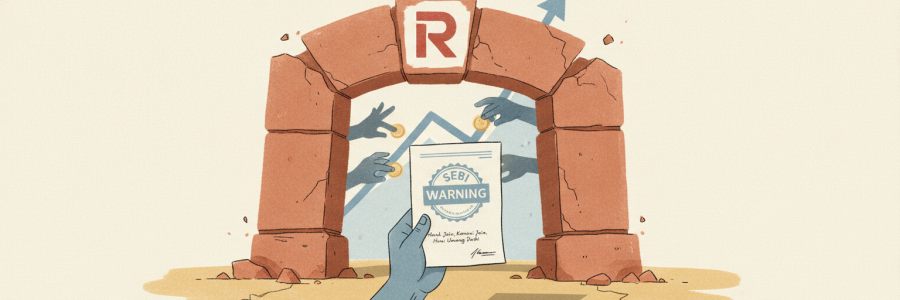
SEBI found two Reliance employees and one relative traded shares while holding unpublished price sensitive information between Jun and Aug 2024.Reliance only detected the trades after SEBI flagged them, exposing gaps in internal compliance monitoring at India's largest listed company by market cap.Reliance's compliance officer received the warning. Named individuals Harsh Jain, Kamini Jain, and Hirai Umang Doshi face potential further action under SEBI rules.
What exactly did the three individuals trade?
The trades were tiny. Harsh Jain bought just 2 shares worth Rs 6,385. Kamini Jain sold 35 shares for ~Rs 1.1L and bought 25 back the next day for ~Rs 79K. Hirai Umang Doshi sold 15 shares for ~Rs 48K. All trades occurred during Jul 2024, when SEBI says unpublished price sensitive information existed.
Were these trades profitable for them?
The amounts suggest minimal profit, if any. Kamini Jain sold 35 shares at ~Rs 3,134 each, then bought 25 back at ~Rs 3,155 each, likely at a small loss on the repurchase. The issue is not profit size but the legal violation. SEBI's insider trading rules apply regardless of trade value or profit earned.
What counts as UPSI in this period?
UPSI, or unpublished price sensitive information, includes earnings, dividends, mergers, or material contracts not yet disclosed. The Jun-Aug 2024 window covers Reliance's Q1 FY25 results period. Quarterly earnings are the most common trigger. Companies must maintain a 'trading window closure' list, and connected persons are barred from trading during these periods.
How did SEBI detect such small trades?
SEBI's surveillance system automatically scans all exchange trades, matching them against insider databases that listed companies must file. Every company submits a list of designated persons and their relatives. SEBI's algorithms flag when anyone on that list trades during a restricted window, regardless of trade size. Even 2-share purchases get caught.
Why did Reliance miss these trades internally?
Listed companies must run pre-clearance systems where employees seek approval before trading company stock during sensitive windows. Reliance's system failed to flag trades worth under Rs 1.1L, a negligible sum for a $230Bn company. SEBI noted Reliance only noticed after the regulator's own communication, suggesting the internal trade-monitoring system had gaps in flagging connected persons and relatives.
How common are insider trading cases in India?
SEBI investigated 90 insider trading cases in FY24, up from 55 in FY21. Most involve connected persons at mid-cap firms. Large-cap cases like Reliance draw attention because of the company's profile. Still, actual prosecutions remain rare. Fewer than 1 in 5 investigations lead to formal orders or penalties.
What makes pre-clearance systems fail?
Pre-clearance works only when companies maintain updated lists of connected persons and their relatives. The common failure point is incomplete relative mapping. If a compliance team doesn't know that Kamini Jain is an employee's spouse, the system won't flag her trades. Many firms still rely on self-declaration by employees, which creates gaps.
Has SEBI penalized other large-cap firms?
Yes. SEBI fined HDFC Bank's former investment banker in 2021 for insider trading. In 2023, it penalized several connected persons at Wipro. Infosys faced scrutiny over whistleblower allegations in 2019, though no insider trading charges followed. The pattern shows SEBI increasingly targets individuals at blue-chip companies, not just promoters at smaller firms.
Could the named individuals face penalties?
SEBI's warning is currently cautionary, with no fines or restrictions. But the letter explicitly states that repeat failures could trigger formal action under the SEBI Act. For context, SEBI fined Reliance Rs 25 crore in a separate 2007 insider trading case. The named individuals could face disgorgement of profits or trading bans if SEBI escalates.
What penalties can SEBI impose here?
SEBI can impose three levels of action. First, disgorgement, where traders return all profits plus interest. Second, trading bans of up to 3 years for individuals. Third, monetary penalties up to Rs 25 crore or three times the profit, whichever is higher. For trades this small, disgorgement would be negligible, but a trading ban would carry reputational consequences.
Do other countries catch trades this small?
The US SEC uses similarly automated surveillance but generally pursues cases above $10K in profit. The UK's FCA has a higher materiality threshold. India's SEBI is unusual in applying zero materiality thresholds. A Rs 6,385 trade triggering a formal investigation would be rare in most Western markets. This reflects SEBI's 2015 regulation design, which treats any connected-person trade during a UPSI window as a violation.
Could this affect Reliance's stock price?
Unlikely in any material way. The trades totaled under Rs 2.5L, and the warning is cautionary with no fines. Reliance's market cap exceeds Rs 19L Cr. For comparison, when SEBI imposed a Rs 25 crore penalty on Reliance in 2007, the stock barely moved. Institutional investors typically discount administrative warnings unless they signal broader governance failures.
Source: economictimes.indiatimes.com