business · 2026-07-30
Swiggy's Losses Shrink as Instamart Nears Break-Even
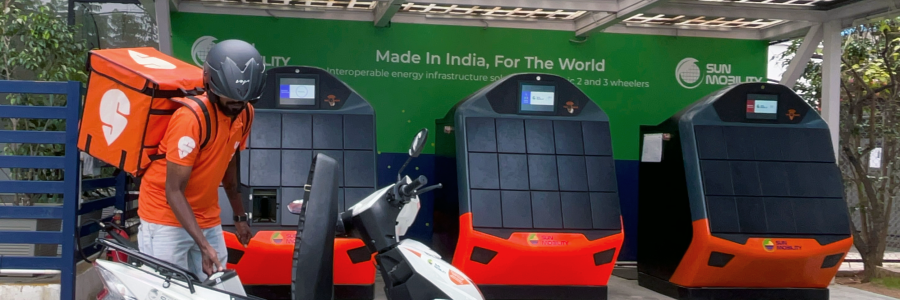
Photo: Eshshiv / Wikimedia (CC0)
Swiggy's Q1 net loss narrowed 34% to ₹791 crore, beating analyst estimates of ₹720 crore loss.Instamart's adjusted EBITDA margin improved to -9.8% from -10.9%, inching toward contribution break-even.Revenue hit ₹6,812 crore, above the ₹6,521 crore analysts expected, led by food delivery and Instamart
How did Instamart move closer to break-even?
Instamart's adjusted EBITDA margin improved to -9.8% from -10.9% the prior quarter, a sign quick commerce orders are covering more of their own delivery and operating costs, even though the unit still loses money on every order.
Why is quick commerce losing money per order?
Quick commerce dark stores carry rent, packing staff and fast-delivery rider costs on every order. Contribution break-even means revenue per order now covers these direct costs, but corporate overheads and expansion spending still sit on top.
What is contribution break-even for a business?
Contribution break-even excludes overheads, depreciation and investments, so full profitability may still lag. Instamart's contribution losses were ₹181 crore in Q2 FY26 (margin -2.6%), with break-even targeted before the June 2026 quarter—one analyst noted "operational profitability is still a long way away.
Which rival is Instamart racing to break-even?
. Blinkit already posts EBITDA profits while Instamart races to catch up.
Were spending trends different for food delivery?
Food delivery stayed resilient as customers ordered more often, and Swiggy earned extra from ads and platform fees. That combination pushed revenue to ₹6,812 crore, ahead of the ₹6,521 crore analysts had forecast.
How do platform fees + ads change unit economics?
Ads and platform fees are revenue that does not require Swiggy to give discounts, so every rupee earned this way adds more directly to profit than a discounted food order does.
Why do analysts track loss estimates so closely?
When a loss-making platform beats a loss estimate (e.g., reporting a smaller loss than a consensus estimate of ₹720 crore), it signals that the timeline to contribution margin and EBITDA breakeven is accelerating. It allows analysts to distinguish between growth fueled by unsustainable capital burn and quality growth driven by underlying operating leverage.
Could ad revenues reduce reliance on discounts?
If ad and platform fee revenue keeps growing faster than order volumes, Swiggy could rely less on discounting to win customers, improving margins across both food delivery and Instamart.
Who gains most from Swiggy's improving numbers?
Sriharsha Majety, Swiggy's CEO, leads a company investors are watching closely since narrower losses and Instamart's progress could ease pressure on the stock and shape how much more capital Swiggy needs to raise.
Who else closely tracks these numbers?
Beyond investors, rivals like Zomato track these numbers to benchmark quick-commerce unit economics and dark-store expansion. FMCG brands and restaurant partners monitor platform health to negotiate commissions and ad spend. Meanwhile, macro analysts assess the earnings as a pulse on broader urban Indian consumer spending appetite.
Does Instamart's break-even affect delivery riders
Riders are paid per delivery regardless of Instamart's margin status. Higher order density improves trip utilization and batching, but achieving break-even typically forces platforms to compress base per-order pay and tighten incentive slabs, requiring riders to complete more deliveries to maintain income levels.
What if Instamart never turns fully profitable?
If Instamart fails to reach bottom-line profitability, Swiggy will likely treat it as a subsidized loss leader or scale back dark-store infrastructure. Perpetual losses would drag down group valuation, force capital reallocation toward profitable food delivery, and potentially trigger a spin-off or consolidation with a rival to stop cash burn.
Source: thehindubusinessline.com