business · 2026-07-10
TCS Posts 14% Revenue Growth, ₹12 Dividend
0e5e58fe-1800-4f2b-a9e2-49e6a98f95ed
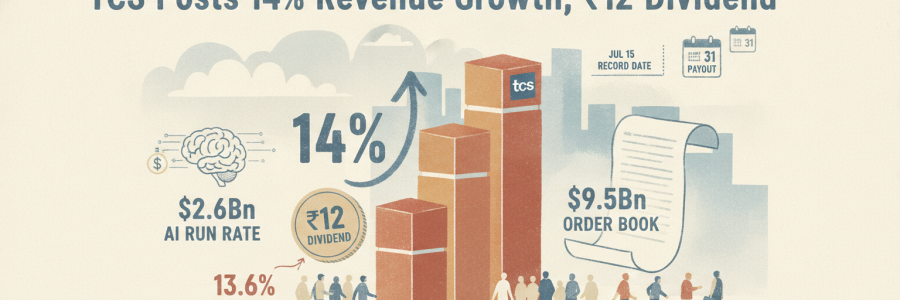
TCS reported Q1 FY27 revenue of ₹72.3K Cr, up ~14% YoY, with net profit rising ~4.6% to ₹13.3K Cr. It declared a ₹12/share interim dividend.Revenue growth was powered by a $9.5Bn order book and AI business hitting a $2.6Bn annualized run rate, signaling AI-led deals are now material.5.9L TCS employees face 13.6% attrition. Shareholders on record by Jul 15 receive the dividend on Jul 31.
What drove the gap between revenue and profit?
TCS revenue grew ~14% but profit rose only ~4.6%, suggesting margin pressure. Higher employee costs across its 5.9L workforce and investments in AI capabilities likely absorbed gains. For comparison, rival Infosys faced similar margin compression in recent quarters due to wage hikes and hiring in specialized skills.
Why did profit margins compress this quarter?
TCS's operating margin likely dipped because revenue growth came partly from large transformation deals like SKF, which typically carry lower initial margins. Deal ramp-ups require upfront staffing and investment. Infosys saw similar patterns when onboarding mega-deals, with margins recovering only after 2 to 3 quarters of delivery.
How large is TCS's workforce cost base?
TCS employs 5.9L people, making employee costs roughly 55 to 60% of revenue. At ₹72.3K Cr quarterly revenue, that implies ~₹40K Cr in people costs. Even a 1% wage increase across this base adds ~₹400 Cr per quarter. Wipro and Infosys operate at similar ratios, making wage inflation the single largest margin lever.
Could TCS restore margins without cutting staff?
TCS can improve margins through automation and offshoring mix. Its AI tools like TCS Ignio automate IT operations, reducing headcount needs on mature projects. Shifting delivery from onsite (US/Europe) to offshore (India) also boosts margins by 15 to 20 percentage points per project. This is how the industry structurally recovers margins without layoffs.
How material is TCS's $2.6Bn AI run rate?
TCS's AI business hit a $2.6Bn annualized run rate, roughly 5% of its total ~$50Bn annualized revenue. The SKF transformation deal signals industrial clients are now buying AI-led overhauls, not just pilots. For context, Accenture's AI bookings crossed $3Bn per quarter in 2025, making TCS's figure competitive but still trailing.
What share of TCS revenue now comes from AI?
At $2.6Bn annualized, AI is roughly 5% of TCS's total revenue, up from near zero three years ago. For scale, that AI run rate alone exceeds the total revenue of mid-tier firms like Mphasis. TCS counts GenAI integration, data analytics, and ML-ops within this figure, not just standalone AI projects.
How does the $9.5Bn order book compare to peers?
TCS's $9.5Bn quarterly order book is among the industry's largest. Infosys reported ~$4.1Bn in large deal bookings last comparable quarter. However, TCS counts all new bookings including renewals, while some peers report only large deals. The meaningful metric is book-to-bill ratio, where above 1.0x signals growing pipeline.
Is AI cannibalizing traditional IT services?
Partly, yes. Traditional application maintenance contracts, once 40% of IT revenue, are shrinking as AI automates testing and monitoring. But AI creates new revenue streams. TCS's SKF deal bundles AI transformation with cloud migration, meaning AI replaces some legacy work while generating higher-value engagements. Net effect so far is revenue expansion, not cannibalization.
Who benefits most from the ₹12 dividend?
Tata Sons, holding ~72% of TCS, receives roughly ₹3.1K Cr from this ₹12/share dividend alone. Retail investors on record by Jul 15 also benefit. TCS pays dividends quarterly, making it a steady income stock. Last FY, total dividends exceeded ₹70/share, yielding ~3.4% at current prices.
How much does Tata Sons depend on TCS dividends?
TCS dividends are Tata Sons' primary cash source, funding the conglomerate's investments in Tata Motors, Air India, and Tata Electronics. With ~72% ownership, Tata Sons collects roughly ₹18K to 20K Cr annually from TCS dividends alone. This is why TCS maintains one of India's highest payout ratios at ~80% of profits.
Do retail investors time purchases for dividends?
Some do. TCS shares often see a small run-up before record dates as retail buyers seek dividend income. However, share prices typically drop by roughly the dividend amount on the ex-date. For a ₹12 dividend on a ₹2,048 stock, the yield is ~0.6% per quarter, attractive mainly for large holders or those in lower tax brackets.
What happens if TCS cuts its dividend policy?
A dividend cut would hit Tata Sons' cash flow, potentially forcing it to raise debt or sell non-core assets. When Vodafone Idea cut dividends in 2019, its stock dropped sharply. TCS is unlikely to cut because its cash generation exceeds ₹40K Cr annually, well above dividend obligations of ~₹36K Cr. The payout is structurally sustainable.
Source: businesstoday.in