business · 2026-07-05
Top 5 IT Firms Now Worth Less Than RIL
f97376c6-b059-4f83-a03c-5d99179ddc30
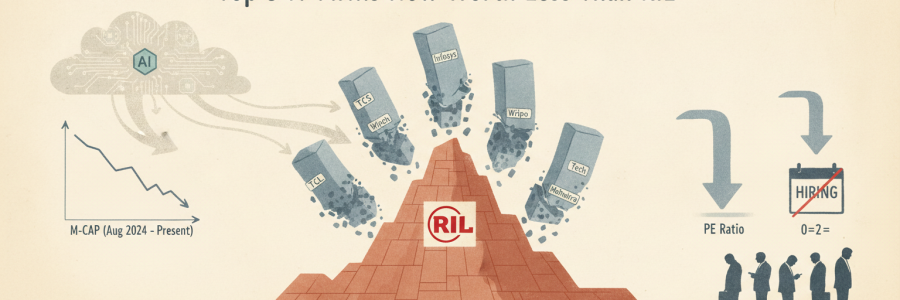
Combined m-cap of TCS, Infosys, Wipro, HCL Tech, and Tech Mahindra fell 46% from ₹33.7L Cr to ₹18.15L Cr since Aug 2024, now below RIL's ₹17.65L Cr.GenAI-led pricing deflation is shrinking demand for traditional IT services. JP Morgan says AI deflation is only in year two, with headwinds likely for two more years.IT sector employees face slower hiring as firms like Wipro guide for negative sequential growth, while brokerages cut target PE multiples by 10-25%.
What drove the 46% m-cap crash specifically?
Three forces combined: enterprises delayed discretionary IT spending amid geopolitical tensions, GenAI automated tasks that traditional services teams once handled, and deal closures slowed as clients waited for AI strategies to clarify. Accenture's weak guidance confirmed the trend is global, not India-specific. Revenue growth has been stuck at 2-3% for three years.
How is GenAI replacing traditional IT work?
GenAI automates tasks like code testing, documentation, and basic application maintenance that IT services firms billed by the hour. A project needing 100 engineers might now need 60. Accenture reported this pattern globally. The pricing model shifts from labor hours to AI-token consumption, structurally shrinking the addressable market for headcount-based firms.
What role did geopolitical tensions play?
The Middle East conflict created direct disruption for IT firms with clients in affected regions. More broadly, US-China tensions and tariff uncertainty made enterprises freeze discretionary tech budgets. JM Financial noted these geopolitical factors compounded AI uncertainty, making clients reluctant to commit to multi-year transformation deals that are IT firms' bread and butter.
Why did deal closures slow so sharply?
Enterprise clients now face a strategic dilemma: sign a traditional IT services contract or wait for AI-native solutions that could be 30-40% cheaper. This indecision delays deal conversion from pipeline to revenue. JP Morgan noted revenue conversion rates dropped as clients extended evaluation cycles. A deal that once closed in 3 months now takes 6-9 months.
Could IT firms pivot fast enough to offset AI?
JP Morgan sees large-cap IT firms stuck at 3-4% growth, down from mid-single-digit expectations. The core problem is structural: AI tokens and cloud spending replace traditional services revenue at lower price points. For context, JP Morgan cut target PE multiples to 12-15x, a level not seen since pre-pandemic IT valuations. Without new revenue streams, these firms can't outgrow AI-led deflation.
Can IT firms charge more for AI services?
The math works against them. AI consulting commands higher per-project fees, but projects finish faster and need fewer people. Infosys and TCS have launched GenAI practices, but revenue per engagement shrinks. For example, a cloud migration project worth ₹50 Cr with traditional methods might cost only ₹30 Cr with AI acceleration, netting less total revenue.
How does AI deflation compare to past shocks?
Unlike the 2008 financial crisis, which cut IT demand temporarily, AI deflation is structural. Post-2008, IT spending rebounded as economies recovered. AI-led deflation permanently reduces the labor intensity of software services. JP Morgan calls it a multi-year compression, estimating at least two more years of headwinds. The closest parallel is when automation shrank BPO margins in 2015-2018.
What would restore mid-single-digit growth?
JP Morgan sees two paths: either IT firms build proprietary AI platforms that generate recurring license revenue, or they acquire AI-native companies. Neither is quick. TCS would need AI platform revenue to reach ~15% of total revenue to offset services deflation. Currently, most large-cap firms derive less than 5% from AI-specific engagements, making the gap substantial.
Which IT company faces the steepest downgrade?
Wipro faces the worst near-term outlook. JP Morgan expects Wipro to guide for negative 2% to flat sequential growth in Q2 FY27. Infosys may cut FY27 guidance to 1-2.5% constant-currency growth. HCL Tech's Services guidance could drop to 1-3.5%. JM Financial flagged that even the seasonally strong Q1 FY27 will disappoint versus expectations.
Who loses most among IT employees?
Mid-level engineers doing maintenance, testing, and support face the highest displacement risk. Entry-level hiring has already slowed. TCS and Infosys reduced campus hiring targets. Employees in AI, data engineering, and cloud architecture remain in demand, creating a two-track workforce where traditional skills lose leverage while specialized AI roles command premiums.
How are IT stock investors repositioning?
Institutional investors are rotating from IT into capital goods, defense, and power sectors. FII holdings in Indian IT dropped to multi-year lows. Some value investors see opportunity at 12-15x PE, but JP Morgan warns against catching a falling knife. Mutual funds like HDFC Technology Fund have underperformed Nifty by ~30 percentage points since Aug 2024.
Could smaller IT firms actually gain here?
Smaller, AI-native firms like Persistent Systems and Coforge could gain share in specific verticals. Their leaner cost structures mean AI-led pricing pressure hurts less. A ₹500 Cr AI project is transformative for a mid-cap but barely moves TCS's ₹2.4L Cr revenue. However, mid-caps face their own risk: large-cap firms could acquire them to buy AI capabilities.
Source: businesstoday.in