world · 2025-07-11
Trump Ends Iran Ceasefire. What Now?
99caeeda-1f73-482a-9f9c-2cbe33b61677
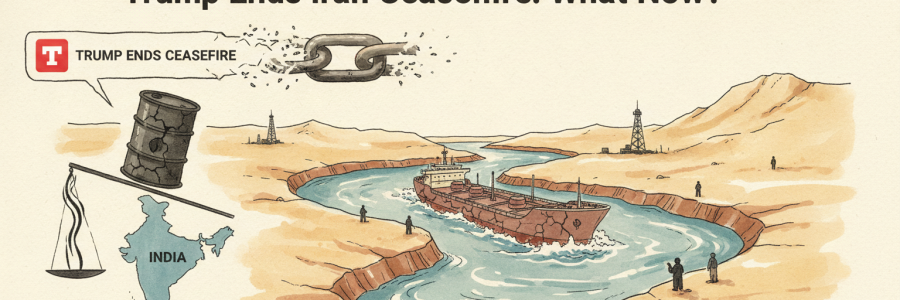
Trump declared the US-Iran ceasefire over on Truth Social, even as Tehran requested continued talks after renewed military strikes this week.Collapse follows failed indirect negotiations and fresh strikes on Hormuz shipping lanes, threatening crude oil transit through the world's most critical chokepoint.Indian refiners importing ~60% of crude via Hormuz face supply disruption risk, while global oil prices and shipping insurance costs could spike.
What triggered the ceasefire's collapse?
Iran attacked commercial shipping in the Strait of Hormuz after indirect US-Iran talks stalled. The US responded with strikes on Iranian targets. Iran retaliated, collapsing the interim accord reached last month. Trump then declared at the NATO summit in Ankara that the ceasefire had effectively ended.
Why did indirect talks fail to produce a deal?
The US demanded Iran permanently halt enrichment and stop arming proxy groups. Iran insisted on full sanctions relief before making concessions. Neither side would move first. This sequencing deadlock mirrors the 2015 JCPOA negotiations, which took 20 months and required direct foreign-minister-level talks to break.
What specific Iranian targets did the US hit?
Reports indicate US strikes targeted Iranian military infrastructure including missile storage sites and naval bases used to threaten Hormuz traffic. The Pentagon previously struck similar IRGC facilities in Jan 2024 after drone attacks killed US troops in Jordan. Iran's retaliatory pattern typically targets US bases in Iraq and Syria.
Has Hormuz shipping been attacked before?
Iran mined Hormuz during the 1980s Iran-Iraq war, and the US Navy's Operation Earnest Will escorted Kuwaiti tankers through the strait. In 2019, Iran seized the British tanker Stena Impero. Each incident caused temporary insurance premium spikes of 5-10x, with Lloyd's of London repricing Gulf transit risk within days.
Could Indian refiners absorb a Hormuz block?
India imports roughly 4.5Mn barrels/day, with about 60% transiting Hormuz. Refiners like Reliance's Jamnagar complex and BPCL run continuously and cannot simply shut down. A sustained blockage would force emergency spot purchases at premium prices. India's strategic petroleum reserve covers only about 9.5 days of demand.
How large is India's strategic oil reserve?
India's strategic petroleum reserves at Visakhapatnam, Mangalore, and Padur hold about 36.7Mn barrels, covering roughly 9.5 days of imports. For comparison, the US SPR holds ~390Mn barrels (about 40 days). India plans to expand to 22 days by building additional caverns at Chandikhol and Padur Phase II.
What alternatives exist if Hormuz closes?
Two bypass options exist but neither replaces Hormuz volume. Saudi Arabia's East-West Pipeline can move ~5Mn barrels/day overland to the Red Sea, but it's Saudi-controlled. The UAE's Habshan-Fujairah pipeline bypasses Hormuz entirely, carrying about 1.5Mn barrels/day. Together they handle a fraction of Hormuz's 20Mn barrel/day flow.
How do refineries handle sudden supply cuts?
Refineries operate continuous catalytic processes that take weeks to safely restart if shut down. Jamnagar, the world's largest refinery complex at 1.4Mn barrels/day capacity, maintains roughly 15-20 days of crude inventory on-site. When supply tightens, refiners shift to costlier spot cargoes and reduce throughput gradually rather than stopping entirely.
Who beyond oil importers faces fallout here?
Indian shipping and insurance firms face immediate cost spikes. Companies like SCI (Shipping Corporation of India) would see war-risk insurance premiums surge, as happened during the 2024 Red Sea disruptions. Airlines dependent on jet fuel, fertilizer producers using imported feedstock, and consumers facing potential fuel price hikes all stand exposed.
How would this affect Indian fuel prices?
If Hormuz disruption persists, crude import costs rise roughly ₹15-20/litre at the refinery gate. Indian oil marketing companies like IOC and HPCL absorbed losses of ~₹25K Cr during the 2022 Ukraine price spike before govt allowed pump price hikes. A similar absorption-then-pass-through pattern would likely repeat.
Which Indian industries are most oil-dependent?
Aviation consumes ~15Mn tonnes of jet fuel annually, with IndiGo alone spending ~40% of operating costs on fuel. Fertilizer producers like IFFCO import naphtha and LNG as feedstock. Fishing fleets using diesel and trucking companies moving 70% of India's freight by road face direct margin compression when diesel prices climb.
Could this push India toward Russia crude?
India already buys ~40% of its crude from Russia, up from under 2% before 2022. A Hormuz disruption would accelerate this shift since Russian Urals crude reaches India via the non-Hormuz Arctic and Baltic routes. However, Western sanctions limit payment channels, and Rosneft's export capacity has structural ceilings around 5Mn barrels/day.
Source: economictimes.indiatimes.com