world · 2026-07-11
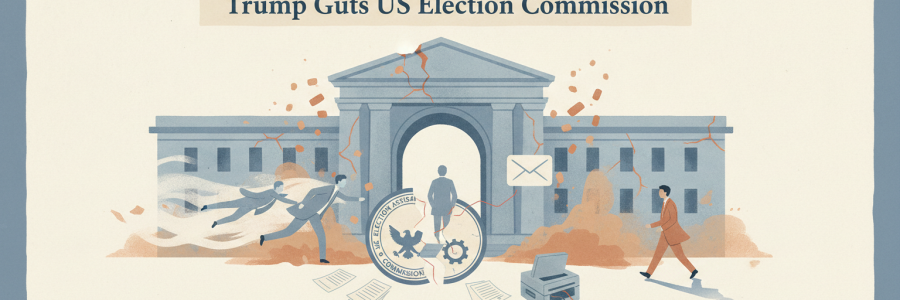
Trump Guts US Election Commission
2a4a1c35-e82f-47ae-ab60-ce31066a43e0
Trump fired the last two Democratic members of the Election Assistance Commission by email, and the lone Republican resigned, leaving zero commissioners months before midterms.The EAC certifies voting systems and sets election guidelines. Without commissioners, no new voting systems can be approved before November's midterm elections.State election officials lose federal support for voter registration forms and equipment certification. Congressional candidates face altered rules on mail-in voting.
Why were the two Democrats fired by email?
The EAC had refused to implement Trump's Mar 2025 executive order requiring proof of citizenship on mail voter registration forms. A federal judge blocked that order, ruling Trump exceeded his authority. The firings came days after the Supreme Court's 6-3 ruling expanding presidential power to fire independent agency heads without cause.
What did the Supreme Court ruling change?
Before Jun 2026, presidents could only fire independent agency heads 'for cause,' meaning misconduct or neglect. The Supreme Court's 6-3 ruling in Trump's favor eliminated that protection, holding Congress cannot insulate executive-branch appointees from presidential removal. This applies to all independent agencies, not just the EAC.
Has the EAC ever lacked a quorum before?
Yes. The EAC lacked a quorum from 2011 to 2014 under Obama because the Senate did not confirm nominees. During that period, no new voting systems were certified nationally. Some states like Virginia had to delay equipment upgrades. But that gap did not fall immediately before a major election cycle.
Could fired commissioners challenge this legally?
They could try, but the Supreme Court's Jun 2026 ruling significantly weakened their case. The 6-3 decision held presidents can remove agency heads freely. Hicks and Hovland could argue the EAC's enabling statute requires bipartisan composition, but courts would likely defer to the new precedent.
Could states run midterms without the EAC?
States technically run their own elections under the Constitution, but the EAC performs functions no one else does. It certifies voting machines, for example. If a state like Georgia needs to approve new equipment before November, there is no quorum to sign off. States would have to rely on older certified systems or improvise workarounds.
How does mail voting tightening work?
The Trump administration is pushing states to add ID verification steps for mail ballots and shorten return deadlines. In 2024, roughly 43% of ballots in states like Oregon and Washington were cast by mail. Adding barriers reduces participation among voters without drivers' licenses, disproportionately younger and lower-income residents.
What federal funding is being threatened?
The administration has threatened to withhold Election Assistance grants, which totaled ~$75Mn in 2024. These Help America Vote Act funds pay for polling place equipment, cybersecurity upgrades, and poll worker training. States like Michigan and Wisconsin used them to replace aging machines. Without them, counties must self-fund or skip upgrades.
Do noncitizens actually vote in US elections?
Studies consistently find it is extremely rare. The Brennan Center found roughly 30 suspected noncitizen votes out of 23.5Mn ballots cast in a 2016 study of 42 jurisdictions. That is 0.0001%. Noncitizen voting is already a federal crime carrying deportation and prison time, which deters it effectively.
Which candidates stand to gain from this?
Republican congressional candidates in competitive districts benefit most. Tighter mail-in voting rules historically reduce turnout among younger and urban voters, who lean Democratic. Democrats in swing seats like those in Pennsylvania and Arizona face headwinds if voter registration support weakens in the months before November.
Who are the swing-seat Democrats at risk?
Democrats defending seats in districts Trump won in 2024 are most exposed. Representatives in suburban Pennsylvania, Arizona, and Nevada rely heavily on mail-in turnout. For example, Democrats in Arizona's 1st and 6th districts won by margins under 3 points in 2024, making any turnout suppression potentially decisive.
Do mail-in restrictions affect rural voters too?
Yes, significantly. Rural voters in states like Montana and Alaska also rely on mail ballots due to distance from polling places. About 46% of rural voters in Montana used mail ballots in 2024. Tighter rules could hurt Republican-leaning rural counties too, creating a bipartisan backlash in states with established vote-by-mail traditions.
Could this shift control of Congress?
Republicans currently hold slim House and Senate majorities. If even 5 to 10 House seats flip due to turnout shifts, Democrats regain the House and gain subpoena power over the administration. Historically, the president's party loses ~25 House seats in midterms. Any additional suppression effect compounds an already difficult environment for Republicans.
Source: aljazeera.com