world · 2026-06-25
Trump Seeks $87.6Bn for Iran War Costs
4e2fbb13-15e8-4176-92a3-445047344265
White House asked Congress for $87.6Bn in extra spending, with ~$67Bn earmarked for the Pentagon to cover Iran war costs including munitions and readiness.Request lands one day after Congress passed a war powers resolution demanding Trump halt military action or seek approval, with 4 GOP senators crossing party lines.Defense contractors, US servicemembers, and India's oil supply chain face consequences as the Iran conflict stretches into its fourth month with only 24% public support.
What exactly does the $67Bn Pentagon share cover?
Of the ~$67Bn for Defense, $21Bn goes to munitions to rebuild depleted stocks, $17.3Bn covers operational costs like fuel and logistics, and $21.1Bn funds classified programmes. This adds to the $150Bn Congress already approved via the One Big Beautiful Bill Act last year.
How does $67Bn compare to past war spending?
The $67Bn Pentagon request is smaller than the $200Bn the Defense Dept sought earlier in 2026 but still substantial. For context, the US spent ~$300Bn total on the Iraq War's first two years. At four months in, the Iran war's funding pace already exceeds that trajectory on an annualized basis.
Why did Trump target the 4 dissenting senators?
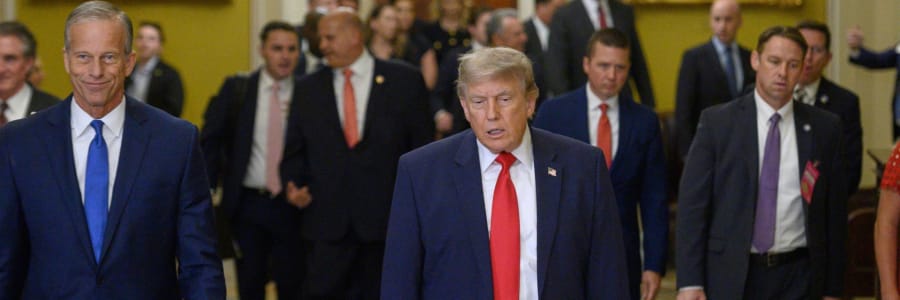
Trump confronted GOP dissenters at a closed-door Senate lunch. Sen. Cassidy pushed back publicly, telling reporters the war was supposed to last four weeks but has stretched to four months. Presidents pressure party defectors because even a few crossover votes legitimize opposition and embolden more defections before midterms.
What munitions are being depleted so fast?
The $21Bn munitions line covers precision-guided missiles, air-launched cruise missiles, and naval strike weapons. Modern air campaigns consume these at rates far exceeding peacetime production capacity. For example, a single Tomahawk cruise missile costs ~$2Mn, and US strikes on Iranian targets have reportedly used hundreds.
Could Congress actually block this funding?
Blocking is structurally difficult but politically plausible. The war powers resolution passed with 4 GOP senators, including Rand Paul and Bill Cassidy, crossing over. With midterms approaching in Nov, vulnerable Republicans face pressure from polls showing only 24% of Americans think the war is worth its cost.
Was the $200Bn request a negotiating anchor?
Budget negotiators often open high. The Pentagon's initial $200Bn ask likely included wish-list items, making the $87.6Bn proposal appear moderate by comparison. This anchoring tactic is common in US appropriations. The final figure Congress approves may land between $50Bn and $70Bn, depending on midterm political calculus.
What happens if the resolution is ignored?
War powers resolutions are non-binding in practice unless paired with funding cutoffs. Congress's real leverage is the appropriations process, not resolutions. Historically, even the 1973 War Powers Act has rarely forced a president to withdraw. The practical consequence is political, not legal: it signals eroding support within the president's own party.
Who beyond India faces oil supply pressure?
Japan and South Korea import ~90% of their crude, much of it through Hormuz. European refiners also face higher Brent crude prices. But the asymmetric hit falls on nations without strategic petroleum reserves large enough to buffer prolonged disruptions. India's reserve covers roughly 9.5 days of imports, vs. the US strategic reserve covering ~40 days.
How does a prolonged Iran war hit India?
India imports ~85% of its crude oil, with a significant share transiting the Strait of Hormuz. A prolonged conflict near Iran disrupts tanker routes, raises shipping insurance, and inflates spot crude prices. Indian refiners like Reliance and BPCL face higher input costs, which can push up domestic fuel prices.
Why is only 24% support significant here?
At 24%, support is lower than the Iraq War ever polled during its first year (~50-60%). This makes Iran the least popular US military action at this stage since Vietnam. For midterm-facing politicians, sub-30% approval creates electoral risk comparable to voting for the 2008 bank bailout, which cost several incumbents their seats.
Could midterms force a policy reversal?
Historically, US midterms punish the president's party. If Iran war opposition becomes a dominant campaign issue, Republican candidates in swing districts may distance themselves. The 1966 midterms during Vietnam saw Democrats lose 47 House seats. However, a ceasefire or dramatic military success before Nov could neutralize the issue entirely.
How do Indian refiners hedge against this?
Indian refiners use long-term supply contracts, futures hedging on Brent crude, and diversified sourcing. Reliance Industries, for example, sources crude from over 20 countries. BPCL and IOC maintain term contracts with Saudi Aramco and Iraq's SOMO. When Hormuz risk rises, refiners shift to West African and US crude, though at higher freight costs.
Source: aljazeera.com