economy · 2026-07-02
Two Sectors Hide India Inc's Capex Slump
b8a65cc5-e9a4-4d52-a1bb-42eb5cc96f71
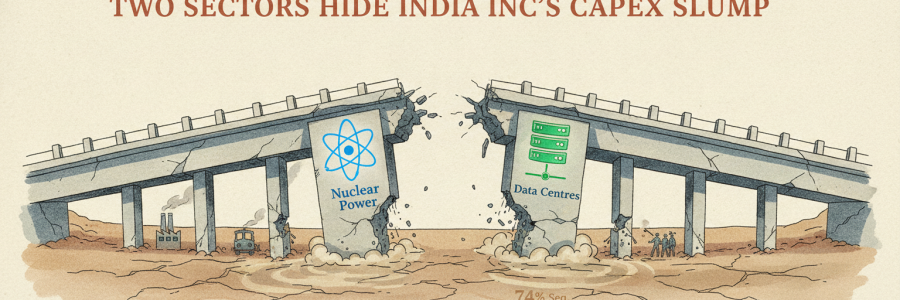
India's new project announcements rose 30% YoY to ₹14.5Tn in Apr-Jun, but nuclear power and data centres alone account for ~75% of that totalStripping out those two sectors, core new investments collapsed ~67% YoY and ~74% sequentially, exposing a broad private capex drought beneath the headline numberManufacturing's share fell from 33% to 14%, transport proposals plunged from ₹3.3Tn to ₹260Bn, squeezing jobs in labour-intensive sectors that drive economy-wide multiplier effects
What drove nuclear and data centre bets?
Two policy shifts converged. The SHANTI Act (Dec 2025) ended the state monopoly on nuclear power, letting private players build reactors. Four of five nuclear proposals this quarter came from private firms. In data centres, India's AI build-out drove ₹4.5Tn in announcements, anchored by a ~₹2Tn Raigad project and a ₹1.1Tn Mumbai AI Compute Hub.
How does the SHANTI Act change nuclear rules?
The old Atomic Energy Act restricted nuclear power to govt entities like NPCIL. The SHANTI Act permits private companies to own and operate nuclear facilities and form international JVs to access reactor technology. This mirrors how India deregulated telecom in the 1990s, replacing a state monopoly with licensed private operators to unlock capital at scale.
Has Adani disclosed specific nuclear sites yet?
Adani has outlined a target of 10GW nuclear capacity by 2035 but has not publicly disclosed specific plant locations or technology partners yet. For context, India's entire installed nuclear capacity today is roughly 8GW across 24 reactors. A single 10GW commitment would more than double national capacity, making site selection and regulatory clearance critical bottlenecks.
Why did data centre proposals spike this quarter?
AI model training requires massive compute clusters that need physical housing. Global hyperscalers and Indian firms are racing to build GPU-dense facilities before demand peaks. The ₹2Tn Raigad project alone would rival the largest data centre campuses globally. Maharashtra's reliable power grid and submarine cable proximity to Mumbai make it a natural hub.
Could this capex mix still create mass jobs?
Unlikely at comparable scale. Elara Capital's Garima Kapoor notes nuclear plants and data centres are far less labour-intensive than roads or railways. Previous capex cycles in transport and manufacturing generated broad employment multipliers. These capital-heavy, tech-driven projects create fewer direct jobs per crore invested, concentrating gains among skilled workers.
Why are nuclear plants less job-intensive?
A nuclear plant costs ₹15K-20K Cr per GW but employs only 500-800 permanent staff once operational. By contrast, a highway project of similar cost employs thousands of labourers during construction and supports trucking, dhabas, and fuel stations permanently. The capital-to-permanent-job ratio in nuclear is roughly 10x worse than in road or rail infrastructure.
Do data centres generate ongoing local spending?
Minimally. A large data centre employing 200-300 technicians consumes enormous power but purchases little locally beyond electricity and security services. Unlike a factory that sources raw materials, creates supplier ecosystems, and employs shift workers, a data centre's supply chain is global: servers from Dell or Nvidia, cooling systems from Vertiv. Local economic multiplier is roughly 1.5x vs 3-4x for manufacturing.
What kind of capex cycle would create mass jobs?
Broad multiplier effects require labour-intensive sectors like textiles, food processing, or construction. India's 2003-2008 capex boom was driven by roads, steel, and cement, which each employed 10-50 workers per crore invested. Economists suggest fresh export deals with the UK, EU, and US could revive manufacturing capex. Elara expects a meaningful pick-up only by late FY27.
Which sectors got left behind and why?
Manufacturing investment halved from ₹3.7Tn to ₹2.04Tn, its share dropping from 33% to 14%. Mining proposals fell ~90%. Transport services, the backbone of the govt's infra push, collapsed from ₹3.3Tn to just ₹260Bn. Kapoor says these sectors have matured and no longer need aggressive capacity additions. Elevated commodity prices are also squeezing margins.
Which manufacturing sub-sectors shrank most?
CMIE data shows broad-based weakness, but metals, chemicals, and textiles, the segments most exposed to global commodity price swings, saw the steepest pullbacks. For example, steel capacity additions slowed as input costs rose ~15% YoY. Companies are delaying expansion until margins recover, treating current conditions as a squeeze phase rather than a structural exit.
Could trade deals revive traditional capex?
Potentially. India's upcoming FTA with the UK could boost textiles and pharma exports, creating demand that justifies new factory capacity. The 2011 Korea-EU FTA precedent is instructive: Korean auto parts exports to Europe rose ~40% within three years, triggering domestic capex. Without similar demand guarantees, Indian manufacturers prefer to sweat existing assets.
Is the govt's infra push actually stalling?
Transport investment collapsed from ₹3.3Tn to ₹260Bn, suggesting the pipeline of new road and rail projects has thinned after a decade of heavy spending. India's national highway network roughly doubled from 2014 to 2024. The remaining projects are costlier per km (tunnels, expressways) and face land acquisition delays, naturally slowing the pipeline even without budget cuts.
Source: livemint.com