world · 2026-06-22
US, Iran Set 60-Day Roadmap at Swiss Talks
de496600-3069-4165-8656-725e220572cb
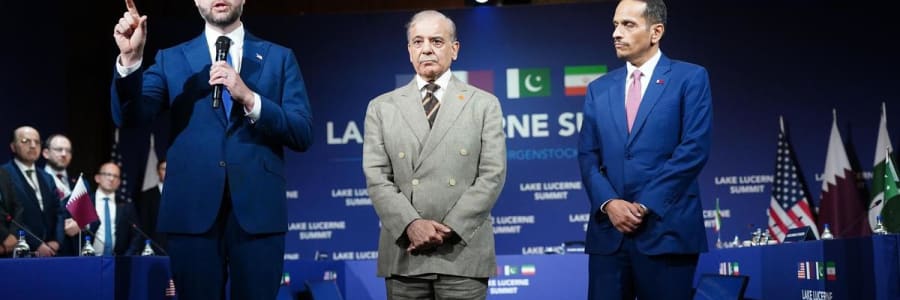
US and Iran agreed on a 60-day roadmap for a final deal at Burgenstock, Switzerland, with Pakistan and Qatar mediating. JD Vance and Iran's Parliament Speaker led delegations.A dedicated communication channel was set up for safe passage of commercial vessels through the Strait of Hormuz, the world's most important oil transit chokepoint.India, which imports ~85% of its crude via Gulf routes, stands to benefit from reduced shipping disruption and lower insurance costs on tanker traffic.
What exactly did both sides agree to do?
The two sides agreed to form a high-level committee to oversee implementation of the Islamabad MoU signed last week. They set a 60-day clock for a final deal and opened a dedicated communication channel to prevent military incidents near the Strait of Hormuz. Technical talks continue this week at Burgenstock. VP JD Vance led the US side, while Iran's Parliament Speaker Ghalibaf led Tehran's delegation.
Why are Pakistan and Qatar the mediators?
Pakistan shares a border with Iran and has maintained diplomatic ties with both Washington and Tehran. Qatar hosts the US Al Udeid Air Base while also maintaining open channels with Iran. This dual access made them acceptable to both sides. The Islamabad MoU was signed last week after intensive shuttle diplomacy by PM Shehbaz Sharif and Qatar's PM Sheikh Mohammed bin Abdulrahman Al Thani.
How does the Islamabad MoU differ from past deals?
Previous attempts, like the 2015 JCPOA, focused narrowly on nuclear enrichment caps. The Islamabad MoU broadens scope to include regional security, military de-escalation, and commercial shipping safety. Crucially, it includes the dedicated communication channel for Hormuz, a real-time incident prevention tool that the JCPOA never had. The 60-day deadline also forces urgency that earlier open-ended talks lacked.
What role does Lebanon's ceasefire play here?
The MoU includes a clause on terminating military operations in Lebanon. A ceasefire brokered over the weekend appears to hold. However, Israel and Hezbollah are not parties to the US-Iran framework. Israel says troops stay in southern Lebanon until threats end. Hezbollah demands Israeli withdrawal first. If Lebanon fighting resumes, it could derail the broader US-Iran roadmap by reigniting regional tensions.
Could Hormuz disruptions resume if talks fail?
Yes, and recent history proves it. Before the Islamabad MoU, the Iran-US military conflict disrupted tanker traffic through Hormuz, triggering crude price volatility. ~20% of global oil trade passes through this strait. Without a final deal, the communication channel expires, removing the safety mechanism. During the recent disruptions, Brent crude spiked ~$8/barrel in a single week, showing how quickly markets react to Hormuz uncertainty.
What makes Hormuz harder to reroute than Suez?
The Suez Canal has alternatives, ships can go around Africa's Cape of Good Hope, adding ~10 days. Hormuz has no viable bypass for most Gulf exporters. Saudi Arabia's East-West Pipeline can move ~5Mn barrels/day overland to the Red Sea, but that covers only a fraction of the ~20Mn barrels/day flowing through Hormuz. The strait's geography creates a structural bottleneck with no full substitute.
How did tanker insurance costs change recently?
War risk insurance on Hormuz-transiting tankers jumped from ~0.05% of hull value to ~0.5% during peak conflict, a 10x increase. For a VLCC (Very Large Crude Carrier) valued at ~$120Mn, that means premiums rising from ~$60K to ~$600K per voyage. Indian refiners like IOC and HPCL pass some of this cost into procurement budgets, ultimately affecting downstream fuel pricing.
Why can't Gulf producers bypass Hormuz entirely?
Only Saudi Arabia and the UAE have partial pipeline bypasses. Saudi's East-West Pipeline reaches Yanbu on the Red Sea. The UAE's Habshan-Fujairah pipeline skips Hormuz to reach Fujairah port. But combined capacity covers less than a third of total Gulf exports. Iraq, Kuwait, and Iran have no bypass at all. Building new pipelines takes 5-7 years and billions of dollars, making Hormuz dependence a structural reality for the foreseeable future.
How does this affect India's oil import costs?
India imports ~4.5Mn barrels/day, with a large share transiting Hormuz. During recent disruptions, war risk insurance premiums on tankers through the strait surged ~300%, adding $2-3/barrel to India's effective import cost. Indian refiners like Reliance's Jamnagar and BPCL's Kochi facility depend heavily on Gulf crude. Stabilized shipping lanes could save India billions annually in insurance and spot-market premiums.
Which Indian refineries are most Hormuz-dependent?
Reliance's Jamnagar complex, the world's largest refinery at ~1.4Mn barrels/day capacity, sources a significant share of crude from Iraq and Saudi Arabia via Hormuz. BPCL's Kochi refinery and MRPL's Mangalore facility are similarly dependent on Gulf grades. Western coast refineries are especially exposed because Gulf tanker routes feed directly into ports like Sikka and Cochin.
What happens to India's SPR if flows stop?
India's Strategic Petroleum Reserve holds ~39Mn barrels across Visakhapatnam, Mangalore, and Padur. At India's daily consumption of ~5Mn barrels, this covers roughly 8 days of imports. A sustained Hormuz blockage would exhaust reserves quickly. By comparison, the US SPR holds ~400Mn barrels, enough for ~40 days. India has approved expanding SPR capacity, but new caverns at Chandikhol and Padur Phase 2 won't be ready until ~2029.
Could India shift crude sourcing away from Gulf?
Partially, but not easily. India already diversified by becoming Russia's largest seaborne crude buyer post-2022, importing ~2Mn barrels/day of Russian Urals grade. But Russian crude is lighter and doesn't suit all Indian refinery configurations, which are optimized for heavier Gulf grades like Arab Heavy and Basrah Medium. Retooling a refinery to process different crude grades costs ~$500Mn-$1Bn and takes 3-5 years.
Source: thehindubusinessline.com